Full Article
about Sant Vicenç dels Horts
Metropolitan town with an agricultural past and vegetable gardens
Hide article Read full article
Arriving with modest expectations
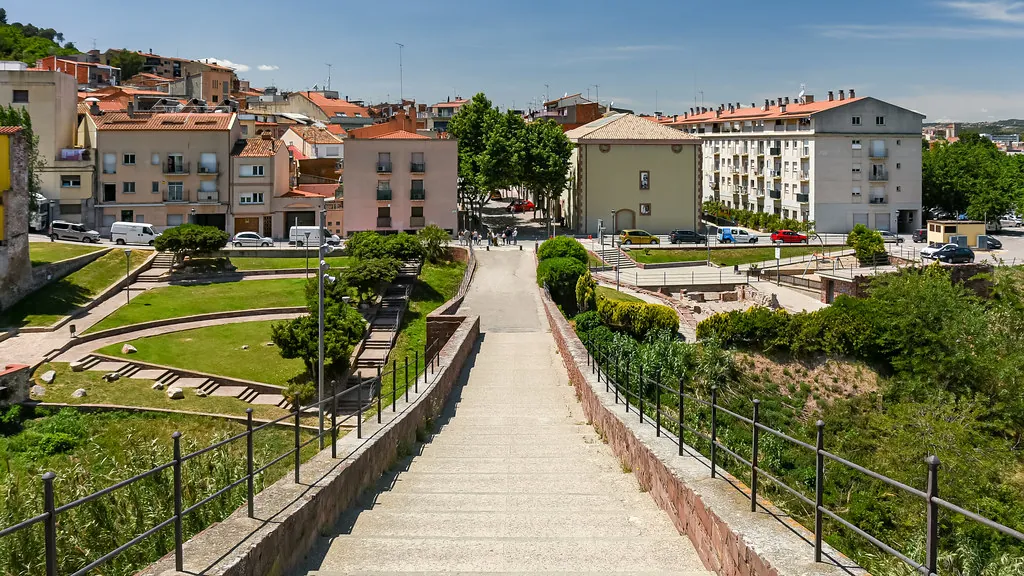
There is something faintly amusing about arriving in Sant Vicenç dels Horts by train. You step onto the platform, look around, and wonder if this is really it. In short, yes, it is. The place does not unfold in layers or build anticipation. What you see at first glance is largely what you get.
That does not make it dull. It simply means the town is not playing the usual game of trying to impress visitors. There are no grand gestures or carefully staged views. Instead, Sant Vicenç carries on at its own pace, whether anyone is watching or not.
Everyday life instead of postcards
Sant Vicenç feels like the quiet flatmate who never draws attention but turns out to have unexpected talent. The kind of place that does not advertise itself, yet reveals small details if you spend a bit of time there.
At its centre stands the church of Sant Vicenç Màrtir. It dates back to the 13th century and has the steady presence of something that has seen centuries pass without fuss. It is not especially large or ornate, yet it holds its ground. The stone is worn smooth in places where people have touched it over generations, a subtle record of time passing through human contact.
There is no attempt here to create a perfect historic scene. The church simply exists as part of daily life, much like the benches in a park where older residents sit and watch the world go by.
Modernisme where you least expect it
Just when the town seems entirely straightforward, it shifts slightly. The town hall appears and feels almost out of place at first glance. It is a modernista building, with curved lines that seem soft, almost as if shaped by hand rather than tools.
Nearby stands Can Dalmau, another example of the same style. Both buildings carry a hint of Barcelona’s architectural flair, as though a fragment of the city quietly found its way into the Baix Llobregat without much announcement.
Then there is Café Carbonell, built in 1871. It remains in place much like an old car kept in a shared garage, still functioning, still part of the surroundings. The appeal is not about finding exceptional coffee. It lies in the sense of continuity, of sitting in a space that has been used by generations of workers returning from fields or factories.
Houses that speak in their own way
Beyond the central streets, the town’s masías add another layer. Can Costa, dating from the 16th century, and Can Pujador from the 17th, stand out not because they dominate the landscape but because of their details. Both feature sgraffiti, decorative designs etched into the surface of the walls.
These patterns have a handmade quality, almost as if they were scratched in with whatever tool was at hand. They are not grand or theatrical. Instead, they suggest a time when building a house meant creating something meant to last across generations.
The Molino de los Fraques, known locally as Fraques Mill, is considered part of the town’s heritage. It carries a certain importance, though it does not match the dramatic image of windmills associated with Don Quixote. It is more modest, the sort of structure that catches your eye briefly and prompts a quick photograph before you move on.
When theatre comes to the street
In May, Sant Vicenç takes on a different tone with its auto sacramental. For those unfamiliar with the term, it is a type of religious theatre performed by local residents. It is not a polished production in the conventional sense, but that is part of its appeal.
People from the town step into roles, turning everyday faces into biblical characters. A baker might appear as an apostle, while a neighbour takes on the role of the Virgin. The result is something that sits between tradition and community gathering, more about participation than spectacle.
A place that doesn’t try to sell itself
Whether Sant Vicenç dels Horts is worth visiting depends entirely on what you are looking for. Anyone expecting perfectly preserved stone houses or carefully framed views may come away underwhelmed. The town does not present itself as a postcard.
What it does offer is a glimpse of daily life in the Baix Llobregat. Many residents work in Barcelona and choose to live here for more affordable housing. This shapes the rhythm of the place. It is lived-in, practical, and unpolished.
There is a weekday market where fruit tastes as it should, without any sense of artificial uniformity. Bars do not carry menus in English, simply because there is no need for them to do so.
A visit does not require much planning. A Saturday morning works well: a walk through the centre, a look at the modernista buildings, perhaps stepping into the church if it is open. Sitting at a terrace with a coffee gives you time to watch the town as it is, without performance.
There are no crowds posing for photos, no queues forming outside landmarks. Just people going about their day.
In a couple of hours, you will have seen most of what Sant Vicenç dels Horts has to show. What stays with you is not a list of sights but a different impression. It is not the kind of place that guidebooks tend to highlight, and that is precisely why it can be worth the time.