Full Article
about Santa Coloma de Cervelló
Famous for Gaudí's Crypt in Colonia Güell, a World Heritage Site.
Hide article Read full article
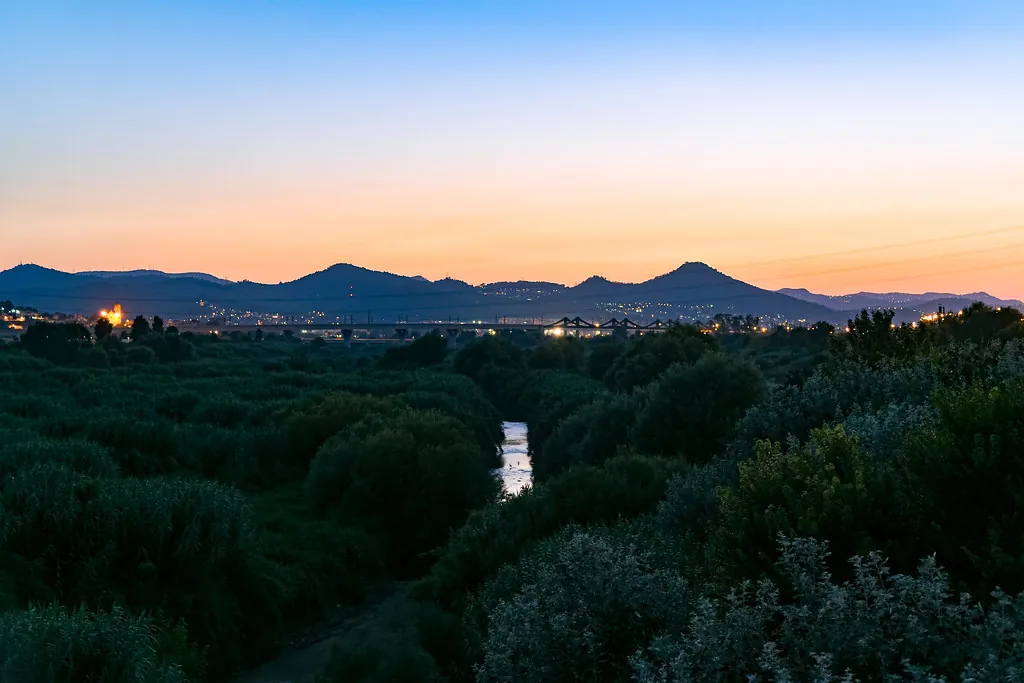
At seven in the morning, when almost no one has yet taken the road that climbs towards Montpedrós, the sound of church bells hangs above the rooftops. From the higher ground, the River Llobregat curves slowly between cherry orchards still in shadow. This is often how tourism in Santa Coloma de Cervelló begins: the village half asleep, the smell of damp earth and fresh coffee in the air, and the houses of the Colònia Güell with their wooden shutters still closed.
Santa Coloma de Cervelló sits in the Baix Llobregat area of Catalonia, not far from Barcelona, yet its rhythm feels separate from the city. It is a place best understood gradually, on foot, with time to notice the brick façades and the orchards that define the valley.
The steady pulse of Colònia Güell
There is something of a paused scene about Colònia Güell. The red-brick workers’ houses remain aligned as they were when the industrial colony was first built, although daily life has left its marks: plant pots on balconies, bicycles resting against walls, the occasional aerial on a roof.
The streets draw you forward almost without realising, until they lead to Gaudí’s crypt. The building was left unfinished, yet it does not feel incomplete. Its slanted columns resemble tree trunks that branch outwards, holding up a low nave where light filters through irregular stained-glass windows. By mid-morning, when the sun falls from one side, shadows move slowly across the brick ceiling.
Silence usually fills the interior, the kind that lowers voices without instruction. The church is not large and does not need to be. Sitting for a moment on one of the wooden benches is enough to watch how the columns split like roots that have chosen to grow upwards.
Colònia Güell began as a planned industrial settlement, built to house workers near the textile factory that once operated here. Today it feels residential rather than monumental, which is part of its character. Daily life continues around one of Gaudí’s most unusual projects.
Up towards Montpedrós
A path leaves the colony and gradually gains height among pines and holm oaks. The walk up to the Iberian settlement of Montpedrós rewards a steady pace; at an unhurried rhythm it can take around three quarters of an hour.
In summer the air carries a strong scent of warm resin. Spring changes the view entirely. Cherry trees in the valley begin to blossom, and from clearings along the trail the landscape appears scattered with white and pale pink.
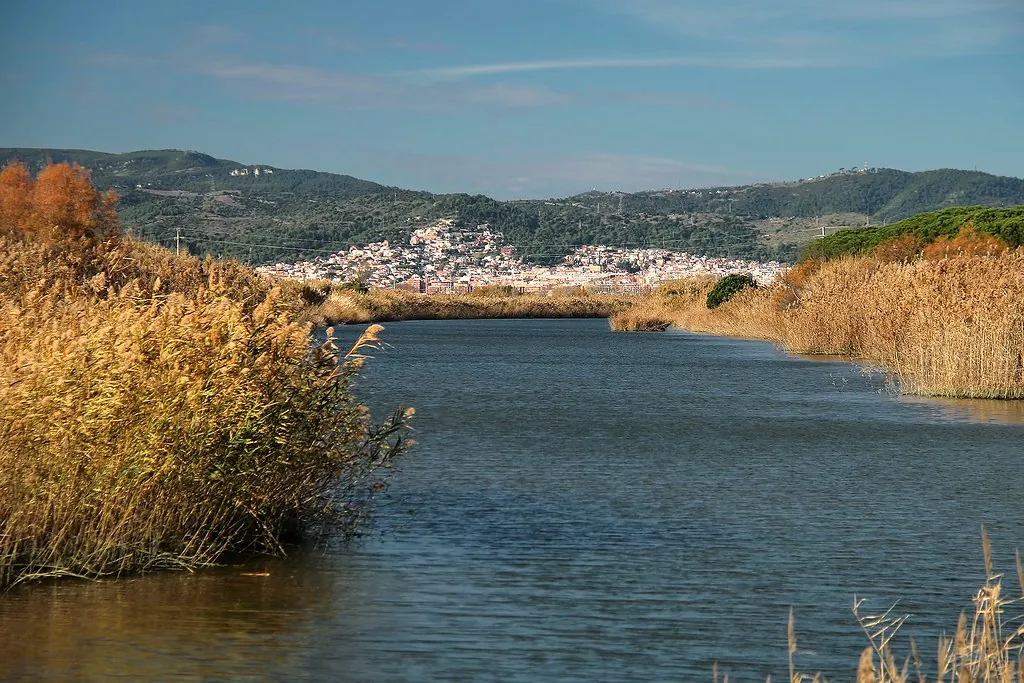
At the top lie the remains of the ancient settlement: low stone walls and little more than the footprint of former houses. The main interest is not so much what survives underfoot as what opens out around it. The Llobregat spreads into a grey ribbon dividing the valley. On one side stretch the cultivated fields where the cherries are grown that make this part of the Baix Llobregat known across the region. On the other side, housing developments have gradually taken over the slopes.
On clear days, looking east, the outline of Montjuïc can sometimes be made out, along with a very fine line of sea on the horizon. The view connects this quiet hilltop with the wider geography of Catalonia.
When the cherries arrive
Towards the end of May, the village usually celebrates the Festa de la Cirera, the Cherry Festival. It does not resemble a large commercial fair. Instead, Santa Coloma brings tables out into the street and covers them with boxes of freshly picked fruit.
Cherries appear everywhere: in baskets, in paper bags, in the hands of children whose fingers are already stained dark. People stop to talk in the middle of the street. Music plays in a square. Conversations stretch on well into the afternoon.
The festival does not feel designed primarily for visitors. Its atmosphere suggests a celebration that belongs first to the village itself. Those who arrive from outside are welcome to observe and join in, but the focus remains local, rooted in the harvest that shapes the surrounding fields.
Walking without hurry
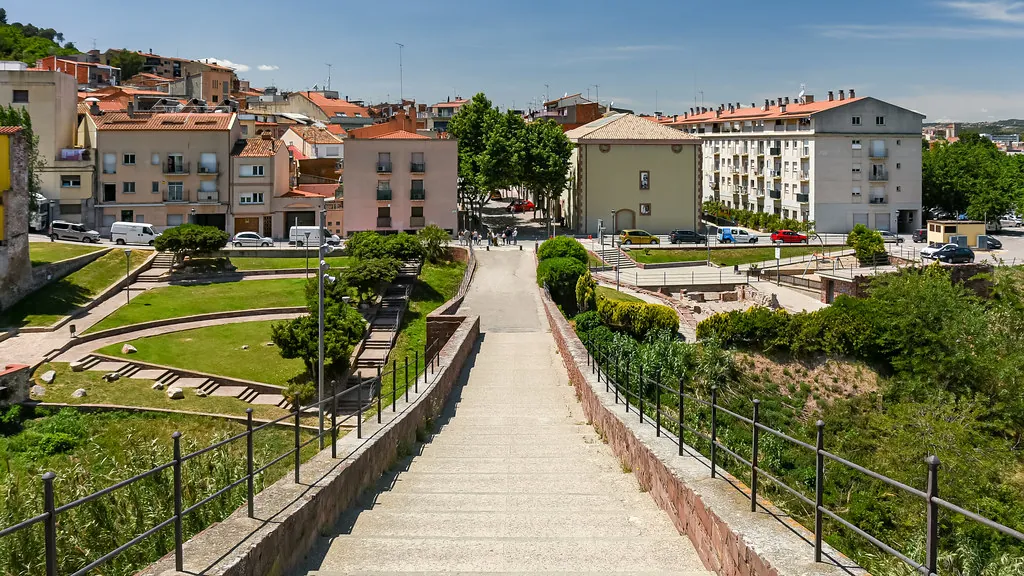
Santa Coloma de Cervelló makes more sense at a slow pace. A walk through the main urban area and the colony is enough to grasp its scale and identity: short streets, brick façades, courtyards where vines or small vegetable plots still appear.
Near the cultivated areas, improvised stalls sometimes appear, set up by neighbours selling cherries picked that same day. They are not always there, yet when you happen upon one it is easy to recognise freshly harvested fruit by its almost black skin and the stem still green.
Those arriving by car often find it more convenient to leave the vehicle near the sports facilities or along the outer streets, then continue on foot into the centre. Walking in from the edges suits the village’s proportions and allows the transition from road to residential streets to happen gradually.
Choosing the right moment
Late spring coincides with cherry season and brings more activity to the village. The valley also looks at its greenest during this period.
Autumn follows a different rhythm. Fields turn more golden, afternoons grow quieter, and in some neighbourhoods the scent of firewood begins to drift through the air as temperatures fall.
High summer, particularly on Sundays and public holidays, can bring a noticeable concentration of people around the crypt and the colony. Those in search of calm often find it easier to come on a weekday or early in the morning, when the streets remain half empty and the echo of the bells rises once again up the slope of Montpedrós.
Santa Coloma de Cervelló does not rely on grand gestures. Its appeal lies in small shifts of light on brick, the curve of the Llobregat, and the seasonal rhythm of cherries that return each year. Arrive early, walk slowly, and let the valley set the pace.