Full Article
about La Cellera De Ter
Hide article Read full article
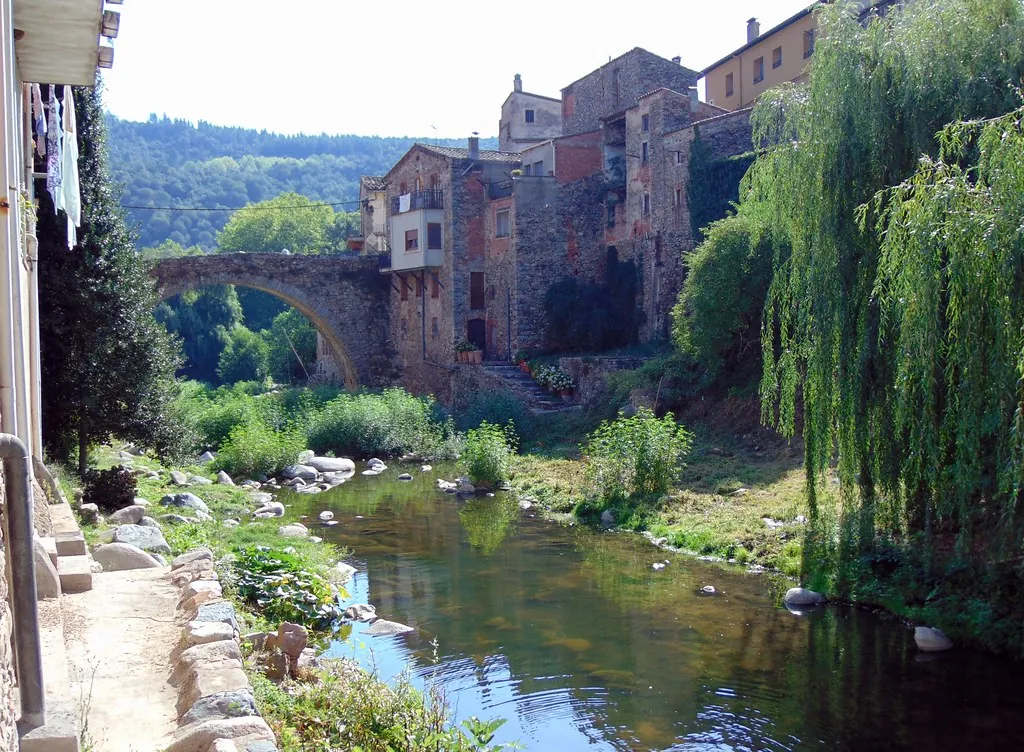
The River Ter runs thick as it descends from the Guilleries, carving a wide meander before crossing La Cellera de Ter. From the road bridge the water looks dark green, almost black where the shade holds it, and the sharp knock of stones carries when cyclists step off the via verde and drag their bikes a few metres across the gravel. At nine on a spring Saturday morning, there is already sweat on T-shirts.
Tourism in La Cellera de Ter often begins like this: with the river close by and the steady murmur of water mixing with the hum of wheels.
Smoke, pork fat and old stone
In the days leading up to the fair held at the end of winter, La Cellera tends to smell of holm oak smoke and pork fat. It is neither pleasant nor unpleasant. It is simply the scent of the place, as familiar as the damp earth rising from the Ter when it runs high. In the narrow central streets, with their short, steep slopes, stone houses keep their doors half open and the hiss of frying pans escapes from some kitchens.
Traditional domestic pig slaughter, once common across rural Catalonia, is no longer practised as it was. Even so, when the fair arrives the village still revolves around that heritage. There is toasted bread rubbed with tomato, freshly made embutidos, and groups of lifelong neighbours talking in small circles while children race across the square clutching pieces of warm bread.
In the square in front of the church of Sant Martí, the stone has a matte bone colour seen in many villages in this part of Girona, shaped by damp winters and harsh summers. To one side stands the esconjuradero, a small open-sided tower that looks slightly out of place among the houses. In the past, the four cardinal points were blessed from here to ward off storms and hail. Today the structure remains, with its dark roof and the wind threading through its arches.
Sant Martí and the memory of earthquakes
The church of Sant Martí occupies a site that has held a place of worship for centuries. Old documents refer to an early medieval church and to a later one damaged by the earthquakes that shook this area of Girona in the fifteenth century.
The building seen today dates from after those tremors. It has a Baroque façade and a reddish brick bell tower that rises above the village rooftops. Inside, there is the scent of wax and old wood. The thick walls mute the sounds of the street and create a dense silence, closer to that of a working village church than a museum.
In one of the side chapels stands an image of Sant Martí on horseback, sword raised as he cuts his cloak in two to share it with a beggar. Local children have always tried to edge a little closer than they should when they come in with their parents.
The Ter and the old railway line
Going down to the Ter is part of the village routine, though midday, when the sun hits the stones head-on, is not the best moment. Late afternoon is gentler, as light slips down from the mountains and the water loses its hard white glare.
Between the large blocks of rock, pools form where residents bathe once the heat arrives. Children with sun-browned skin leap in, older neighbours ease themselves slowly into the water and linger, chatting with it at waist height. In the background runs the via verde, the former railway line now converted into a route for cyclists and walkers. At times there is the steady buzz of tyres, at others only blackbirds among the willows.
Near the municipal campsite begins the route of les Pedreres. It is a short trail with gentle rises and dips through scrub, pine trees and large slabs of rock split open as if the mountain had been cut into blocks. For years, stone from here was used in building work in surrounding villages. What remains are the straight marks scored into the rock and a clean, almost complete silence when the wind drops.
When to go, what to bear in mind
Spring is usually the most rewarding season. The river carries water, the paths are no longer so muddy and the green still holds in the fields. At the end of winter and the beginning of spring, the village celebrates its fair linked to the tradition of the pig slaughter, when the squares fill more than usual.
August can feel heavy. Heat settles between the stone walls and the via verde sees a fair amount of cycling traffic, often in groups and at speed.
If arriving by car, it is most practical to leave it at the entrance to the village and continue on foot. The central streets are narrow and some of the slopes make manoeuvring awkward. Footwear with a good grip is advisable if heading down to the river, as the stones of the Ter are polished by water and more slippery than they appear.
Should the dish known as olla cellerense appear on a menu, it tends to do so on special occasions or when there is more movement in the village. It is a stew that calls for hours over a slow fire, rooted in the same patient rhythm that shapes life here: river close by, stone underfoot, and the sense that everything moves at the pace of water finding its way around a bend.