

Full Article
about Berga
County capital famous for its La Patum festival, a UNESCO World Heritage event.
Hide article Read full article
A square with a mountain attached
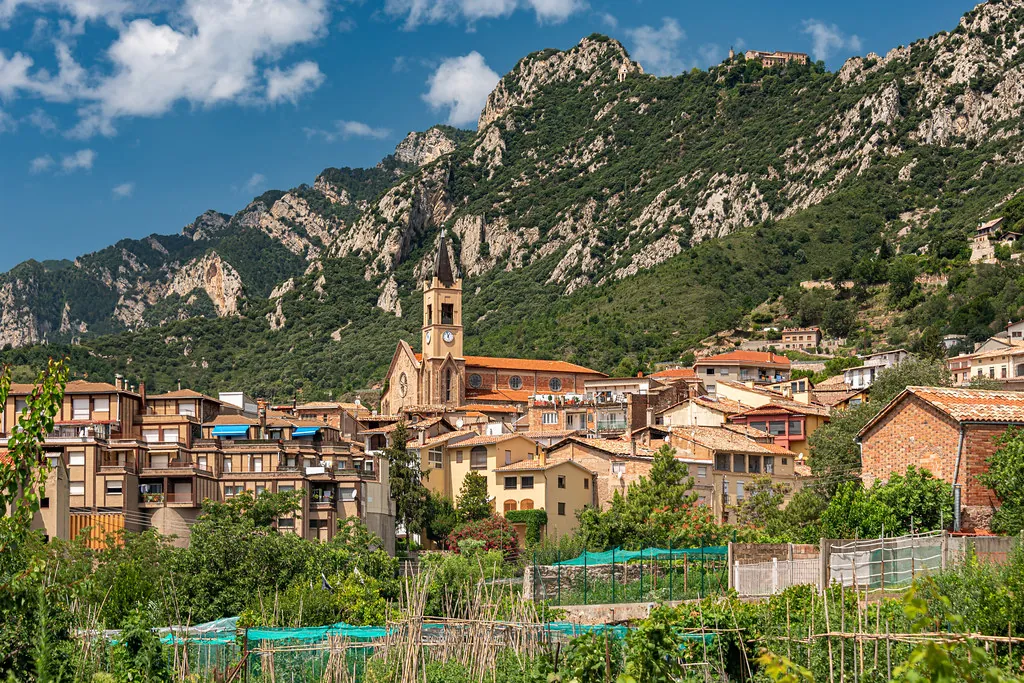
There is a photo almost everyone ends up taking in Berga: Plaça de Sant Pere with the mountain of Queralt rising behind it, as if it had been placed there on purpose. The first time, it just looks like a good view. The second time, it becomes clear that the mountain is more than a backdrop.
Queralt acts as a kind of compass. You see it from most parts of town, and it quietly tells you where you are. It also says something about the weather. And sooner or later, it becomes a suggestion that turns into a plan. Someone will ask, usually with a bit of surprise, why you have not gone up yet.
Berga itself is compact. The square sits at its centre, and daily life unfolds at a pace where people recognise each other. The mountain is always there, just above it all.
La Patum, when the square fills with fire
Trying to explain La Patum often leads to comparisons. Imagine a festival full of fire and noise, but compressed into a single square in a mountain town. Replace familiar elements with the smell of gunpowder and grilled butifarra, and you get close.
La Patum takes place during the week of Corpus and has been recognised by UNESCO as intangible cultural heritage. In simpler terms, it is fire, groups of performers, drums, and a packed Plaça de Sant Pere. The intensity builds throughout the events, reaching its peak during the Plens. At that point, the square fills with sparks and smoke, and the rhythm of the drums is something you feel as much as hear.
Being inside the square during the Plens is an experience that tends to stay with people for years. Watching from the edges still has impact, though you leave without quite the same smell of gunpowder on your clothes.
During those days, moving around Berga is slow. Distances that normally take minutes stretch out, with crowds filling the streets. It can feel like trying to cross a busy station at peak time. Even if you are staying just a couple of streets away, getting there takes patience. That sense of congestion is part of how the festival works.
Outside the festival period, the atmosphere shifts completely. A few weeks later, the town settles back into its usual rhythm. The square feels smaller again, and conversations replace drums.
The climb to Queralt
From the centre of Berga, the sanctuary of Queralt is clearly visible, perched on the mountain. It looks close enough to tempt you, but far enough to make you hesitate.
There are two ways up. One is by road, the other on foot along the traditional path that winds through pine trees. The walk stretches over several kilometres with a steady climb. Taken at an unhurried pace, it takes around an hour and a half. It is not a dramatic expedition, but it is enough to make your legs work.
At the top, there is usually a breeze, even on warm days. The viewpoint opens out across the Llobregat valley, and Berga appears below, compact and slightly hidden among rooftops. From up there, the square that seemed so central becomes harder to pick out.
People often linger near the sanctuary. It is common to see simple food taken from a backpack and shared: bread, cured meats, and a piece of strong cheese that smells more than expected. Conversations stretch out, and eventually someone will point out that it might be wise to head down before it gets dark.
When the weather turns
Berga changes noticeably when low cloud rolls in and Queralt disappears from view. Without the mountain, the town feels more enclosed. The pace slows, a bit like when the power goes out and everything becomes quieter.
On those days, one of the classic options nearby is the Museo de las Minas de Cercs, a few kilometres away. It focuses on the mining history of the area, and part of the visit takes you into an old gallery. It gives a clear sense of how demanding that work was.
Another alternative is to follow paths along the river and past old mills. There are several easy stretches through the valley that are mostly flat, suitable for a walk without rushing or worrying about steep climbs.
If the weather becomes truly uninviting, the local solution is simple: a hot coffee and a slice of pa de pessic. This sponge cake can seem dry at first, but once dipped slightly, it turns into exactly what it should be.
Eating without overthinking it
Food in Berga leans towards straightforward, filling dishes. One of the most characteristic is butifarra negra, often simply called negre. If you order butifarra without specifying, this is likely what will arrive.
It appears in stews or cooked over a grill. There is a saltiness to it that tends to linger, usually followed by reaching for a glass of water. Even so, it works.
Another local staple is coca de recapte. It is topped with roasted vegetables and sometimes sardines or anchovies. Visually, it can resemble a rustic pizza, though the flavour is closer to grilled ingredients and garden produce.
A simple way to choose where to eat is to watch where locals go at mealtimes. Full tables, families gathered together, and conversations carried between the dining room and the kitchen are usually a good sign.
Choosing your moment
Spring brings a deep green to the Berguedà region, and the mountains around Berga invite long walks. During Corpus, everything revolves around La Patum, and the atmosphere becomes intense and crowded.
August comes with dry heat and plenty of movement, though early starts make the surrounding paths more manageable. Autumn changes the colour of the valley, and forest routes become particularly appealing. Winter is quieter. When snow settles on Queralt, the mountain stands out even more strongly over the town.
Berga does not try to compete with the more polished mountain villages of the Pyrenees. It simply goes about its own rhythm, with a square, a festival, and a mountain that is always present.