Full Article
about Castellar de n'Hug
Stone village where the Llobregat River rises, known for its giant croissants.
Hide article Read full article
A mountain village at 1,400 metres
At eleven in the morning, the air in the main square of Castellar de n’Hug still carries a trace of cold and damp earth. Sunlight slips between the gaps in the stone houses and warms only part of the cobbles, while the rest remains in shadow. A door opens somewhere, wood creaks, a sparrow darts beneath the eaves. It is one of those quiet hours when the village seems to move more slowly than the clock.
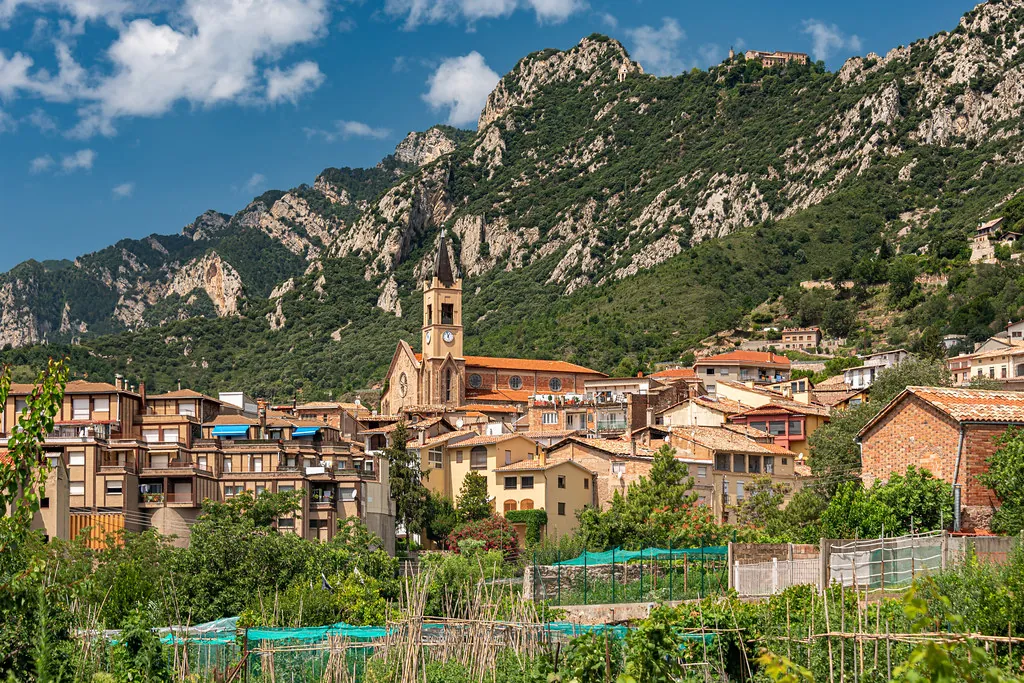
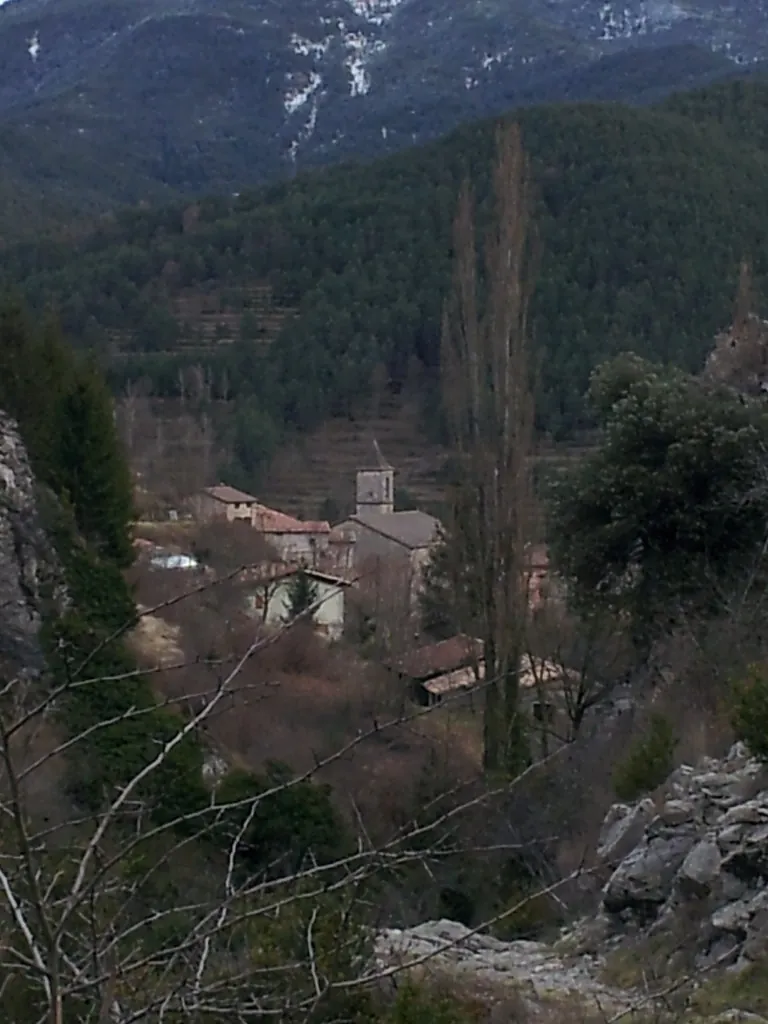
This small settlement in the Berguedà region, at almost 1,400 metres above sea level, has fewer than two hundred inhabitants and a direct relationship with the surrounding mountains. Dark stone houses with sloping roofs cluster along short streets, broken by steps and small squares where the wind passes through unchecked. For years, life here revolved around livestock, timber and coal mining in the wider area. That history still shows in the walls and former animal pens, and in the compact shape of the village itself.
Winter light arrives low and fades quickly. By mid-afternoon the mountains begin to cast long shadows over the rooftops. In summer the air tends to carry the scent of freshly cut grass and resin from nearby forests. These are the busier months. At weekends cars appear, and sometimes a coach, largely because of the proximity to the sources of the Llobregat. Anyone who prefers to wander the streets at an unhurried pace would do well to come early in the day or during the week.
Castellar sits within the surroundings of the Cadí‑Moixeró Natural Park, an extensive protected area of high peaks and slopes covered in pine and steep meadows. Very close to the village, the river Llobregat begins its journey. Here it emerges as a series of springs among rocks, before eventually travelling many kilometres to the Mediterranean.
The streets can be explored quickly. Half an hour is enough to cross the village without rushing. It is worth slowing down, though, to notice the worn granite steps, the wooden balconies darkened by weather, and the occasional climbing plant that reaches up a sun-facing wall.
Towards the source of the Llobregat
One of the most common walks from the village leads to the Font del Llobregat, the point where the river surfaces among moss-covered rocks. The path descends through damp woodland, and the temperature there is usually several degrees lower than in the square above.
In spring the green can feel almost excessive. After snowmelt or several days of rain, the water falls with considerable force. In dry summers the flow is more discreet. The contrast between seasons is clear, and the visit is never quite the same twice.
The trail itself is not long, although there are stretches of steps and patches where the ground remains wet. Ordinary footwear is generally sufficient, but extra care is sensible after rainfall or when there is ice in winter.
Above the village centre stands the Romanesque church of Santa María, set in a slightly commanding position. From here, the structure of Castellar de n’Hug becomes easier to understand. Houses press close together, streets are narrow as protection against the wind, and beyond the last doorway the meadows and forests begin almost immediately.
Near the square there is also a small interpretive space dedicated to the history of the valley and its former trades. It is modest in size, yet it helps to place what can be seen outdoors: livestock routes across the hills, mining activity that once took place in the comarca, and the realities of mountain life before tourism arrived.
Paths into Cadí‑Moixeró
Several walking routes set out from Castellar de n’Hug into the wider Cadí‑Moixeró area. Some follow the Llobregat valley and can be tackled at a gentle pace. Others climb towards higher ground such as the area around Tosa d’Alp or Puigllançada. Distances that look short on a map can feel more demanding here because of the steep gradients, and the weather shifts quickly, particularly outside the summer months.
In winter and early spring, snow is common at higher elevations. Nearby ski resorts bring a noticeable increase in visitors. Yet only a few kilometres away along the footpaths, the quiet of the mountains returns.
Those who set out early sometimes spot chamois moving across the steepest slopes, or hear marmots whistling from among the rocks. It does not happen every day. Even so, standing still for a while and watching patiently is often enough to realise that the valley remains very much alive.
Castellar de n’Hug is small, compact and closely tied to its landscape. Its streets can be covered in a short visit, but the wider setting invites more time. Between the springs of the Llobregat, the Romanesque outline of Santa María and the high paths that lead into Cadí‑Moixeró, the village offers a clear sense of how mountain life has shaped both place and rhythm.