Full Article
about Puig-reig
Former Templar and industrial center with textile colonies along the river
Hide article Read full article
Where the Berguedà opens up
There is a stretch of the C-16, just after the Cercs tunnel, where the landscape shifts. The Berguedà opens out and the Llobregat runs through it like a thin silver line between the mountains. Lower the car window and the air carries a mix of river damp and something harder to place, somewhere between history and wool. That smell is often enough to tell you that Puig Reig is close, even before any road signs appear.
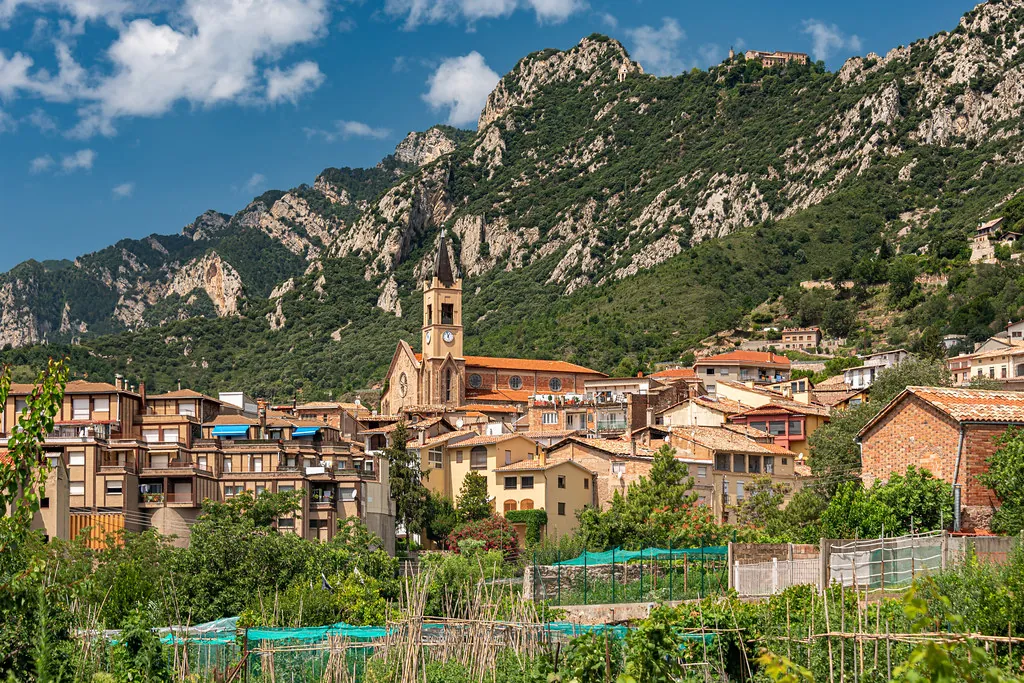
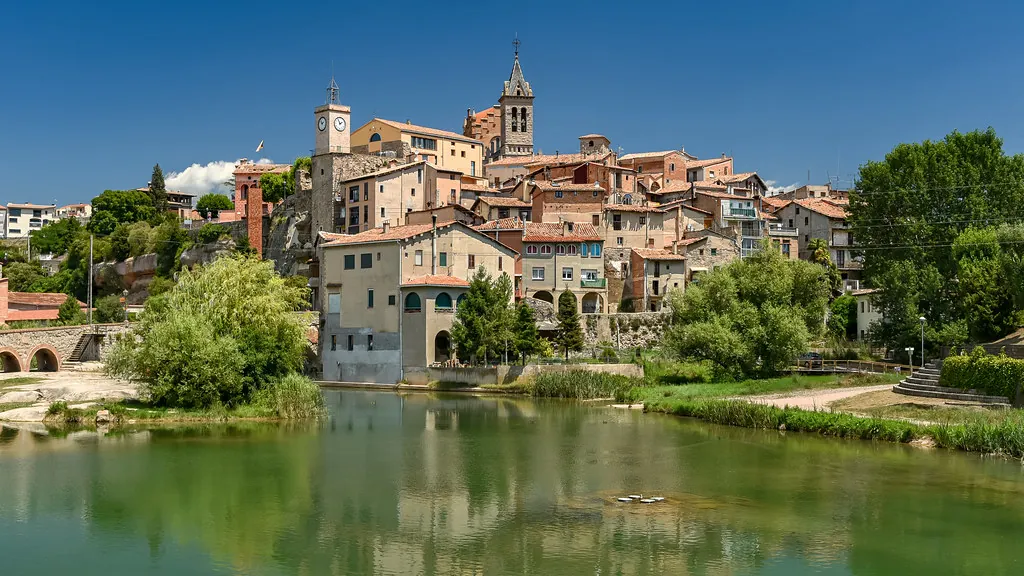
The town sits quietly in the middle of the valley. Nothing about it feels staged or overly explained. A castle watches from above, the river sets the pace below, and everything else seems to fall into place around those two elements.
A castle that tells its story plainly
The castle visible from the road does not try to impress in the usual sense. It is an honest ruin, with no reconstruction or theatrical touches. What remains are stones and walls, just enough to imagine what once stood there.
Local accounts often mention the troubadour Guillem de Berguedà, a 12th-century figure known as much for his sharp character as for his verses, as having lived here. Whether you come for that story or simply for the view, the setting explains itself quickly. From the top, a large part of the Berguedà lies open, along with much of the route towards the Bages. The strategic value becomes obvious without needing much interpretation.
It is not a long visit, but it does something useful. It gives context. After standing there for a while, the rest of Puig Reig begins to make more sense.
The textile colonies that reshaped the valley
Closer to the Llobregat, the town reveals another layer. Within just a few kilometres, several textile colonies appear, and together they explain what Puig Reig was for more than a century.
Cal Vidal is the best known of these and can be visited today. It offers a clear picture of how a colony functioned: factory, housing, school, church, and an economato, all organised around industrial work. It was not just a workplace. It was an entire way of life built around the rhythms of the factory.
Walking through the streets does not feel like stepping into a staged reconstruction. The place still carries the sense of everyday life. People worked here, went to school here, took part in theatre groups, and built routines that filled the space with meaning. Some residents who grew up in the colony still share their memories. They speak about a time when the machines rarely stopped, and they do it in a straightforward way, as if recalling an ordinary neighbourhood from childhood.
That continuity makes a difference. The colonies are not frozen in time, yet they have not lost their identity either. They have simply moved into a different phase of life.
A quiet church with hidden colour
From the outside, the church of Sant Martí does not draw much attention. It appears modest, almost easy to overlook. Inside, the atmosphere remains understated until someone points out where to look.
Medieval wall paintings cover parts of the interior, although they were not always visible. For centuries, they lay hidden beneath layers of lime. It was only in the mid-20th century that these coverings were removed and the paintings came back into view.
The scenes focus largely on the figure of Mary and follow a Romanesque style that can feel both simple and unexpectedly expressive. Some of the faces carry gestures that seem surprisingly human, almost modern in their emotion. It is the kind of detail that holds attention longer than expected. This is not something many visitors anticipate finding in a small town, and that contrast adds to the experience.
Food that follows tradition
Food in Puig Reig stays close to tradition, especially during local celebrations. There is no need for elaborate concepts or reinvention.
The Fiesta de la Corrida, usually held in January, revolves strongly around shared meals. Longanizas cooked over open flames, bread, wine, and long communal tables define the atmosphere. It is straightforward food that works precisely because it does not try to be anything else.
At other times of the year, coca de recapte topped with embutido appears regularly, and when mushroom season arrives, more substantial dishes take over. The cooking is filling and satisfying, the kind that naturally leads to a walk afterwards. People here do not talk about gastronomy as a trend. They simply talk about eating well.
Taking your time in Puig Reig
Puig Reig does not lend itself to quick visits or a checklist of photo spots. It works better at a slower pace. Parking the car, walking a little, and paying attention to the surroundings tends to reveal more than rushing between points.
A single morning is enough to combine a walk up to the castle, a visit to the church, and time spent in one of the colonies along the river. Along the way, small details start to appear: an old bridge crossing the Llobregat, traces of canals that once powered mills or factories, and paths that follow the course of the water.
Near the river, it is common to see people fishing or simply walking. The rhythm of the town is calm, and that calmness shapes the experience without needing to be pointed out.
There is also a small social detail that often stands out. It is not unusual for someone to greet you even if they do not know you. If an older passer-by says “bon dia”, it is worth answering. Sometimes that brief exchange turns into a short conversation, and from there into a story about the colonies, the factory, or the valley as it once was, when the sound of machinery could be heard from far away. Those stories do not appear on maps, but they form part of what Puig Reig is.