Full Article
about Sant Jaume de Frontanyà
One of the smallest villages, home to a gem of Lombard Romanesque
Hide article Read full article
Before the sun reaches the slopes of the Moixeró range, bells ring out in Sant Jaume de Frontanyà. The bronze sound carries cleanly across the valley, strikes the stone façades of the village’s two streets, then fades into the beech woods. Just over twenty people live here, at 1,072 metres above sea level. At that hour, no one is visible. When the bells stop, an odd emptiness lingers in the air, and from far below comes the murmur of the Llobregat river.
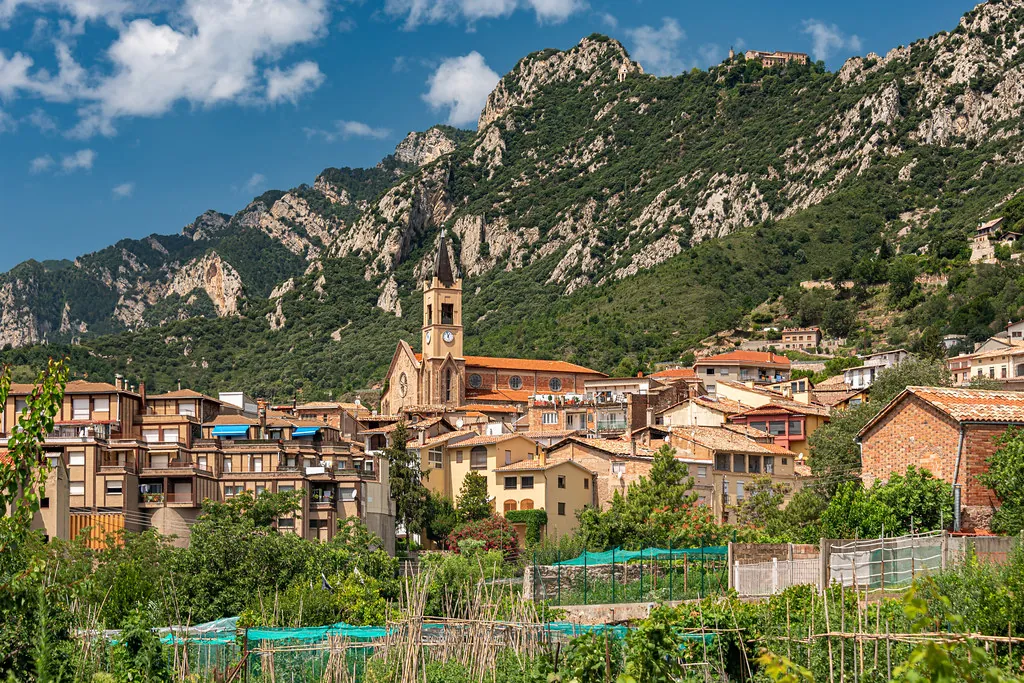
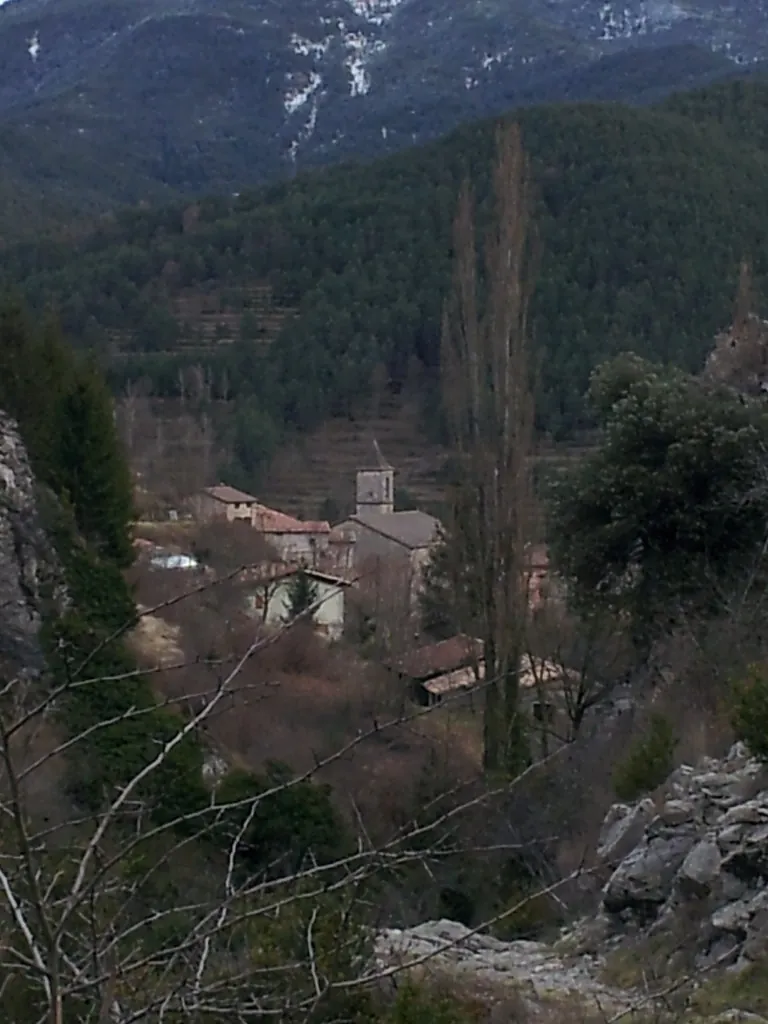
Sant Jaume de Frontanyà is small enough to take in at a glance, yet the setting gives it unusual depth. Forest presses close to the houses, and the valley drops away sharply. What happens here is measured more by light, weather and season than by schedules.
The Romanesque church above the valley
Turn the corner of the square and the church appears. It is not large. The first thing that draws the eye is its twelve-sided dome tower, outlined against the sky. The ochre stone shifts in tone throughout the day, pale in the morning and more golden when the sun falls from the side.
This Augustinian canonry was built in the 11th century. Inside, the dome is ribbed with twelve stone arches that meet at a small central oculus. Through that opening a circle of light enters and moves slowly across the presbytery as the hours pass.
The key is usually kept in a house on the square. If there is movement by the door, someone comes down to open up. The interior smells of damp stone and wax. On 25 July, the feast day of Sant Jaume, the nave fills with people who return to the village just for that night. Many houses still have no heating; even so, some prefer to sleep there, as has always been done.
There are occasional open days or organised visits led by people from the surrounding comarca, a local county area in Catalonia. When these take place, a volunteer may point out details such as the capitals on the north side, carved on the part of the building most exposed to the cold wind.
Two streets and open countryside
Carrer de Baix and Carrer de Dalt. The village fits within them. Houses lean against one another, with thick walls and slate roofs. On some doorways, pots of geraniums break up the grey of the stone.
To the south there are still a few pens with hay. Walk north and a track begins, heading into the beech forest. From there the path leads to Sant Jaume Vell, the original church, consecrated at the beginning of the 10th century.
The climb is around two and a half kilometres. It is not demanding. After about half an hour, the forest opens and the valley appears all at once, with the Cadí range in the distance like an uneven saw edge. At the top, remains of walls can still be seen, along with a stone altar. The air often carries the scent of thyme and resin.
Halfway along this route, the path crosses the route of les Fonts, a circular walk that passes several springs known in the area. The water from the Font de la Plana runs very cold and has a faint mineral taste. On Sundays it is still common to see people from the comarca filling large bottles to take home.
Everything here feels close to the land. Fields give way to forest within a few steps, and the horizon is defined by ridgelines rather than buildings.
Autumn: deer calls and mountain cooking
Towards the end of September, the nights carry the sound of the deer rut, known in Spanish as the berrea. The calls travel along the slopes and echo against the rocks. Sometimes quiet outings are arranged at dusk to listen from nearby mountain passes. Torches are avoided and conversation kept low.
Back in the village, there is often the smell of firewood. In the houses, cooking follows what this land has long provided: cabbage, potato and tocino del Berguedà, a local cured pork from the Berguedà area. From these comes trinxat, a traditional mountain dish of mashed potato and cabbage mixed with pork.
When rain falls, mushrooms appear in the nearby pine woods, especially rovellons, known in English as saffron milk caps. Many people head up the forest tracks to look for them.
At this time of year, sturdy footwear is a good idea. Sections of track turn muddy quickly after rain.
Getting there and choosing the season
The BV‑4656 road climbs from Borredà in a series of long bends, covering about thirteen kilometres. The final stretch is narrow and requires a slow approach.
In winter, snow can make access difficult. It is sensible to check conditions before setting out if the weather looks unsettled.
The village changes noticeably with the months. In June, the beech forest is a vivid green and the nights remain cool. August brings more cars, especially at weekends, when people arrive from Berga and other nearby towns.
Visitors need to come prepared. There is no cash machine, no petrol station and no shop. There is only the square, the church and the forest all around.
Sant Jaume de Frontanyà does not offer distractions in the usual sense. Its scale is modest, its streets few, its population small. What it does offer is space to hear bells travel across a valley, to watch light move across Romanesque stone, and to follow a path from a living village to the remains of one that stood here a thousand years ago.