Full Article
about Calonge i Sant Antoni
Dual municipality with an inland medieval core and coastal tourism; book town
Hide article Read full article
Morning Light at Torre Valentina
At nine in the morning, light filters through the pines at Torre Valentina beach and falls in golden shapes on the still damp sand. An elderly man drags a wooden rake through a line of seaweed. His ageing golden retriever gives half‑hearted barks at the gulls. This is Sant Antoni before the beach bars open, before bright towels and plastic bats appear across the shore.
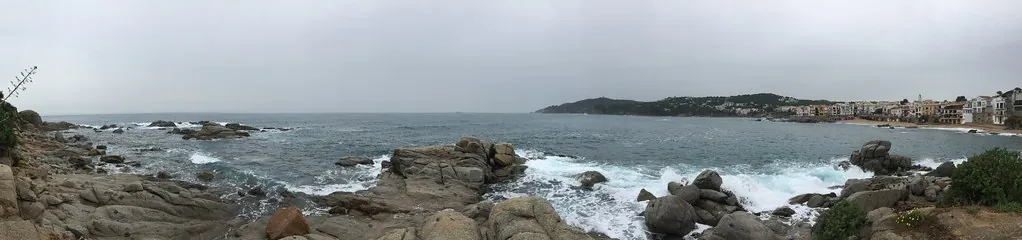
The sea carries a scent of rosemary and salt. On the horizon stands the old watchtower of Torre Valentina, built centuries ago to guard this stretch of coast. It still acts as a reference point for swimmers heading out into deeper water, a fixed mark against the shifting blue.
Sant Antoni, the coastal part of the municipality, has a different rhythm at this hour. Later, the promenade fills and the beach changes character. Early on, it feels closer to what it once was: a working shoreline facing an uncertain sea.
When the Coast Became Liveable
For centuries this section of the Catalan coast was considered dangerous. Pirate incursions were a real threat and small fishing communities relied on defensive towers such as Torre Valentina and others dotted along the shoreline. Constant vigilance shaped daily life.
Older residents recall how women would mend fishing nets on the sand while keeping an eye on the horizon. Today, those same nets sometimes hang from the balconies of second homes as decoration. Yet the knowledge has not entirely disappeared. Some families still know the old knots, tightened with the mouth while the hands hold thread and lead in place.
The administrative union between Sant Antoni and the inland village of Calonge came after the Spanish Civil War. Despite that, the distinction remains in everyday speech. In the Platja neighbourhood, locals still say “I’m going up to the village” when they head towards Calonge, as though crossing the C‑31 road meant stepping into another scene altogether.
The shift from exposed coastline to summer resort did not happen overnight. Sant Antoni grew as the sea gradually ceased to be seen primarily as a source of danger. What was once a defensive landscape of lookout points and fishing activity evolved into a place for bathing and strolling.
Calonge Castle and the View Over Baix Empordà
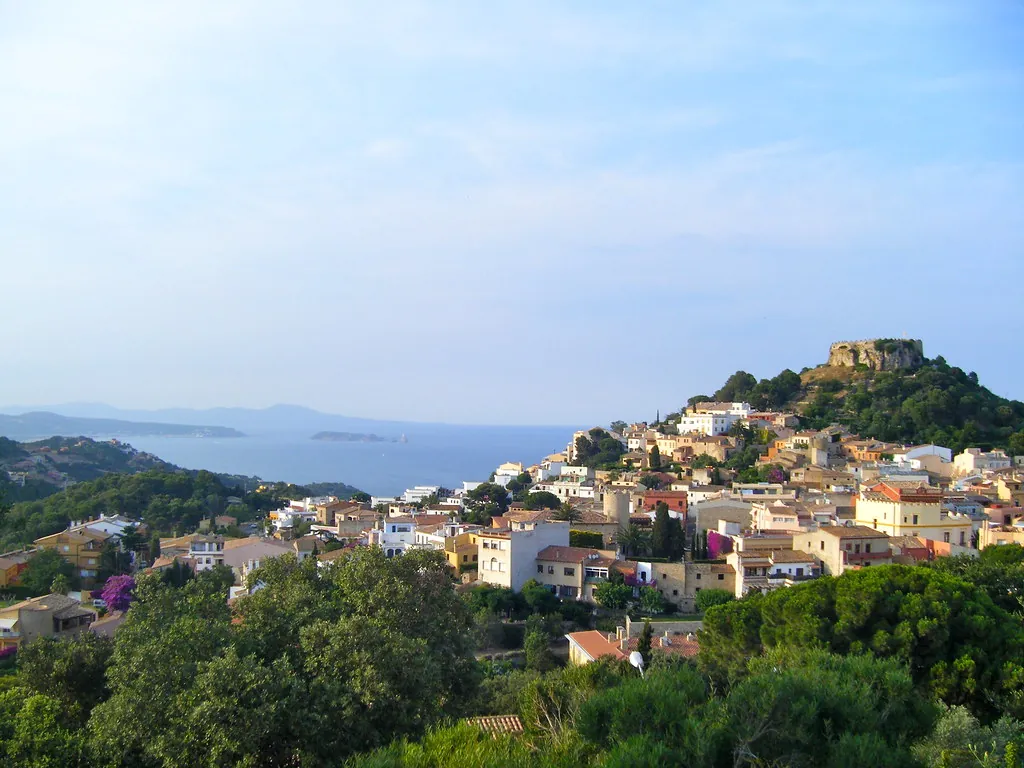
From the beach, Calonge Castle appears as a solid mass of grey stone on the hill above. There is nothing romantic or decorative about its outline. The impression changes once inside the old town, climbing its steep streets towards the castle walls. Thick masonry, quiet courtyards and cool shadows even in high summer give the stone a different presence.
The castle dates back to medieval times and was later transformed into a stately residence. Today the complex usually opens for cultural events and guided visits at different times of year, so it is worth checking in advance whether anything is scheduled.
Within the walls lies a broad courtyard where the stone retains the day’s warmth. In one corner grows an ancient olive tree, its trunk twisted as if it had spent centuries overhearing conversations. From the highest part of the ramparts, the view opens across the Baix Empordà region. Inland lie the pine forests of les Gavarres. In the opposite direction stretches the blue line of the Mediterranean.
When the wind rises, the air shifts quickly. Pine resin gives way to salt, then to the faint trace of smoke from a distant barbecue. The landscape here is defined as much by scent as by sight.
Beneath the Surface: Roman and Iberian Traces
History in Calonge i Sant Antoni is not always clearly signposted. Near the coast lies the Collet site, once a Roman centre for amphora production. Amphorae were the clay vessels used to transport goods such as wine and oil across the Roman world. Today the setting is understated: open ground, low vegetation and a few signs explaining what once stood here.
Looking closely at the soil, fragments of reddish pottery can still be found among the earth and thistles. They are small reminders of an industry that connected this coast to wider Mediterranean trade.
More concealed is the Iberian settlement of Castell Barri. The access begins along a path that heads into the hills and gradually gains height. The ascent takes around forty minutes, so water and comfortable footwear are advisable, particularly on hot days.
At the top, stones begin to organise the landscape. Low walls, the remains of structures and an old cistern outline what used to be a settlement long before Roman rule. The air carries the scent of thyme and resin. From this vantage point, Sant Antoni appears like a model laid out beside the sea, its buildings arranged along the curve of the shore.
Everyday Flavours in Calonge
Early in the morning in central Calonge, the smell of warm bread drifts from the bakeries around the plaça Major. One local speciality is coca de vidre, a thin, crisp dough topped with sugar. It cracks easily when broken by hand. At that hour, tables fill with neighbours who take their time over breakfast as the square slowly wakes up.
Another dish closely associated with home cooking is suquet de peix de roca, a fish stew made with whatever rock fish is available that day rather than expensive seafood. The base is a slow‑cooked sofrito prepared with ñoras, small dried peppers typical of Catalan cuisine. Often it is served in a clay casserole that has been in the family for years.
This is the sort of food more commonly seen at family meals or neighbourhood gatherings than along the seafront promenade. It speaks of a coastal tradition shaped by what the sea provided on any given morning.
Walking the Camí de Ronda
At the northern end of Sant Antoni’s promenade begins the Camí de Ronda, the coastal path that links the town with Palamós. The first stretch runs along wooden walkways set among the pines. Soon the route becomes a reddish dirt track that curves above small coves.
The distance is not great, but it rewards an unhurried pace. In certain sections the water is so clear that fish can be seen from above, their moving shadows sliding across the sandy seabed.
The beach itself changes markedly over the course of a summer day. Before mid‑morning, it is still possible to walk calmly along the shoreline. Around midday the sun faces the bay directly and the sand reflects the light intensely. By evening the temperature drops and the promenade once again fills with residents heading out for a walk.
If there is a choice of month, June…