Full Article
about Castellbisbal
Industrial and residential municipality on a hill above the Llobregat River
Hide article Read full article
Living in Barcelona’s Shadow
Small towns that sit beside major cities often have a quiet identity crisis. Castellbisbal, in Catalonia, knows the feeling. With around 13,000 inhabitants and just half an hour from Barcelona, it has grown quickly in recent decades. Its location is its advantage and its challenge. Why would anyone stop here instead of driving straight on to the Catalan capital?
That question sits at the heart of tourism in Castellbisbal. It does not have the cathedral of Vic or the polished air of Sant Cugat. It rarely features on postcards. Yet it works on its own terms. There is no attempt to compete with its neighbours. The town seems clear about what it is, and just as clear about what it is not.
Castellbisbal is the sort of place you pass on the way somewhere else. The surprise comes when you decide to pause.
A Castle That Is Only Half a Castle
The turó, the hill above town, is the obvious starting point. The expectation might be another crumbling site with views over a car park. There is indeed parking nearby. There is also a medieval tower that still stands firm, like an elderly relative who refuses to leave home. The surrounding walls barely rise far from the ground, so “castle” requires a little imagination, but the setting does the rest.
From the top, the Vallès opens out. The Llobregat winds across the landscape. Fields survive between industrial estates. In the distance, Montserrat appears on the horizon as if keeping watch over the valley. It is a broad, honest view that explains the geography of the area better than any information board could.
Just a few metres away sits the ermita de Sant Vicenç, a small Romanesque chapel that resembles a simple stone box. The door was open during the visit described in the original account, which feels like a point in the town’s favour. Inside there is the scent of damp stone and recently extinguished candles. No audio guides, no QR codes, no panels competing for attention. Only silence and the sense that people have been coming here for centuries.
This hilltop does not take long to explore. It does, however, provide perspective. Castellbisbal is not about monumental architecture. It is about location and continuity.
Walking with the Llobregat
The GR‑270 long-distance path crosses the municipality as it follows the course of the Llobregat. It does so at an unhurried pace, as if accompanying a friend who prefers to stroll. One spring morning, with a chill that still called for long sleeves early in the day, the route proved largely flat. Anyone searching for a technical challenge will not find it here. Anyone who wants to walk without overthinking each step will.
At one point the river widens and becomes almost still, more pool than current. A bench provides a place to sit and watch. Ducks drift across the water. Nearby, a man fishes with the relaxed expression of someone who claims to be busy but answers to no one. It is a modest scene, yet it captures the rhythm of the area.
Another option branches off towards the Turó de la Guineueta. The paths are clearly marked and there are signs explaining the vegetation. The gradient increases enough to make you work a little, though not so much that it turns into a serious climb. It is the sort of walk that leaves you feeling you have earned your vermouth before lunch, a reference that in Catalonia signals a late-morning social drink rather than a formal meal.
These routes reveal a practical truth. For many residents, this is their nearby countryside. Families head out at the weekend along the riverside path because it is close at hand. Cyclists pause for a drink after their ride. The landscape is used, not staged.
Sant Vicenç and a Winter Fiesta
The winter Festa Major, dedicated to Sant Vicenç and usually held in January, offers another glimpse of the town’s character. Picture cold air, perhaps a little fog, and the main square hosting activities organised for locals.
There are no vast stages or elaborate productions. Inflatable attractions sometimes sag as the air escapes. Music comes from local bands. Stalls encourage conversation more than spending. Hot chocolate circulates because the temperature demands it.
What stands out is that the celebration is not designed to attract outsiders. It exists for the people who live here. An elderly man teaches his granddaughter to dance sardanas, the traditional Catalan circle dance. She is eight or nine and steps on his feet every couple of moves. He laughs as if it were perfectly normal.
For visitors unfamiliar with sardanas, they are danced hand in hand in a circle, following a measured pattern of steps. In Castellbisbal, during Sant Vicenç, they are less a performance and more a shared habit. The atmosphere feels communal rather than curated.
Everyday Food and Ordinary Streets
Search for a typical dish of Castellbisbal and the results tend to be institutional rather than culinary. There is no single recipe that draws travellers from afar.
What appears instead is what you find in many towns across the Vallès. Bars where a butifarra sandwich, a classic Catalan sausage in bread, arrives quickly and disappears even faster. Bakeries selling sweets to neighbours who have popped in for their daily loaf. Terraces that fill up when the sun is out.
This is not a destination chosen solely for food. It is somewhere to stop, sit for a while and continue the journey. The appeal lies in the ordinariness. Eating here feels less like an event and more like a pause in daily life.
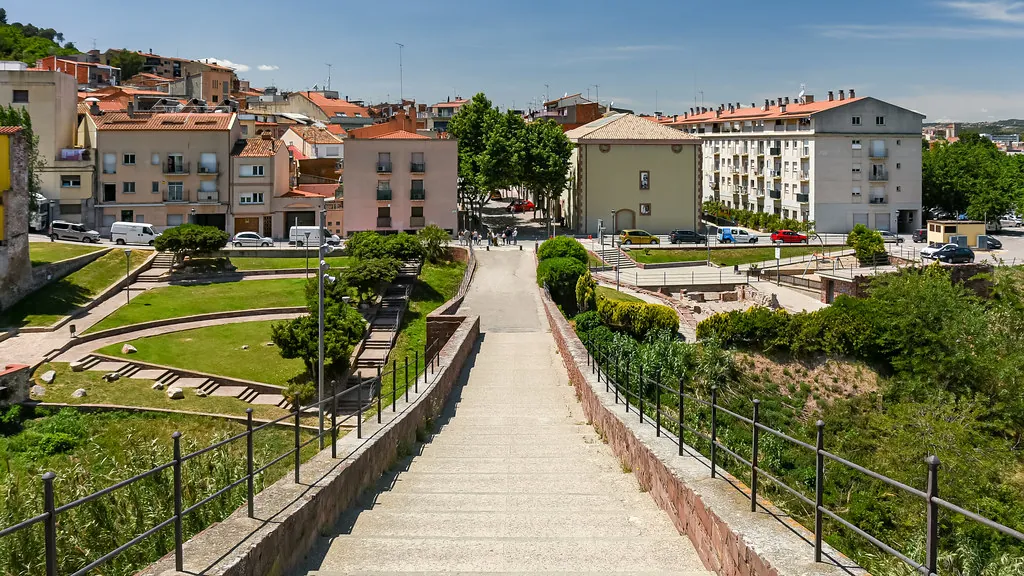
A walk through the núcleo antiguo, the old centre, reinforces that impression. Streets serve residents first. Traffic on the access roads is a regular topic of complaint. Many people commute each morning to Barcelona or to nearby industrial estates. Castellbisbal functions as a lived-in municipality of the Vallès, not as an open-air museum.
Adjusting Expectations
The key to understanding Castellbisbal is expectation. Visitors will not encounter a medieval town preserved unchanged. Nor will they find a landscape polished for brochures.
What they will find is a real place within reach of Barcelona. Climb the tower and look across the valley. Cross the old stone bridge. Watch cyclists stop for a drink after a route along the river. In those moments it becomes clear that Castellbisbal does not try to be something else.
It suits a short stop rather than a long stay. A few hours are enough to wander through the older streets, head up to the tower for the view, then drop down towards the Llobregat for a gentle walk. By the end, there is a fairly clear sense of daily life here.
Castellbisbal may not headline international travel catalogues. It does offer a straightforward experience of the Vallès, close to Barcelona yet grounded in its own routines. Sometimes that is reason enough to turn off the road and see what is there.