Full Article
about Alp
High-mountain municipality key to skiing; blends snow tourism with historic heritage
Hide article Read full article
First light in the valley
Early in the morning, when the sun begins to touch the slopes of the Cadí, Alp is still half asleep. Light slips sideways into the Cerdanya valley and picks out the grey lines of the massif with unusual clarity. In the older streets, a shutter lifts, a car starts slowly. This is often how time in Alp begins, with a sense of space that defines this part of the Cerdanya, where the sky feels larger than in many other Pyrenean valleys.
La Molina ski resort is only a few kilometres away, and Masella is close too, yet the rhythm inside the village is different. Life here moves along short streets, past small vegetable plots, and onto paths that lead almost unnoticed out towards the meadows.
Stone streets and Sant Pere
The old centre is easy to recognise. Narrow streets wind between stone houses, some with wooden balconies darkened by many winters. Not everything is historic, newer buildings are mixed in, though there are still corners where traditional Cerdanya architecture remains clear. Thick walls, wide doorways, and sloping roofs built to carry snow define these older structures.
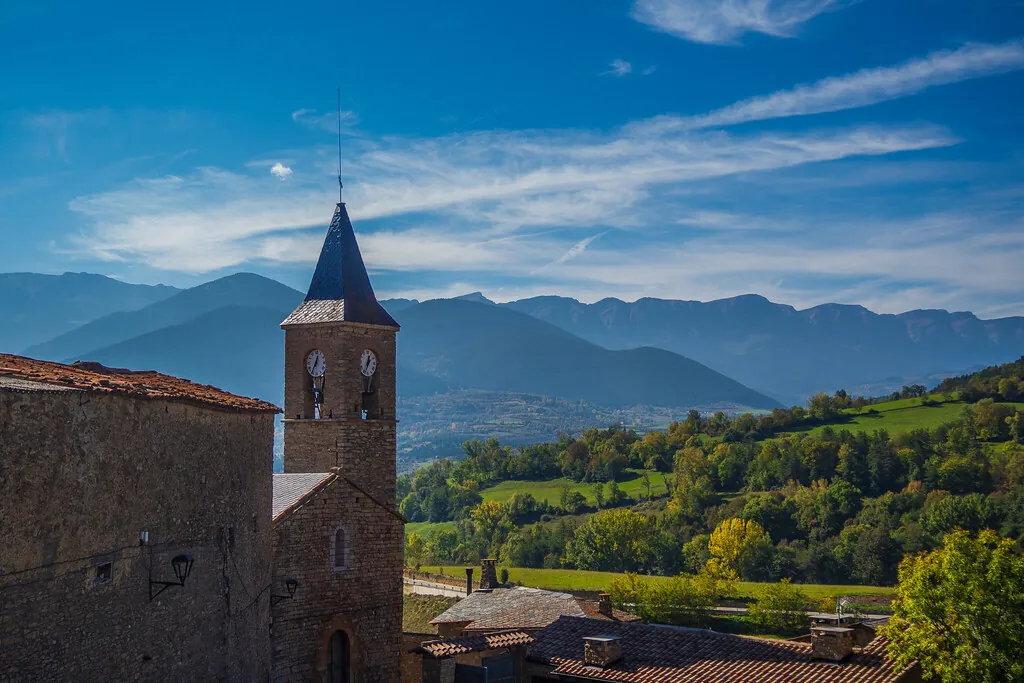
The church of Sant Pere stands out, its square bell tower visible from several points around the village. Its origins go back to medieval times, though it has been altered and expanded over the centuries. Inside, the air often feels cool even in summer. The walls show the gradual layering common in mountain churches: small restorations, details that do not always match perfectly, but together tell the story of how the place has changed.
Paths across meadows towards the Cadí
Several rural paths leave from the centre and within minutes the last houses fall behind. The landscape opens quickly. Wide meadows stretch out, an occasional masía sits apart, and the sharp line of the Cadí closes the horizon to the south.
In spring and early summer, the green is intense and the air carries the scent of cut grass. Horses and cows are often seen grazing near the paths. Many of these routes are straightforward, gentle tracks or trails with little change in elevation, making walking accessible without much effort. On clear days it is worth bringing a hat or water. Parts of the Cerdanya plain have little tree cover, and the midday sun can be strong.
A short distance from the village, the sanctuary of the Remei sits on a small rise above the valley. It can be reached on foot along easy paths or by car. From there, the open shape of the Cerdanya becomes clear, with Alp resting against the slope and the meadows spreading out across the valley floor.
Moving around from a quiet base
Because of its location, Alp often works well as a base for exploring the wider comarca. The nearby ski resorts of La Molina and Masella bring steady movement in winter, especially on the approaches to the village.
Even so, staying in Alp tends to feel calmer than being right at the foot of the slopes. In the mornings, cars head up towards the mountains carrying skis. By late afternoon, the village settles again. During heavy snowfall, roads can slow down, which is fairly typical in this part of the Pyrenees.
At other times of year, the local roads are more likely to fill with cyclists. The gradients are not extreme, yet the altitude and the long, straight stretches of the valley make themselves felt in the legs.
Food and flavours of the Cerdanya
The cooking here remains closely tied to mountain produce. Menus often include cured meats from the comarca, beef raised in the valley’s meadows, and substantial dishes suited to the colder winter months.
Trinxat, made with potato, cabbage, and sometimes a little pork, is one of the most recognisable dishes of the Cerdanya. On winter weekends and in August, the village tends to be busier, so eating at usual times can mean allowing for a bit of extra time.
A place shaped by the seasons
Alp changes noticeably over the course of the year. In winter, its proximity to the ski resorts fills the streets with cars and people moving up and down the mountain. A similar pattern appears for a few weeks in summer, when many second homes open again.
Yet it does not take much to find a quieter pace. Setting out early or following the paths beyond the village brings a different rhythm into focus: the sound of cowbells across the meadows, the wind coming down from the Cadí towards evening, and the long light of the Cerdanya lingering over the valley as the sun drops. This is when Alp makes the most sense.