Full Article
about Bellver de Cerdanya
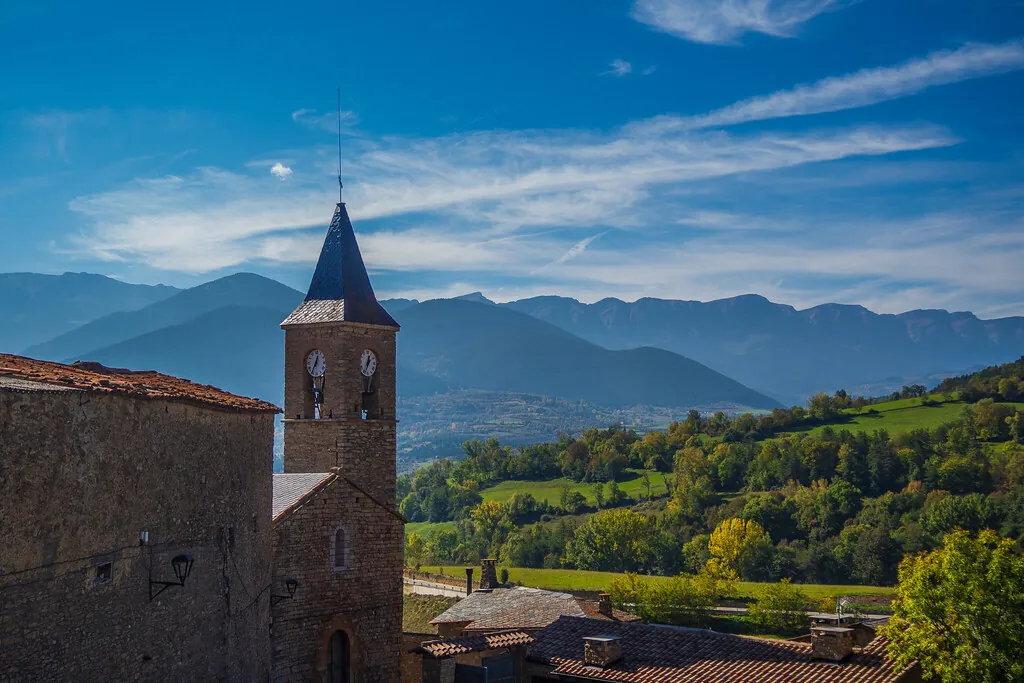
Historic center of the Batllia; medieval old town and gateway to the Cadí-Moixeró Natural Park
Hide article Read full article
Bellver de Cerdanya is like that friend who moved to the mountains and now measures time by the sun, not the clock. You arrive with your city rhythm and it takes about twenty minutes for your shoulders to drop. The air is thin at a thousand metres up, and the village sits right in the middle of the Cerdanya basin, with the Cadí range on one side and open meadows on the other.
The tower that sets the tone
Before you even get to the old quarter, you’re met by the Torre de la Presó. It’s a 13th-century stone cylinder that feels less like a tourist attraction and more like a stubborn fact. This was frontier land once, and the tower doesn’t let you forget it.
The old town isn’t big. You can walk its narrow streets and under its stone arches in a lazy loop. It doesn’t feel staged. Some houses are neatly kept, others show their age. The local story they tell involves Gustavo Adolfo Bécquer and something called the Cruz del Diablo. Whether the writer actually got his idea here is anyone’s guess, but in Bellver they tell it like it’s just another piece of family gossip.
The church that gave up standing straight
A ten-minute drive towards Nerellà brings you to Santa Eugènia church. Its bell tower doesn’t just lean—it looks like it decided to take a nap centuries ago and never got up. We’re talking over a metre off vertical.
No one has propped it up or turned it into a ticket booth. It just stands there, crooked, next to a quiet road. Locals call it their “Pisa,” but that feels too grand. This is more like finding a wonky shelf in your grandma’s house; everyone knows it’s not straight, but it’s part of the furniture now.
Food for when the cold bites
The cooking here makes sense once you remember winter lasts five months. Trinxat is the classic: cabbage, potato, and bacon fried into a kind of hearty cake. It’s peasant food, designed to stick to your ribs.
Then there are the turnips—nabos de Talltendre. People from here swear by them, saying the soil gives them a sweetness you won’t find elsewhere. They even have a whole fair dedicated to them. It’s one of those local quirks where you realise how much pride can be stored in something as humble as a root vegetable.
A walk with history scratched into the rocks
For a leg stretch, head towards Vall de l’Ingla. Part of the path follows the Camí dels Bons Homes, which traces the old Cathar escape routes north. Now it’s just a quiet track through woods.
Keep your eyes peeled on certain rock faces. There are prehistoric carvings here—lines and shapes etched by people who walked this valley millennia before it had a name. They aren't highlighted with spotlights or signs; you might miss them entirely. Finding one feels less like visiting a museum and more like accidentally overhearing a very old secret.
Talló and traditions that just continue
Down the road in Talló stands one of Cerdanya's better-known Romanesque churches. But for locals, the real spot is the Font de Talló meadow nearby.
This is where one of those deeply rooted village festivals happens every year—the kind where specific men from Bellver perform specific dances while everyone else watches from around an open field against mountain backdrop . From an outsider's view , these customs can seem opaque . But here , they persist simply because no one has ever stopped doing them .
Bellver isn't trying to win any beauty contests . Other villages in Cerdanya might be more immediately striking . What you get here instead is functionality : a working village in a wide valley , where history feels like layers you can peel back yourself if you slow down enough . You come for lunch , maybe stay for an easy walk , and leave with dust on your shoes instead of brochures in your hand .