Full Article
about Bolvir
Sunny Cerdanya municipality with Iberian ruins; upscale second homes
Ocultar artículo Leer artículo completo
Morning light at 1,145 metres
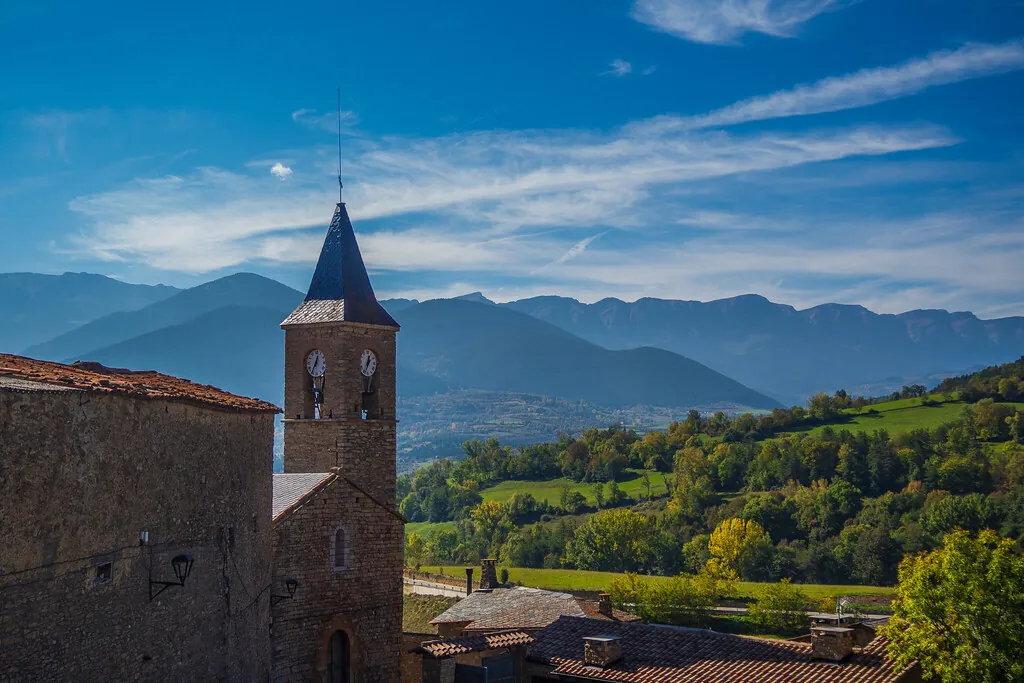
The first thing you notice is the valley floor. It spreads out like a vast green runway, wider than any British upland has a right to be, framed by two ranks of mountains that still carry snow long after the Lake District fells have turned brown. Bolvir sits on a low ridge above this amphitheatre, 1,145 m up, high enough for your morning coffee to cool faster yet low enough for holm oaks to mingle with the pines. Stone walls the colour of weathered Cotswold limestone keep the fields in order; the only sound at 8 a.m. is a tractor heading out to cut hay that will feed cows through a Pyrenean winter tougher than anything Hertfordshire ever manages.
Most British maps stop at Puigcerdà, ten minutes’ drive north. That is exactly why skiers who’ve endured the neon of the Alps give Bolvir a second look. La Molina’s first chairlift is 12 km away, Masella’s even closer, yet the village itself has no souvenir stalls, no boot-room disco bars, just a single delicatessen that smells of paprika and strong coffee. The deli, Cal Ticus, opens at 9 a.m. sharp and sells duck magret cured like Parma ham for €6 a pack—hand it round the chalet later and everyone assumes you’ve spent three times that in Barcelona.
Stone, slate and the 12th-century silence
The old centre is barely four streets wide. Houses are built from chunks of local granite, roofs pitched steep for snow and tiled in black slate that glints after rain. The church of Sant Julià i Sant Germà squats at the top; its oldest stones date to 1163, though Victorian-style restorers got carried away in 1892. Push the heavy door at midday and you step into cool darkness that smells of candle wax and damp stone. No charge, no guide, just a single bulb over the altar and the faint sound of someone practising Bach on a portable keyboard in the vestry. Stay five minutes and the outside world feels presumptuous.
Beyond the church lane the village dissolves into lanes bordered by irrigation ditches still running with snow-melt in July. Walk east for ten minutes and you reach the Roman road that once linked the Cerdanya plain with Toulouse; the flagstones are rutted by cartwheels older than any A-road in Britain. A signpost invites you onward to Ger, the next hamlet, 3 km across hay meadows. The path is flat, stroller-friendly, and you meet more horses than people.
A season for everything, except August
Spring arrives late. May can still drop to 5 °C at dawn, so pack a fleece even if the BBC swears the Med is balmy. The upside is empty trails and orchards of pear blossom that photograph like a watercolour. Autumn, late September into October, gives crisp air and beech woods the colour of burnt toast; morning mist pools in the valley until the sun tops the ridges. These are the months locals recommend, before the first snow closes the high passes and after the summer exodus that empties the village.
August is the surprise let-down. Temperatures hit 30 °C, humidity rises, and half the houses shutter up while owners escape to the coast. The bakery shortens its hours, the single supermarket shuts from 13:30 to 17:00, and if you haven’t shopped by Saturday night you’ll breakfast on crisps. British visitors expecting Alpine cool have been known to flee to the beach at Roses, two hours away. Bolvir is honest about this: it is a mountain working village, not a hill station.
Ski lifts, tyre chains and the 07:10 bus
Come December the picture changes. Snow guns start on La Molina’s lower slopes and Bolvir becomes a commuter settlement for the lifts. Drive time to parking sector A is 18 minutes on a clear morning, 35 if fresh powder has brought out every Barcelona number plate. Winter tyres or chains are compulsory from 1 November; the Guardia Civil set up roadblocks on the N-260 and fines start at €200. One local taxi—a battered Seat Alhambra—will do the run for €25 each way, but you need to book the night before.
Public transport? There is a weekday bus to Puigcerdà at 07:10 and 19:10, none on Sunday. British families used to Oxford Tube frequencies find this hilarious until they realise the timetable is aimed at schoolchildren, not tourists. Hire a car at Girona airport (Ryanair from Stansted, Manchester, Bristol, Edinburgh October–March; 1 h 10 min drive) and you regain control. Barcelona is an hour longer and the car-hire queues at peak times make Heathrow look polite.
Trout, trinxat and the €8 cava that beats prosecco
Evenings revolve around food rather than nightlife. The village’s one restaurant, Can Xavier, seats thirty and does a fixed menu for €22: start with trinxat, a sturdy cake of potato, cabbage and streaky bacon that tastes like Catalan bubble-and-squeak, then river trout grilled whole on a flat stone, served with almonds and local saffron. Vegetarians get escalivada, smoky aubergine and peppers that could convert a committed carnivore if no one mentions the word “plant-based”. Wine is poured from a 1-litre carafe and costs €9; the house cava, made down the valley, outclasses anything the Co-op sells for £12.
Self-caterers head to Cal Ticus for vacuum-packed stews, artisanal sausages and the aforementioned duck ham. The village shop, three aisles squeezed into a former barn, stocks fresh milk in glass bottles and a surprisingly good Manchego aged 12 months. Bread arrives at 8 a.m.; by noon the crusty loaves are gone. If you miss the window, drive five minutes to a larger supermarket in Puigcerdà where British cravings for teabags and Marmite are discreetly accommodated.
Walks that don’t require an ice-axe
You don’t need to be a Munro-bagger to enjoy the surrounding paths. A 5 km loop south of the village follows the river Segre through poplar plantations where nightingales sing in May; the elevation gain is 80 m, less than climbing Hampstead Heath. Longer routes climb to abandoned stone shepherd’ huts at 1,600 m, perfect picnic spots with views across to France. The GR-177 long-distance trail passes nearby: follow it east for two hours and you reach the Romanesque chapel of Sant Serni de Tavèrnoles, unlocked, empty, echoing.
Mountain-bikers can join the dirt track that skirts the golf course—yes, the Cerdanya has an 18-hole course, green fees €55, open March–November. Road cyclists relish the silky-smooth tarmac to Llívia, a Spanish enclave surrounded by France; the climb is gentle enough for hybrids, the café in the square serves espresso strong enough to power a return leg.
When the lights go out
By ten o’clock the village is dark enough to see the Milky Way from the church steps. Nightlife is a bottle of local beer on the balcony, listening to the irrigation water gurgle through stone channels older than most countries. If you crave dancing, Puigcerdà has two bars that shut at 3 a.m.; the drive back is an automatic €30 taxi because the Guardia Civil like to wait just outside the roundabout.
Bolvir will never shout about itself. It offers altitude without attitude, ski access without the sausage-party soundtrack, and a reminder that in parts of Europe the village clock still matters more than the algorithm. Bring chains in winter, patience in summer, and a willingness to let the valley set the pace. If that sounds too slow, the motorway south is only twenty minutes away—though once you’ve watched dawn lift the mist off the Cerdanya plain, the fast lane feels like the wrong kind of progress.