Full Article
about Das
High-mountain municipality with Ceretan architecture; near the Cadí tunnel and ski slopes.
Ocultar artículo Leer artículo completo
The morning tractor rolls past at half seven, towing a trailer of hay that blocks the single lane through Das. Nobody honks. The driver simply lifts two fingers from the steering wheel, the Catalan equivalent of a formal bow, and continues uphill. At 1,219 m above sea level, this is the closest thing to rush hour you’ll encounter in a village where livestock still outnumber humans by a comfortable margin.
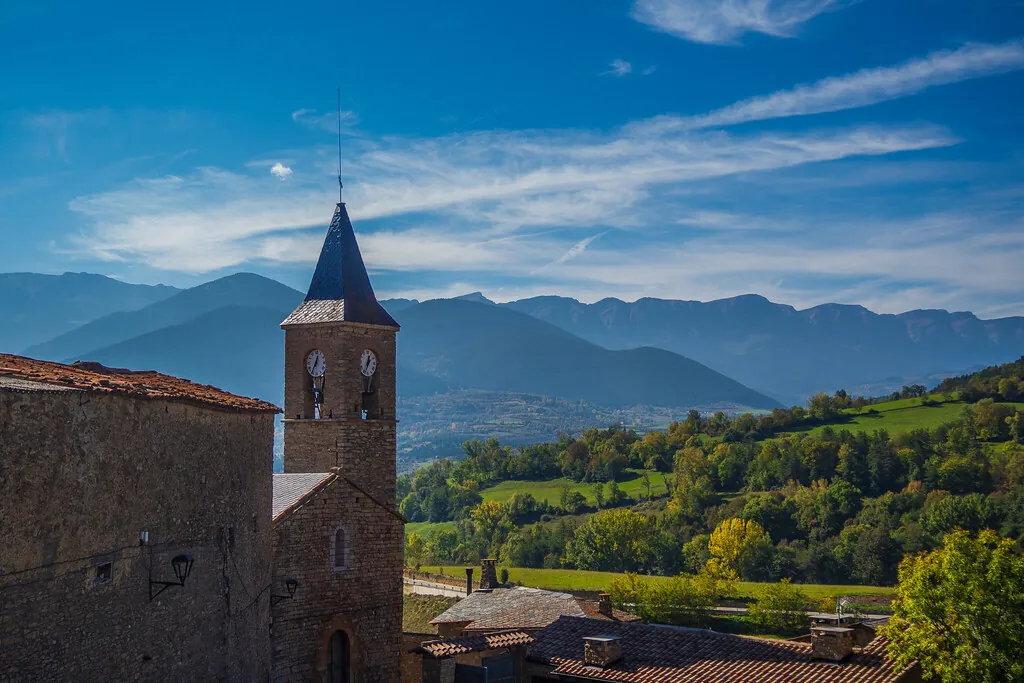
Das sits on a ridge above the Cerdanya basin, close enough to the French border that phone networks sometimes waver between Spanish and French carriers. The air is thinner, clearer, and—above all—quieter than the coastal Catalonia most British visitors know. Temperatures drop sharply after sunset even in July, and snow can linger in north-facing hollows until May. If you arrive expecting a sun-baked pueblo blanco, you’ll be disappointed; stone walls here are the colour of weathered slate, roofs are slate, and the only white you’ll see in winter is the stuff that falls from the sky.
Stone, Snow and Silence
The parish church of Sant Martí squats in the geographical centre of the village, its bell tower the highest man-made point for kilometres. The building is neither cathedral nor ruin—just a solid Romanesque core patched over whenever earthquakes, avalanches or parish budgets allowed. Step inside and the temperature falls another five degrees; the stone floor is worn into shallow ruts by four centuries of farming boots. Sunday mass still draws a congregation, though numbers swell in August when second-home owners from Barcelona remember they have souls to save.
Radiating from the church are three lanes narrow enough to touch both walls with outstretched arms. Houses are built shoulder-to-shoulder, each one dated on the lintel: 1783, 1821, 1899. The older doorways are barely five foot six; people were shorter before the arrival of imported Argentine beef. Many façades carry modern additions—double-glazing, solar tubes, the occasional glass balcony—but planning rules insist on local stone, so the overall palette remains grey-on-grey until geranium pots explode into colour in June.
Winter rewrites the script entirely. When snow arrives (usually by Christmas, occasionally as early as late October) the lanes become toboggan runs and the village water tank freezes solid. Driving requires chains even with four-wheel drive; the council grades the main access road twice a day, but side streets are left white. What looks postcard-perfect at 10 am can feel mildly terrifying after dark when the streetlights flicker and the thermometer reads –12 °C. Bring a sleeping bag rated to –5 if you’ve booked one of the stone cottages; Catalan builders trust thick walls over central heating.
Walking Tracks That Start at the Front Door
You don’t need a car to leave Das, but you do need a map. Marked trails exist—look for yellow-and-white paint flashes—but they’re designed for locals who already know which meadow belongs to whom. One reliable route heads south-east along the Camí Vell de Das, an old mule track that contours above the village for 4 km before dropping into the neighbouring hamlet of Prullans. The gradient is gentle, the views widen with every step, and you’ll share the path with exactly zero souvenir stalls.
More ambitious walkers can continue uphill to the Coll de la Creu de Meians (1,765 m), a five-hour round trip that delivers a full panorama of the Cerdanya valley and, on clear days, the snow-capped Canigó massif on the French side. The ascent is straightforward in summer; in winter it becomes a serious snow-shoe or micro-spike undertaking once the sun leaves the ridge. Fog can descend in minutes—if the cowbells stop ringing, you’ve probably wandered off-route.
Closer to home, a fifteen-minute stroll west of the church brings you to the Pla de Das, a high meadow where cattle graze between glacial erratics the size of hatchbacks. Early risers sometimes spot roe deer retreating into the pine fringe, and griffon vultures circle most afternoons, riding thermals that rise from the valley floor 600 m below. The meadow is also the launch site for local paragliders when the wind blows south-westerly; watching a neon canopy drift silently over your head is surreal at 8 am on a Tuesday.
Eating Without the Tour-Group Menu
Das itself has no restaurant, café or bar. The last grocery closed in 2017 when the proprietor retired at 84. For supplies you drive ten minutes down to Puigcerdà, the comarcal capital, where supermarkets stock everything from Welsh cheddar to kimchi. What the village does offer is proximity: within a 20-minute radius you can eat truffle-scented risotto at a Michelin-listed table in Bellver de Cerdanya, or demolish a €9 three-course menú del día in a workers’ canteen in Alp.
If you’re self-catering, shop Thursday morning at Puigcerdà’s covered market. Look for trinxat—a cabbage-and-potato fry-up bulked out with local bacon—formatge de tupí, a soft cheese matured in earthenware pots, and Cerdanya potatoes, small, waxy and sweet enough to convert the carb-averse. Farmers still sell eggs from the back of vans; leave coins in the honesty box and remember that “medium” in Spain would qualify as “large” in Tesco.
August brings the Festa Major, a weekend of communal meals, sardana dancing and a tractor-decorating contest judged by the mayor. Tickets for the Saturday night barbecue cost €18 and sell out by Friday lunchtime; vegetarians get grilled peppers and profound sympathy. November’s Festa de Sant Martí is smaller—basically a long lunch after mass—but the local cava flows freely and outsiders are welcomed with the same courtesy extended to lost hikers.
Getting There, Staying Warm, Paying for It
Barcelona El Prat to Das is 160 km door-to-door: train to Puigcerdà (three hours, €22), then taxi for the final 10 km (€25 fixed fare). Car hire slices the journey to two and a half hours via the C-16 toll tunnel; budget €18 each way for the toll alone. Girona airport is closer mileage-wise, but mountain roads add time: allow two hours forty in good weather, four when the Pyrenees decide to snow on the N-260.
Accommodation is scarce and mostly private. Airbnb lists two properties in the village itself: a ground-floor flat with under-floor geothermal heating (crucial in February) and a studio carved into a 17th-century barn where the Wi-Fi works only if you sit by the east window. Nightly rates hover around €85–110 year-round; hosts drop keys in a flowerpot and leave you firewood stacked like Jenga. Hotels cluster down in the valley—expect €130 for a three-star in Puigcerdà, more during ski season when La Molina and Masella crank up their snow cannons.
Bring layers, not outfits. A 20 °C May afternoon can flip to sleet by dusk; in July you’ll still want a fleece after nine o’clock. Hiking boots with ankle support save ankles from loose scree and cow-pocked mud. Catalan is the default tongue, but most under-40s speak castellano and enough English to explain why the shower has stopped (usually a frozen pipe).
Leave the village as you found it: quiet, stone-coloured, indifferent to Instagram. Das doesn’t need visitors, which is precisely why some end up staying longer than planned—sometimes long enough to wave at the next tractor and receive the two-finger salute that passes for a royal welcome.