Full Article
about Guils de Cerdanya
Border municipality with a Nordic ski station; exceptional panoramic views over Cerdanya
Ocultar artículo Leer artículo completo
A Village That Looks Down on the Pyrenees
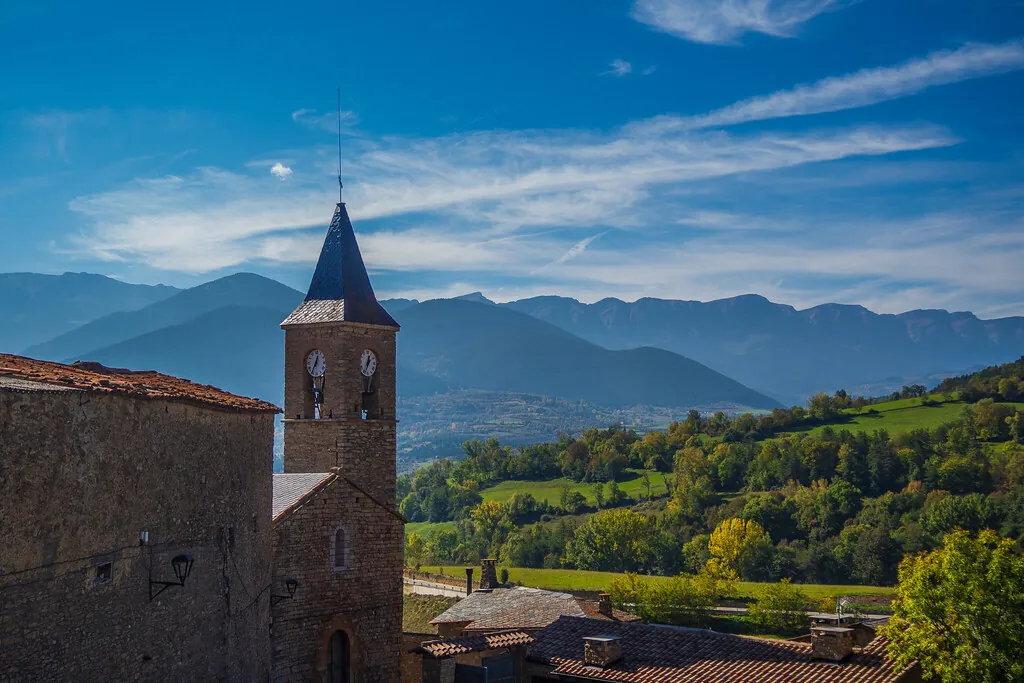
From Guils de Cerdanya the Cerdanya Valley spreads out like a map. You stand at 1,385 metres, almost level with the circling griffon vultures, while the 2,600-metre wall of Cadí-Moixeró rears up to the south and France sits just beyond the ridge to the north. The altitude matters: morning temperatures can be eight degrees cooler than in nearby Puigcerdà, snow lingers two weeks longer, and even in July you might wake to frost on the car windscreen.
The village itself is strung across three hamlets – Guils de Cerdanya (the administrative centre), la Collada and Fontanera – linked by single-track lanes that still follow the medieval drove roads. Stone barns called bordas hunker into hillsides; their slate roofs hang low like eyebrows to shrug off winter storms. Fewer than 500 people live here year-round, a number that swells to just over a thousand when the second-home owners arrive for Christmas or August. The result is a place that feels half awake and wholly self-contained: the baker from Saillagouse delivers baguettes three times a week, the mobile library parks outside the church every Thursday, and the nearest traffic light is 18 kilometres away.
What Passes for Sightseeing
There is no checklist of must-see monuments. Instead, the village offers a short loop of lanes where you can read the local climate in the architecture. Windows are postcard-sized, south-facing and set deep in metre-thick walls. Balconies are made of pine that silvered decades ago. Even the church of Sant Martí – rebuilt piecemeal since the 11th century – sits low in its own wind shadow, its bell tower more watchtower than campanile. Step inside and you’ll find a single nave warmed by the smell of candle wax and damp stone; the only splash of colour is a 16th-century polychrome Pietà whose paint has flaked to a bruised purple.
If you want grander views, walk ten minutes above the last houses to the mirador where a stone bench faces the valley. On clear days you can pick out the radio mast above La Molina ski station and, further east, the bull-ring curve of the Puigcerdà golf course. Bring binoculars: the brown specks on the opposite pasture are not stones but the Catalan vacas brunas, a hardy mountain breed whose milk ends up as tupí, a soft cheese matured in earthenware pots.
Snow Without the Sales Pitch
Most British visitors arrive in winter, lured by the Nordic ski station at Guils Fontanera. It is not downhill skiing – there are no chairlifts, no fondue-serving mountain huts, no thud of bass-heavy après-ski. Instead, 34 kilometres of machine-groomed tracks thread through Scots pine and birch. A day pass costs €18, half the price of a single downhill lift ticket in the Alps, and rental gear (boots, skis, poles) is another €15 from the hut beside the car park. Red squirrels outnumber skiers mid-week; you’ll meet more dog-sled teams than snowboarders.
Lessons are low-key. The Catalan instructors speak fluent English – many trained in Norway – and a two-hour group class is €25. British families like the gentle gradient: the highest loop reaches only 1,650 metres, so altitude headaches are rare and the risk of a high-speed tumble into a tree line even rarer. Bring a thermos: the only on-trail refreshment is a weekend-only refuge serving caldo (thin broth) and beer at farmhouse prices.
When the snow melts the same tracks become hiking paths. The most popular route, a 90-minute circuit to the Malniu lakes, starts at the Nordic car park and climbs gently through cow pastures. The lakes sit in a glacial bowl where the water stays grey-green even in July; add another 45 minutes if you want to reach the stone refuge hut for coffee, but check opening times on Facebook – the guardian shuts early if the weather turns.
Where to Eat and What You’ll Pay
Guils itself has two restaurants and a bakery that opens when the owner’s alarm clock feels like it. El Picarol, on the main road into the village, offers a three-course menú del día for €16. Expect roast chicken with proper chips, or trinxat – a cabbage-and-potato fry-up mixed with crispy bacon that tastes like a Catalan take on bubble-and-squeak. Vegetarians can ask for escalivada (smoky aubergine and peppers) though you need to order at breakfast time so the vegetables can be slow-cooked in the wood oven.
For a splurge, drive ten minutes downhill to Hotel del Prado in Puigcerdà where the chef trained in Toulouse and the wine list leans French. A four-course dinner with half a bottle of local vi novell costs around €40 a head. Closer to home, the village shop (open 09:00-13:00, closed Sun/Mon) stocks UHT milk, tinned tuna and surprisingly good local cider. Bring your own bottle and they’ll fill it from the 20-litre keg behind the counter – €3.50 a litre, dry enough to make a Somerset cider drinker blink.
Getting There, Staying Warm
The nearest airports are Barcelona and Toulouse, both roughly two hours and fifteen minutes away by hire car. Toulouse is often cheaper from UK regional airports and, if you exit the motorway at Puigcerdà, you avoid the French tolls. From Puigcerdà, the C-162 climbs 400 metres in 12 kilometres: the road is kept clear in winter but snow chains are compulsory after storms. There is no petrol station in Guils; fill up before you leave the valley floor.
Accommodation is mostly self-catering. Stone bordas have been converted into rentals sleeping six; expect beams low enough to crack a six-footer’s skull, underfloor heating powered by ground-source heat pumps, and Wi-Fi that slows to 1990s dial-up when it snows. Mid-week outside Spanish school holidays a three-bedroom house costs €120-€150 a night; in white-week (usually the second week of February) prices jump 40 per cent and you need to book early enough to secure a parking space.
Pack layers. In January the daytime high can hover just above freezing while the sun is strong enough to burn; by May the thermometer hits 20°C at noon but plunges to 5°C after dark. Mobile coverage is patchy – download offline maps before you leave the main road – and the village cash machine has been out of order since 2022, so bring euros.
The Catch
Guils is quiet, deliberately so. If you want nightlife beyond the occasional folk concert in the church, stay in Puigcerdà. The village shop’s erratic hours mean a 25-minute round trip for milk on Sunday morning. And while the Nordic trails are blissfully empty mid-week, Spanish school holidays turn the car park into a coach-stop circus; arrive before 09:30 or you’ll queue for ski rental and listen to reggaeton echoing across the pines.
Still, for anyone who measures a good day by kilometres skied in silence, or by the number of red squirrels spotted from a stone bench, Guils de Cerdanya delivers. Just don’t expect a souvenir shop. The only thing you’ll take home is the smell of wood smoke in your coat and the knowledge that, up on the sunny side of the Pyrenees, life still runs on barn doors rather than billboard promises.