Full Article
about Isòvol
Small municipality near the Segre; known for the Quadres sanctuary and natural surroundings
Hide article Read full article
A small village shaped by the land
Tourism in Isòvol begins with a simple idea: this is one of the small agricultural settlements that still define the landscape of the Cerdanya. The village sits on the valley floor, just over 1,000 metres above sea level, in a wide setting of open meadows and patches of pine forest. With a population of just over 300, its scale explains its layout. Houses cluster together without grand avenues or monumental squares, arranged instead according to the practical needs of a livestock community that, for centuries, made use of every workable metre of land.
The architecture reflects that environment. Stone houses combined with wood are common, topped with sloping roofs designed for the long winters typical of the region. It is not a uniform or especially monumental place, yet it feels consistent with its surroundings. These are solid buildings, constructed to withstand the climate rather than to stand out.
Isòvol lies relatively close to Puigcerdà, around 12 kilometres by road. That proximity explains why many residents now move between the two on a daily basis. Even so, the immediate surroundings remain clearly rural. Hay meadows, small agricultural tracks and streams running along the valley floor still shape daily life here.
Sant Martí and the oldest streets
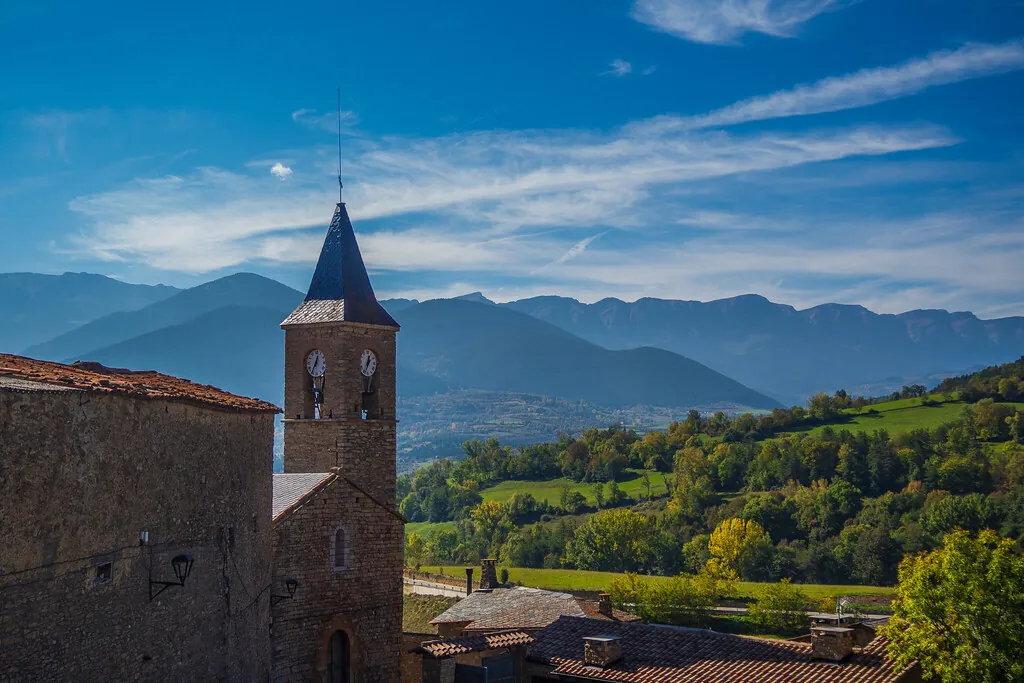
The village’s main historic building is the church of Sant Martí, of Romanesque origin and likely built in the Middle Ages. It retains the defining features of small mountain churches in the Cerdanya: a simple layout, a semicircular apse and thick stone walls with very little decoration.
Its single-bell gable captures that sense of restraint. There are no major later additions or dramatic renovations, and the building has remained relatively austere, blending naturally into the fabric of the village.
Around the church lies the oldest part of Isòvol. Streets are narrow and short, lined with old stone doorways and wooden balconies. In several houses, it is still possible to recognise spaces once used as haylofts or stables. Dry-stone walls between homes and kitchen gardens hint at how closely domestic life and agriculture were once intertwined. The boundary between house and farmland was never sharply defined.
From certain points in the village, especially towards the south, the view opens out across the Cerdanya valley floor. On clear days, the long silhouette of the Cadí-Moixeró mountain range appears in the distance, closing off the horizon. There is no marked viewpoint. A short walk along the paths leading out of the village is enough to find these perspectives.
Walking the rural paths
The surrounding area preserves a network of old routes that once linked the different villages of the valley, long before modern roads concentrated traffic elsewhere. Some sections follow historic mule tracks.
Walking these paths brings scattered structures into view: barns, animal enclosures and small stone walls marking out plots of land. Many are still in use or have been adapted over time, giving the landscape a sense of continuity that feels unforced. There are no interpretive panels or signposted itineraries. Instead, it is a matter of moving through a landscape that is still actively worked.
These routes also reveal how the local economy was organised. Livestock grazed in the flatter meadows, while slightly higher ground was covered by woodland that traditionally provided timber and firewood.
Moving through the Cerdanya
From Isòvol, paths connect with other nearby villages across the valley. One commonly followed route heads towards Bellver de Cerdanya, crossing meadows and small wooded areas. These are not demanding mountain hikes but gentle routes, closer to long walks than to serious trekking.
Seasonal rhythms shape how the area is used. In winter, much of the activity in the wider region turns towards the ski resorts of the Cerdanya and Berguedà. In summer, the valley lends itself more to walking or cycling along secondary tracks.
Nearby forests also attract those who head out in search of wild mushrooms when the season arrives. In this part of the region, ceps and níscalos are among the varieties that appear. As in many parts of Catalonia, mushroom picking is regulated in various areas, so it is worth checking local rules beforehand.
Food and local life
The traditional cooking of the Cerdanya remains closely tied to simple, filling ingredients. One of the dishes most often associated with the area is trinxat, made with potato, cabbage and pork, and especially common during the colder months. Cured meats and locally produced cheeses also form part of the everyday food culture.
Isòvol itself is small, and commercial activity is limited. For shopping or a wider choice of places to eat, people usually head to other towns in the valley.
Local celebrations follow a modest, community rhythm. The festival linked to Sant Martí brings together residents and families who maintain ties to the village, even if many now only return at weekends or during holidays. In June, bonfires are still lit on the night of Sant Joan, a tradition observed throughout the Cerdanya to mark the summer solstice.
Getting there
The most direct way to reach the area from Girona is typically by following the N-260 towards the Cerdanya.