Full Article
about Lles de Cerdanya
High-mountain municipality with a Nordic ski resort and beautiful lakes.
Ocultar artículo Leer artículo completo
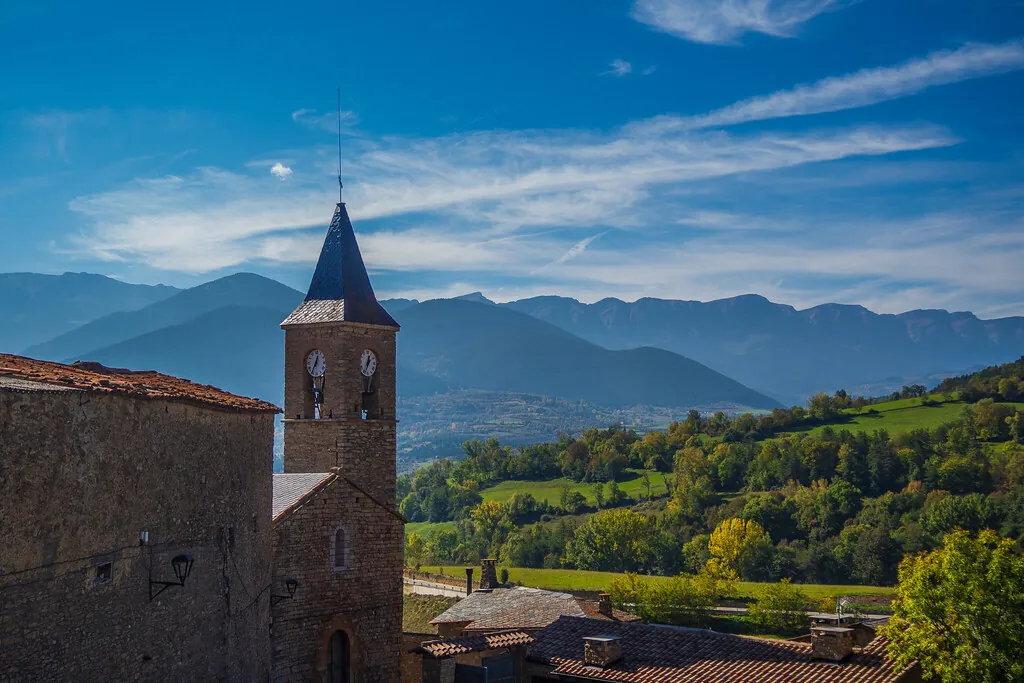
At 1,471 m, the morning light reaches Lles de Cerdanya later than the valley floor. Stand on the church porch at 08:30 in October and you’ll watch the sun climb over the Cadí ridge like a slow-motion spotlight, turning stone roofs from pewter to honey-gold while cows still graze in half-shadow. By 17:00 the same day the same ridge has stolen the light back; villagers retreat indoors before the BBC Six O’Clock News has started. Altitude doesn’t just shape the weather here, it dictates the daily rhythm.
Stone, Slate and Silence
The village proper is a scatter of hamlets—Aristot, Aíns, Talló—linked by single-track roads so quiet that grass grows down the middle. Houses are built from whatever the mountain delivered: dark schist walls two feet thick, timber balconies painted ox-blood red, hand-made tiles that ring like bells when hail hits. Most dwellings date from the 17th and 18th centuries, enlarged piecemeal as families and livestock expanded. Look for the carved dates above doorways—1693 on a lintel in Aíns, 1742 beside a bread-oven in Talló—proof that Britain’s civil wars were already history when these roofs first kept out the snow.
The population hovers around 268, roughly the same as a single London Underground carriage at rush hour, except here everyone knows whose tractor is misfiring. English voices stand out; the handful of British second-home owners tends to visit outside school holidays, swapping damp Norfolk winters for February’s Nordic ski tracks. They arrive with snow chains in the boot and a Tesco cool-box of bacon, because the local shops close for siesta at 13:00 and don’t sell rashers.
A Church, Two Chapels and a View that Beats Television
Sant Martí de Lles, the 12th-century parish church, sits on a grassy knoll that doubles as the village social centre. Inside, the air smells of candle wax and centuries of wood-smoke; the only decoration is a Romanesque arch crudely carved with what might be grapes, or possibly trout—opinion divides. Services are held twice a month, but the door is unlocked. Visitors leave 50-cent coins in an ashtray for the electric heater; if the bulb has blown, bring a torch.
From the churchyard you can pick out two smaller Romanesque chapels. Sant Jaume lies 40 minutes’ walk west across hay meadows, its doorway framed by wild thyme. Sant Pere del Burgal requires a stiffer climb through oak and scots pine, but delivers a picnic table positioned for serious ridge-gazing. On clear days the view stretches 70 km south to the plains of Lleida; night skies are dark-sky reserve quality, the Milky Way bright enough to cast shadows. One Yorkshire astronomer brings his Dobsonian telescope every August and claims the seeing rivals Northumberland’s Kielder.
Snow-shoes, Skis and the Occasional Cow
Lles is the starting point for 36 km of machine-groomed Nordic tracks that fan out across the plateau. A day pass costs €16, half the price of a single ride on the London Eye, and you rarely queue. The red-loop climbs gently to the Refuge de Prat Llong, a stone bothy where you can boil a kettle on a wood-burning stove; the black-loop drops into the neighbouring valley and back, burning enough calories to justify supper. Classic skis are rented at the tiny office beside the car park—€14 a day, cash only, boots from size 28 upwards, so bring your own if you’re below a UK 8.
When snow is thin, the same trails become bridleways. Way-markers show yellow-and-white stripes for short circuits, red-and-white for day hikes into Cadí-Moixeró Natural Park. Spring arrives late: daffodils in May, wild orchids in June. By July the high pastures smell of oregano and warm pine, and marmots whistle warnings from granite boulders. The GR-150 long-distance footpath skirts the village; follow it east for three hours and you reach the stone labyrinth of Rocaviva, a 2017 land-art project that looks like Gaudí sketched Stonehenge after too much rioja. Children love it; signal is non-existent, so they have to talk instead.
Eating: What to Expect when you’re Expecting a Pub
There is no pub. The only bar opens at 07:00 for coffee and brandy, serves croissant and tomato-rubbed toast, then shuts at 22:00 sharp. Brits craving ale should head 23 km downhill to Puigcerdà’s micro-brewery ‘Rosita’, where a 4.2 % golden ale slips down easily and the menu lists fish-and-chips written in Comic Sans—don’t let the font put you off, the batter is proper.
In Lles itself you self-cater. The village shop in Aristot stocks UHT milk, tinned tuna and rubbery but edible Manchego. For anything green or fresh, drive to Supermercat Pujol in Puigcerdà before you head up the mountain. Local restaurants within 30 minutes include El Recó de l’Avi, where lamb is grilled over oak and the chips arrive in a miniature frying basket. Vegetarians get trinxat—cabbage, potato and bacon hashed together like Catalan bubble-and-squeak—just ask them to hold the bacon. Prices run €14–18 for a main, wine included, cheaper than a motorway service lasagne on the M6.
Getting Lost (and Found)
Barcelona and Toulouse airports sit an almost equal 160 km away; the Spanish side is cheaper for hire-car fuel and tolls. From Barcelona take the AP-7, peel off at junction 4 for the C-16 mountain motorway, then the N-260 towards Puigcerdà. The final 20 km climbs 900 m through hairpins; in winter carry chains, and don’t trust the weather app—cloud can drop faster than you can say “contingency fund”. Girona is nearer (130 km) but involves smaller roads; allow three hours if it’s snowing.
There is no railway. Buses from Barcelona stop in Puigcerdà at 18:00; miss one and you’re spending the night. Taxi onward costs €35 pre-booked, more if you wing it. Once installed you can survive without a car: taxis will fetch groceries, and ski buses run twice daily in season, but expect to pay. Mobile coverage is patchy—Vodafone works on the church porch, EE prefers the meadow behind the school. Download offline maps and stash a paper one; batteries die faster in cold.
The Downsides (Let’s be Honest)
August is mayhem without the noise. Barcelona families book cottages months ahead; availability shrinks to zero, prices double. The village fountain becomes a kiddie paddling pool, and the silence that sells Lles in winter evaporates. Winter itself brings short days—sunset before 17:30—and if the snow machines break you’ll be hiking for bread. Spring can rain for a week straight; paths turn to chocolate mousse and the cows trudge past your window smelling distinctly agricultural. And remember: nightlife ends where the generator hum stops. Bring cards, whisky and friends, or you’ll be asleep by ten.
Last Light
Book a clear February evening and climb the meadow behind Sant Martí half an hour before dusk. The Pyrenean chain glows rose, then lavender, then bruise-blue. Head-torches flicker on as villagers lead horses to barns; wood-smoke threads between roofs. Somewhere down-valley a dog barks once. The temperature drops two degrees a minute; retreat inside, latch the wooden shutter, feed the fire. You are 1,471 m closer to the sky than sea-level Britain, and the altitude has reset your clock to mountain time. When the northbound flight path rumbles silently overhead at 38,000 ft you’ll feel, perhaps smugly, that the view is better from down here.