Full Article
about Prats i Sansor
Small municipality in the Segre valley; residential tourism and nature
Hide article Read full article
Where the Cerdanya plain meets the Cadí
Prats i Sansor sits at the northern edge of the Cerdanya plain, a handful of settlements where the flatlands begin to buckle into the first folds of the Cadí range. The geography is administrative as much as physical: the modern municipality stitches together two old villages, Prats and Sansor, whose stone churches still mark separate centres. Life here is organised by altitude, just over 1,100 metres, and by the demands of a landscape that is farmed and forested in equal measure.
Two villages, two parishes
The union of Prats and Sansor is a modern convenience. For centuries, they functioned as distinct parishes, each with its own church and community.
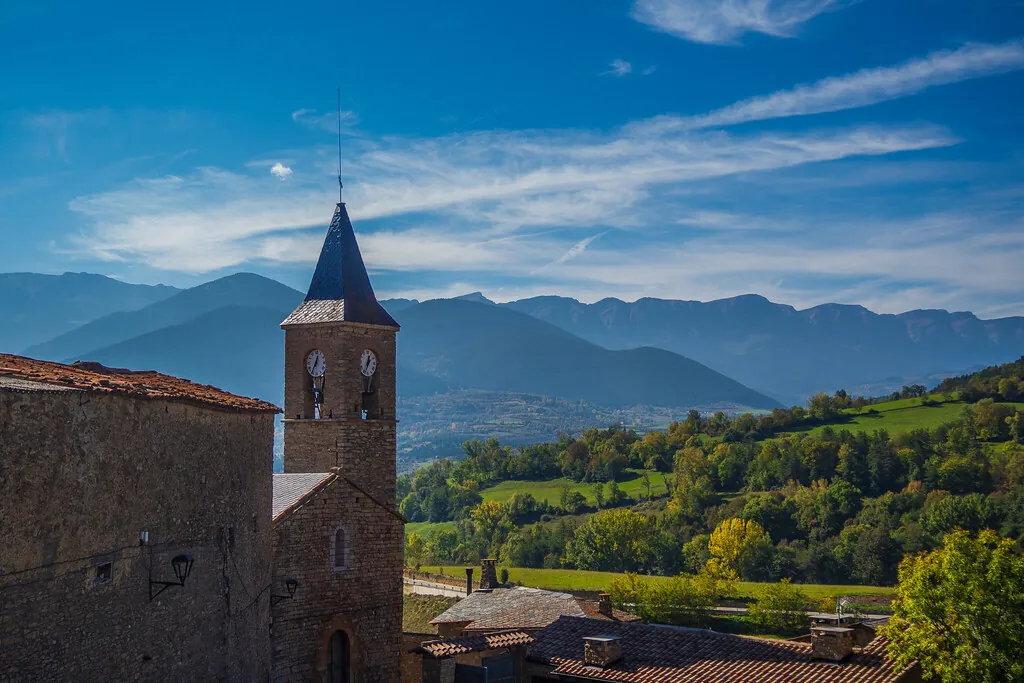
In Prats, the church of Sant Martí occupies a slight rise. Its structure is Romanesque in origin, a common base in the Cerdanya, though modified over time. You can see it in the proportions of the nave and the cut of some stone around the apse. The bell tower, visible from the fields, served as much as a landmark for farmers as a call to mass.
Sansor’s church, dedicated to Sant Climent, is smaller and plainer. Its thick walls and single nave follow a Pyrenean vernacular that prioritised solidity over ornament. These buildings were never meant to be grand. Their significance lies in their continuity, marking the same points in the landscape for eight hundred years.
The logic of the masía
The space between the two villages is defined by working farmland and isolated masías. These traditional stone farmhouses are not scenic set pieces; they are the architectural blueprint of pre-industrial Pyrenean life. Living quarters, stables, and hayloves were combined under one long, sloping roof to conserve heat and streamline the work of the seasons.
Walking the agricultural tracks that link them, you see the logic of the place. Arched doorways were built for carts, not aesthetics. The orientation of a barn door considers the prevailing wind, not the view. Some masías stand abandoned, their roof timbers sagging, while others are clearly maintained, with wood smoke curling from their chimneys on cold mornings.
From meadows to forest
The cultivated land gives way abruptly to woodland. Black pine takes over on north-facing slopes, while Scots pine appears on sunnier ground. In between, clearings hold mountain meadows that bloom with gentians and narcissus in late spring.
The wildlife is what you would expect: roe deer at the forest edge at dawn, the occasional wild boar rooting at dusk, and ever-present birds of prey riding the thermals above the valley. In winter, when snow settles deeply, these same forest tracks become routes for snowshoes or quiet walks. The landscape doesn’t change its function, only its texture.
Walking the cadence of the land
There are no waymarked grand routes here. Instead, a network of rural paths connects Prats to Sansor and weaves past the outlying farms. The most straightforward walk is to follow this loop between the two villages, which takes little more than an hour at a slow pace.
The Cadí range forms a constant southern horizon. You don’t walk into it from here; you walk with it in view. For longer excursions into the foothills, carrying a map or a GPS track is advisable, as paths can fade into grazing land.
A seasonal rhythm
Prats i Sansor has no ski lifts, but several Cerdanya resorts are a short drive away. This proximity means some houses become seasonal residences in winter, a modern echo of transhumance. The contrast is sharp once the snow melts and the pace reverts to the slow meter of agriculture—the cutting of hay, the movement of cattle.
The villages themselves hold little to “see” in a conventional sense. A visit here is about absorbing the layout of a working mountain landscape. Come prepared with supplies from Bellver or Puigcerdà, and wear footwear suited to farm tracks and forest paths. The reward is a clear sense of how this corner of the Cerdanya has been lived in, and continues to be.