Full Article
about Prullans
Known as the Cerdanya lookout; dolmens and family tourism
Hide article Read full article
A Village Between Valley and Mountain
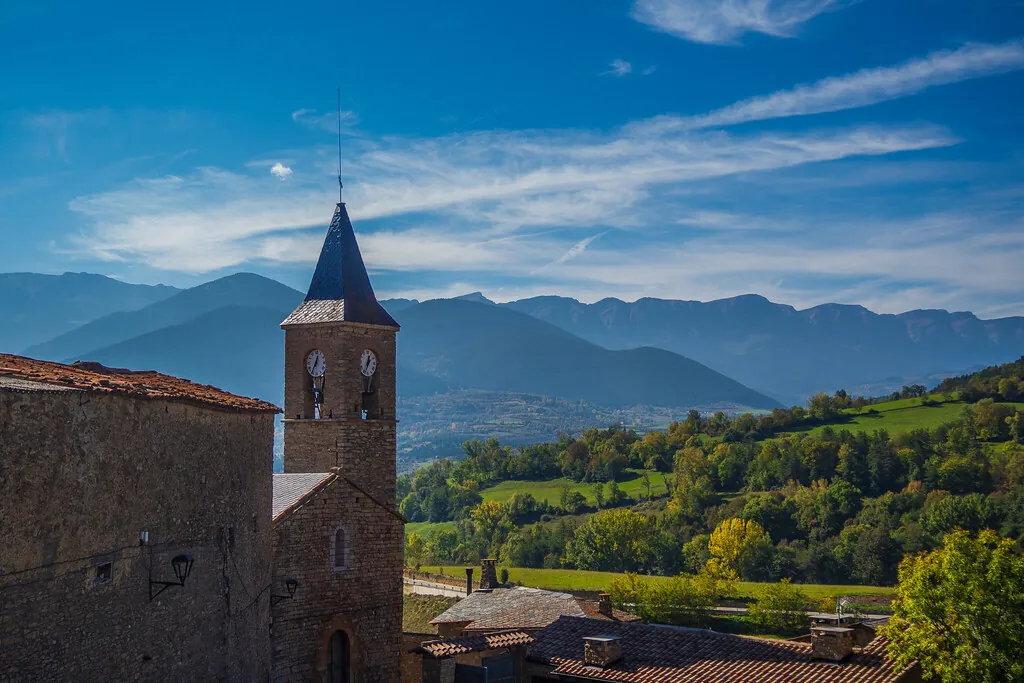
Tourism in Prullans begins with its setting. The village stands on the southern side of La Cerdanya, at around 1,100 metres above sea level. It occupies a slope that opens towards the valley, with the Cadí massif directly opposite. That position explains much of its layout: scattered houses, meadows around them and paths that descend towards the floor of the Cerdanya plain, one of the few broad depressions within the Pyrenees.
La Cerdanya is unusual in this mountain range. While much of the Pyrenees is defined by narrow valleys and steep terrain, here the land opens out into a wide plain. Prullans sits above it, neither high in the mountains nor on the valley floor, but in a middle ground that links the two.
For centuries the local economy revolved around livestock and small-scale mountain crops. The landscape surrounding the village, with its meadows, dry-stone walls and Scots pine woods, is not simply scenic. It reflects long, continuous use of the land. Fields were cleared, boundaries marked and slopes managed over generations. Even today that rural structure remains visible in the patterns of pasture and woodland.
From many points in the upper streets, the horizon is dominated by the long limestone wall of the Cadí‑Moixeró. This mountain range forms a constant reference across this part of the comarca, or county. Its presence shapes both the views and the sense of scale. The contrast between the open plain below and the abrupt rise of the Cadí defines the rhythm of the landscape.
Prullans is part of a network of small settlements that organise La Cerdanya. It has never been an isolated village. Historically it was linked to the routes that connected the plain with Pyrenean passes and with hamlets on the slopes of the Cadí. The relationship between valley floor and mountain continues to structure daily life in the area.
The Village and Sant Esteve
The village centre preserves features typical of rural architecture in La Cerdanya. Stone houses line narrow streets, with sloping roofs designed to shed winter snow. Many façades include wooden balconies oriented towards the sun. Large entrance doorways and interior courtyards reveal their original agricultural use, when homes were closely tied to barns and storage spaces.
At the centre stands the church of Sant Esteve. Its origins are usually placed in the Romanesque period, probably around the 12th century, although later alterations have modified the building. The structure is simple, in keeping with rural parish churches in this part of Catalonia. Its importance lies less in size than in what it suggests: a stable community established on this hillside since the Middle Ages.
A walk through Prullans does not take long. The village has no grand squares or monumental buildings. It is better understood as a collection of houses adapted to the terrain. Attention naturally turns to details. Carefully laid stone walls, old wooden doors and slate roofs all speak of practical construction shaped by climate and available materials.
From several points within the built-up area, the view opens across the plain of La Cerdanya. There is no formal viewpoint, yet the edges of the village act as natural balconies. From there the valley stretches towards Bellver and, further on, to the line of mountains that marks the border between Catalonia and France. The sense of breadth contrasts with the closeness of the hillside streets.
Paths, Slopes and the Wider Landscape
Tracks and footpaths begin just outside the village. These agricultural routes cross meadows and small wooded areas. They were traditionally used for farm work and still connect isolated farmhouses and neighbouring settlements.
Some itineraries climb towards the first foothills of the Cadí‑Moixeró. This is not yet high mountain terrain, but the ground gains height quickly. As the ascent continues, the views over the valley widen. The changing perspective makes clear how Prullans occupies a transitional space between plain and range.
Signposting is not always consistent. Anyone planning to explore beyond the immediate surroundings is advised to carry a map or a downloaded track. The paths themselves reflect their working origins rather than being designed as formal walking routes.
La Cerdanya is also known among cyclists for the relatively gentle relief on the valley floor. From Prullans it is possible to head out by bike towards nearby villages without major climbs. Some stretches, however, follow roads with traffic and narrow verges, so conditions vary depending on the route chosen. The broader geography, with its wide plain framed by mountains, shapes both cycling and walking in the area.
Practical Notes and Seasons
Prullans is small and can be explored on foot in a short time. A brief stroll through its streets offers a clear sense of its character, yet it is worth setting aside time for the paths that leave the village. Within minutes the setting becomes entirely rural, with open fields and the backdrop of the Cadí.
Winter is usually cold, with frequent frosts. The altitude and exposure to the mountains make low temperatures a regular feature of the season. Roofs and building techniques reflect the need to withstand snow.
Clear days in autumn and spring often provide the best views of the Cadí and the plain of La Cerdanya. Light and visibility at these times highlight the contrast between the limestone ridge and the open valley below. Seasonal change is part of the experience here, as it has long been part of agricultural life.
Prullans does not rely on major monuments or large-scale attractions. Its appeal lies in its position on the slope, its relationship with the Cadí‑Moixeró and its place within the wider structure of La Cerdanya. The village makes sense when seen as part of that landscape, shaped over centuries by movement between valley and mountain.