Full Article
about Puigcerdà
Historic capital of Cerdanya; a commercial and tourist hub with an iconic lake
Hide article Read full article
The lake in the centre of Puigcerdà is a medieval piece of engineering. It was dug to guarantee irrigation for the plain of La Cerdanya, and its geometric shape still reflects that practical origin. The town grew around this artificial basin, becoming the capital of the comarca at 1,200 metres above sea level. Here, the wide plain meets the first slopes of the Pyrenees.
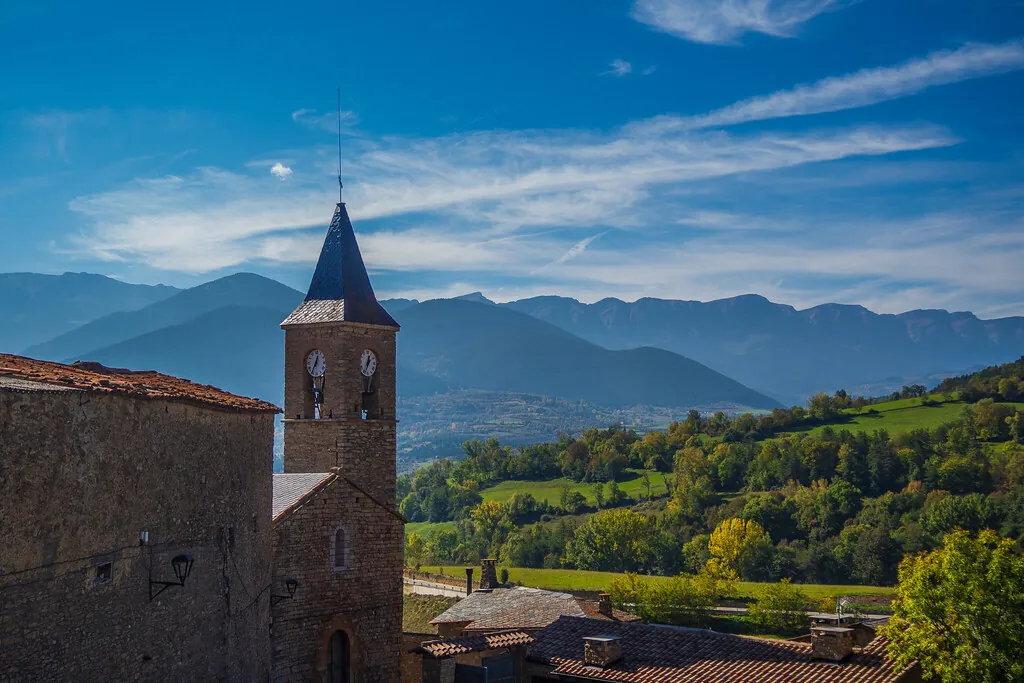
From the tower of Santa María, the only part of the old church that survived destruction, you can see across the rooftops to Bourg‑Madame in France. The border was fixed by the Treaty of the Pyrenees in 1659. Before that, La Cerdanya functioned as a continuous territory for centuries, with its villages oriented towards the valley, not a political line.
A medieval grid and a market square
The historic centre retains a clear medieval layout. Straight streets converge on the arcaded main square, which has held the market since the 12th century. Alfonso I founded Puigcerdà as a royal town at the end of that century.
The town hall, with its clock tower, has presided over the square since the early modern period. Nearby stands the former convent of Santo Domingo, established by the Dominicans in the late 13th century. Inside, fragments of mural painting have been uncovered from beneath layers of whitewash. They are not extensive, but they signal the town’s significance in the 14th century.
Textile production, especially wool, relied on the waters of the Segre and employed much of the population. Medieval records also mention a hospital for the poor and travellers, the precursor to today’s regional hospital. The building has changed, but its purpose has not. Winter in La Cerdanya is cold, and fog can settle for days.
Livestock fairs and transatlantic tombs
Puigcerdà’s calendar still revolves around traditional livestock fairs. The main one is in November, historically tied to the trade in animals and Pyrenean produce. Summer brings other fairs and historical re‑enactments to the streets.
Local food follows the seasons. Trinxat, a dish of cabbage, potato and bacon, is common in winter. On the night of Sant Joan, bonfires and firecrackers fill the town, as they do across Catalonia.
A walk to the upper part of town leads to the cemetery. Several 19th‑century family pantheons stand out, built by ceretans who emigrated to the Americas—often to Cuba—and returned with money for monumental tombs. Near the edge of the old quarter, an obelisk commemorates the defenders of the town during the Carlist episode of 1873, a reminder of the area’s strategic past.
Walking the lake and the river
The path around the estany is short and used daily by residents. Plane trees and poplars line it, offering shade in summer. The lake is fed by a historic canal that diverts water from the Segre.
Beyond Schierbeck Park, an early 20th‑century garden, a path begins that follows the river towards Bourg‑Madame. It is flat and straightforward, popular for walking or cycling.
For longer routes, the Camí dels Bons Homes (GR‑107) crosses the comarca. This trail is associated with the Cathars who crossed the Pyrenees. It passes through Puigcerdà and continues towards Bellver de Cerdanya on a mix of forest tracks and narrower paths.
Practical notes
The centre is easily walked. Cars are usually left near the lake or on wider peripheral streets.
When open, the tower of Santa María serves as a viewpoint. The climb clarifies the geography: the broad valley, the course of the Segre, and the urban continuity towards France.
Behind the main square is the covered market, active in the mornings. You will find local products like aged mountain cheeses, tupí fermented in earthenware, cured pork meats, and savoury cocas that change with the season.
In the evening, activity moves from the lakeside promenade back to the centre. Puigcerdà keeps the rhythm of a border town, Catalan in language and custom, with France just a short walk away. In La Cerdanya, that blend is part of the landscape.