Full Article
about Riu de Cerdanya
Small mountain municipality; gateway to the Cadí-Moixeró natural park
Hide article Read full article
Morning light over a very small village
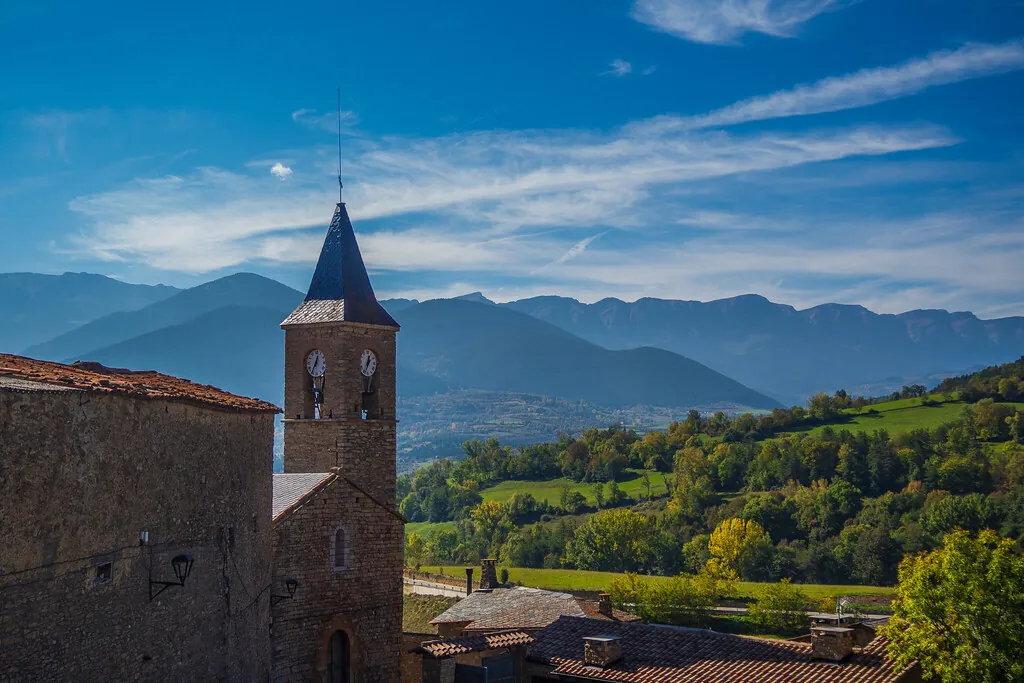
By mid-morning, once the sun has cleared the ridges of the Cadí, Riu de Cerdanya settles into near silence. The sound that carries most clearly is water from the small river running between meadows, along with the occasional thud of a wooden door. Light here tends to be crisp and sharply defined. It falls across stone and slate façades and picks out every crack left by long winters.
The village is tiny, with barely around a hundred residents. It feels less like a place shaped for visitors and more like a cluster of homes that has simply grown over time. Houses gather along a handful of short streets, with vegetable plots and grazing land pressed right up against the edge of the settlement. In many yards, stacks of neatly piled firewood are still a common sight, a practical detail that makes sense in this part of the Cerdanya when January arrives.
A hillside setting facing the Cadí
Riu de Cerdanya is its own municipality, set on the sunny side of the valley. Across from it rises the long limestone wall of the Cadí, which forms a clear southern boundary to the view. From the higher streets, that mountain line dominates the horizon. To the north, the land opens out into the wide plain of the Cerdanya, where fields shift in colour as the seasons change.
The village can be walked in a short time. Twenty minutes is enough to cover most of its streets, yet the appeal lies in small details rather than distance. There are stone doorways darkened by age, former animal pens now absorbed into homes, and the occasional wooden bench where the winter sun falls directly at midday.
At one of the central points stands the church of Sant Joan Baptista. It is modest in size and decoration. Thick walls and visible repairs say more about continuous use than about architectural ambition.
Paths leading out into open land
Beyond the last house, tracks and footpaths spread out into the surrounding landscape. They connect with the typical patchwork of the Cerdanya: open meadows, small areas of pine woodland, and cooler corners where beech trees appear.
Many of these routes have been used for generations. They linked nearby villages or gave access to grazing land. Signposting is not always clear, though the paths themselves are usually easy to follow and the terrain remains quite open. Walking here is straightforward, particularly in spring and autumn when temperatures are milder and the air often feels especially clean after cold nights.
Early starts sometimes bring a glimpse of birds of prey riding the currents that rise from the valley. Along the edges of woodland, traces of animals are not unusual. Footprints in damp ground or flattened grass between shrubs hint at their presence, even if sightings require patience.
A landscape shaped by the seasons
The Cerdanya has strongly defined seasons, and that is immediately visible around Riu. Each part of the year leaves a distinct mark on the fields and forests.
Spring fills the meadows with small flowers, and for a few weeks the green becomes especially intense. Summer brings bright, dry days. Afternoons stretch out as the light slowly lowers towards the Cadí.
Autumn tends to be short but noticeable in nearby woodland, where yellows and ochres appear before the first frosts arrive. Winter covers the village with snow on some days each season. It does not always remain on the ground for long, yet when it coincides with clear skies, a deep quiet settles across the whole valley.
In colder months, road conditions can change. Night-time frost sometimes leaves ice on shaded sections, so it is worth checking conditions before heading up.
Easy outings from the village
Short walks begin directly from Riu de Cerdanya. Paths lead out towards meadows and woodland edges without much need for planning. These are gentle routes, suited to unhurried walking and simply observing the surroundings rather than covering long distances.
For those looking to explore further, the village can serve as a starting point for visiting other settlements on the sunny side of the valley or heading closer to the higher areas of the Cadí. In winter, ski resorts in the region are within a reasonable driving distance, something that forms part of the wider pattern of travel in the Cerdanya.
A slower pace of life
Riu de Cerdanya has no major attractions or constant tourist activity. It is a small place where life follows a slower rhythm, shaped by the seasons and by work in the surrounding meadows.
That pace is part of its character. A visit works best without urgency: park, walk through the streets, then follow one of the paths that drift out towards the valley. At certain times of day, especially early morning or late afternoon, the dominant impressions are simple ones. Water moving, a light breeze through grass, and very little else competing for attention. In a setting like this, that quiet says enough.