Full Article
about Passanant i Belltall
Municipality in Baixa Segarra with scattered farmsteads and castle ruins amid cereal fields.
Hide article Read full article
A high plateau in northern Conca de Barberà
To understand Passanant i Belltall, look at a map of the Conca de Barberà. The municipality sits on a plateau around 700 metres high, where the land flattens into broad cereal fields. The population is just under 150, spread across several small settlements. There is no single town centre; the place is defined by the distance between its villages and the wide, open sky.
Life here has been organised around agriculture for centuries. You see it in the grid of fields, the vineyards, and the patches of holm oak and pine forest on the less workable ground. The light and colour change sharply with the seasons: the muted greys of winter, the green flush of spring along the tracks, and the dry, golden glare of the cereal fields in summer.
This isn’t a place built for tourism. The rhythm is still set by farming and the routines of a small, dispersed community.
Belltall and Passanant: two villages, one municipality
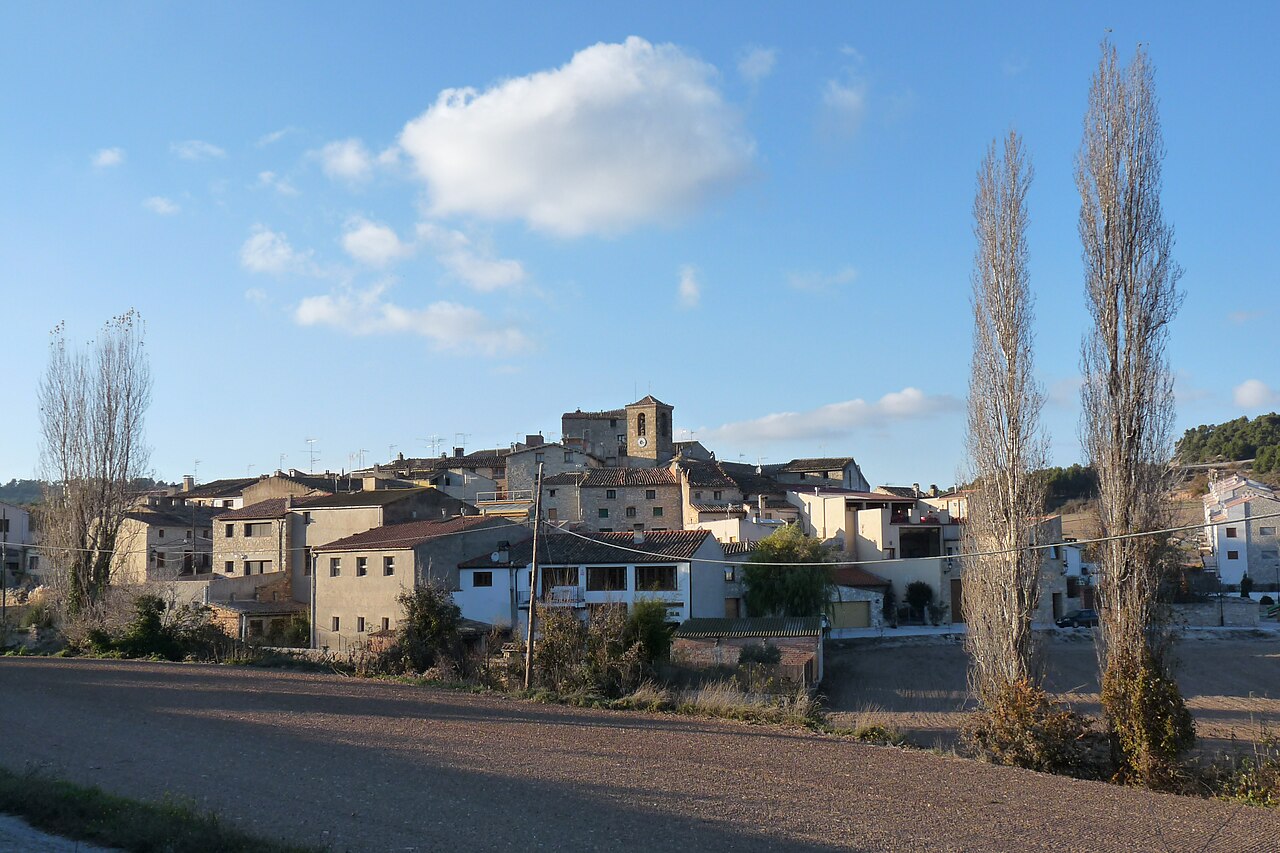
Belltall follows a low ridge. Its houses gather around the parish church of Sant Miquel, a building with medieval foundations altered over time. The streets are narrow and slope gently. From the higher points, the view is of a geometric landscape—a division of farmland and woodland laid out by generations of work.
A few kilometres away, Passanant is similarly scaled. The church of Sant Pere hints at a medieval past, though the structure you see now is the result of later modifications. A short walk covers the village: stone houses with tile roofs, simple doorways, and the occasional former barn or storage room built into the fabric of a home. The interest is in this ensemble—the quiet streets, the building stone, the proximity to the fields—not in any single monument.
Walking between the two villages is straightforward, following rural paths used to access farmland. They aren’t always waymarked, but their purpose is clear.
On foot and by car
The best way to grasp the layout of Passanant i Belltall is to walk it. The route between Passanant and Belltall involves gentle slopes. In summer, carry water; stretches of the plateau have little shade.
The municipality also functions as a quiet base for the wider Conca de Barberà. A short drive leads to Montblanc, with its intact medieval walls. The Cistercian monasteries of Poblet and Santes Creus are also within reach, representing the region’s major historical architecture.
Locally, the agricultural output is visible. Wines from the DO Conca de Barberà are common here, alongside olive oils and cured meats. On walks, you’ll pass the functional landscape of haylofts, stone animal pens, and drystone walls—features still in use, not preserved as decoration.
The calendar of a small community
Social life here peaks in summer, when former residents return. Belltall holds its main festival in late September; Passanant’s is usually in August. These are local gatherings, with shared meals and activities organised by villagers themselves.
A few religious celebrations and pilgrimages persist through the year. They are not staged for visitors but serve as points of reunion for the community.
Passanant i Belltall doesn’t offer monuments or curated experiences. What it provides is space: open farmland, stone villages built to a human scale, and a pace that hasn’t been hurried. You come here for the silence and the long sightlines across the plateau.