

Full Article
about Besalú
One of Catalonia’s most important medieval sites, known for its Romanesque bridge and Jewish quarter.
Hide article Read full article
There is a moment, just as you approach the bridge, when the car moves from bright sunlight into the shadow of the arches and the river Fluvià appears far below. That is when Besalú stops being a name on Google Maps and becomes something physical. Perhaps it is the drop in temperature, the smell of water, or simply the feeling that the twenty-first century has been left behind. Whatever the reason, the visit begins there.
The bridge that is more than a bridge
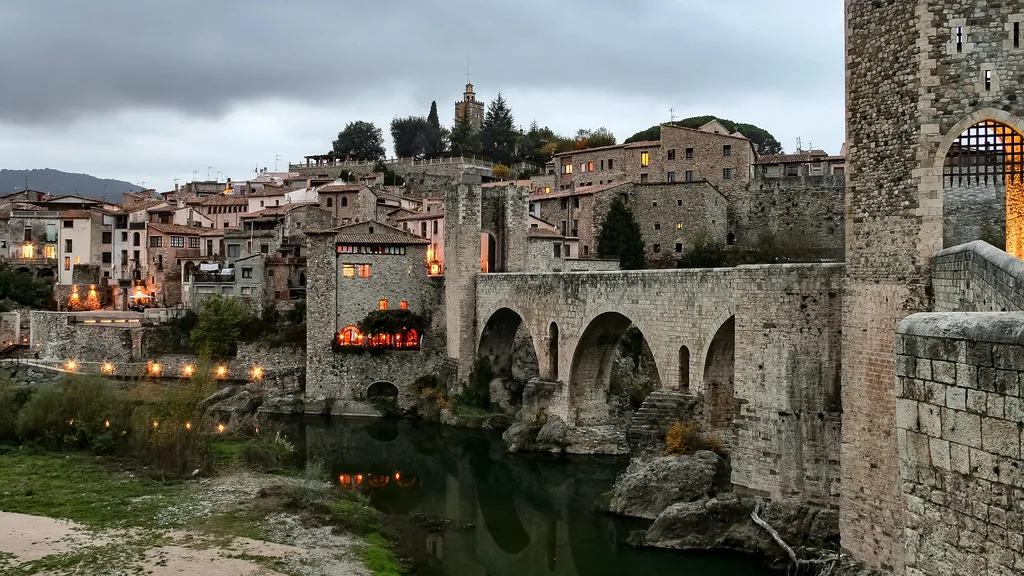
The Pont Vell looks as though it has always been there. In reality, the original structure is medieval, although it has undergone reconstructions and repairs over the centuries. It now stands so neatly framed that it can seem almost theatrical. Walk across it, and you will, probably more than once, and the impression changes. The stones are worn in the exact spots where people have been passing for hundreds of years.
The best thing about the bridge is not the bridge itself, but the view from it.
Upstream, the town presses against the hillside. Downstream, the Fluvià runs between stones with the steady sound of a river that has been doing the same job for centuries.
Take it slowly and it is easy to picture what this once meant. Merchants entering the county. Farmers crossing with carts. Travellers arriving without knowing what they would find on the other side.
The Jewish quarter that is no longer one
The former Jewish quarter of Besalú is still there in layout, even though the community disappeared in the fifteenth century. The streets remain narrow, some houses open onto interior courtyards and, above all, there is the micvé.
This medieval ritual bath was discovered during building works a few decades ago and can now be visited. The entrance is through an unremarkable door. A staircase leads down to a stone chamber where, centuries ago, someone would immerse themselves according to a specific religious ritual.
It is a place that works best with very few people around and a minute of quiet. If you join a guided visit, the explanations usually cover how the Jewish community functioned here before their expulsion.
Walking through this part of town feels different once you know what stood here. The buildings remain, but the life that once filled them belongs to another era.
Eating in Besalú without falling into the trap
Besalú attracts a fair amount of tourism, yet it is still possible to eat as you would in a town from the area if you look carefully.
The basic rule is simple. If you see tables occupied by older locals speaking Catalan and nobody is photographing their food, you are probably on the right track.
One dish that often appears is cargols a la llauna. These are roasted snails cooked with salt, oil and sometimes a touch of spice. The first encounter can feel unusual. After that, they tend to disappear from the plate one by one, almost without noticing.
Another classic is butifarra con mongetes. Grilled sausage served with white beans. It is straightforward food, yet after a walk through the old town it feels exactly right.
If ratafía is on the menu, that is normal. This liqueur made from green walnuts and herbs has been part of the local gastronomic landscape for generations.
When the town fills with cloaks and swords
Once a year Besalú transforms itself with a market set in the Middle Ages. For a few days, craft stalls appear, people walk around in tunics and the squares are noticeably busier.
Residents approach it with a mix of routine acceptance and good-humoured resignation. They know the town will fill up, that there will be photographs taken on every corner and that someone may ask them to pose with a rented medieval costume.
There are also other fairs linked to traditional trades and crafts. These tend to be smaller and much calmer. If your visit coincides with one, it is worth spending some time watching how certain artisans work.
Details that often go unnoticed
In some balconies you will spot dried flores carlinas hanging on the wall. Traditionally they were used as a kind of homemade barometer. When the flower closed, rain was on the way. Today many remain out of habit, although some people still glance at them before hanging out the washing.
Near the centre there is a small museum dedicated to miniatures. The pieces are so tiny that microscopes are needed to see them properly. It is the sort of place people enter without many expectations and leave pleasantly surprised.
Step two streets away from the most obvious routes and Besalú changes quickly. Neighbours walk their dogs. Laundry hangs between buildings. The quiet feels like that of a lived-in town rather than the image framed by the bridge.
A friendly suggestion
Besalú is not a place to stretch into a full-day programme. It works better like a good tapa: compact, intense and best enjoyed without overextending it.
Arrive in the morning, while things are still calm. Leave the car before entering the historic centre and cross the bridge on foot. Wander without rushing. Turn down a side street. Lean over the river. If possible, go down into the micvé.
After that, something to eat or drink in the square, one last walk across the Pont Vell, and that is enough.
Besalú does not need much more. Cross the bridge, spend a few unhurried hours within its stone streets, and then step back into the present the same way you arrived.