
Full Article
about Castellfollit de la Roca
Spectacular village perched on a basalt cliff; one of the smallest and most photogenic.
Hide article Read full article
A Village That Appears All at Once
The first time you see Castellfollit de la Roca, something unexpected happens. You are driving calmly through the La Garrotxa region in Catalonia and, without warning, it is there. It does not gradually come into view or hint at its presence. It simply appears, as if someone had placed an entire village along the edge of a table.
By the time you register what you are looking at, you are already slowing down for a better look.
That, in essence, is tourism in Castellfollit de la Roca: a village set on top of a volcanic cliff that seems far too narrow to hold so many houses, and yet it has done exactly that for centuries.
Built on Solidified Lava
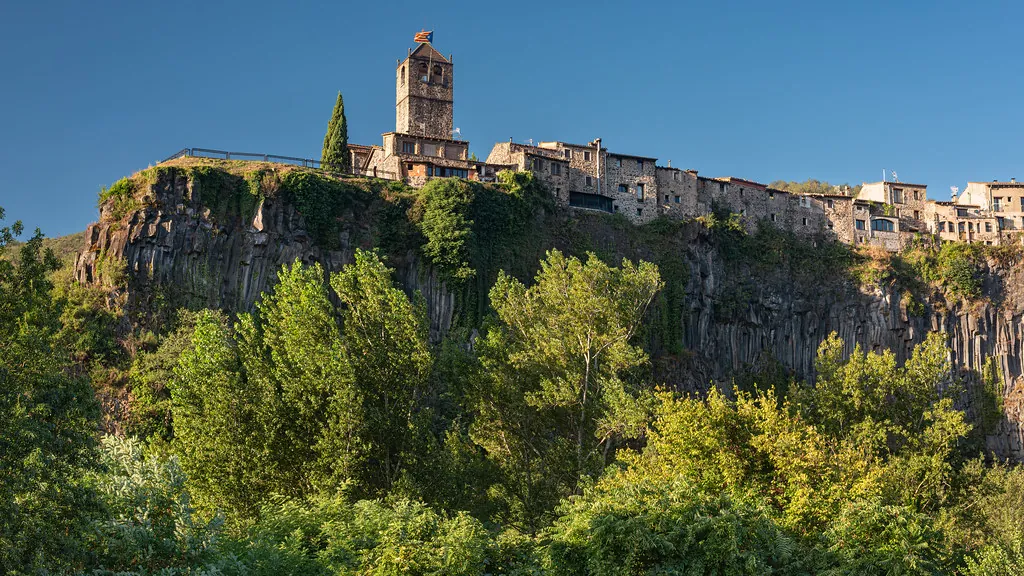
Castellfollit stands at the meeting point of the rivers Fluvià and Toronell, perched on a basalt platform around 50 metres high and almost a kilometre long. This is not a poetic description. The rock beneath the village is solidified lava.
La Garrotxa experienced volcanic activity long ago, and the lava flows eventually formed this dark wall that now supports the settlement. From below, for example from the road bridge, the effect is far more striking than from within the village itself. The basalt columns create a sharply defined vertical face, almost geometric in appearance. It looks less like a natural formation and more like the work of someone with infinite patience.
It is one of those places where people instinctively reach for their phones as soon as they step out of the car.
From above, the drama is subtler. The houses follow the narrow line of the cliff, their backs often aligned with the rock itself. Only when you step to the edge, or view the village from the valley floor, does the full scale of the setting become clear.
Walking the Old Quarter, with the Drop Nearby
Once at the top, Castellfollit is quick to explore. The main street, Carrer Major, runs almost the entire length of the old quarter, tracing the line of the cliff. It is narrow, with cobbled stretches and houses that in places seem to rise directly out of the volcanic stone.
What stands out most is the constant awareness of the edge. You are not perpetually peering over a precipice, but you know it is close. At times it reveals itself between buildings, at others in small informal viewpoints. In certain spots the impression is unmistakable: a couple of steps further and the void begins.
At the far end of the village stands the church of Sant Salvador. Medieval in origin, though altered over time, its silhouette marks the tip of the rocky spur. In many photographs of Castellfollit, it is this outline that defines the scene, a final punctuation at the edge of the basalt platform.
The old quarter does not overwhelm with monuments or museums. Its impact comes from the setting itself. The scale is intimate, the route straightforward, and the cliff always present in the background.
Seeing the Basalt Cliff from Below
Inside the village, you understand its shape. From below, you understand its drama.
Heading down towards the river area or the nearby bridges, the full basalt wall comes into view. This is where the dimensions of the place truly register. The dark columns rise vertically, forming a continuous façade beneath the row of houses. From this angle, the improbability of the settlement becomes even clearer: a line of buildings suspended above a sheer volcanic face in the middle of the valley.
Light changes the atmosphere significantly. Early in the morning or towards the end of the day, the black basalt columns stand out more sharply, their texture and structure clearly defined. At midday, the scene flattens somewhat and loses part of its intensity.
It is worth taking the time to see Castellfollit from both perspectives. From above, you experience the narrowness and proximity to the edge. From below, you grasp the scale of the cliff that makes the village so distinctive.
The Ruta dels Tres Ponts
For those who feel like walking a little further, there is a route known as the Ruta dels Tres Ponts. This trail loops around part of the surrounding area and passes over several bridges across the Fluvià.
It is not a demanding path and serves mainly to offer different angles on Castellfollit and its setting. As you move away, the village appears even more unlikely. The row of houses seems suspended above the dark wall, framed by the wider landscape of the valley.
The route also helps place the settlement within its natural surroundings. Castellfollit is not an isolated curiosity but part of a broader volcanic terrain that defines this corner of Catalonia.
La Garrotxa and Its Volcanic Landscape
Castellfollit is often visited alongside other sites within the Parc Natural de la Zona Volcànica de la Garrotxa, one of the best-known volcanic areas on the Iberian Peninsula. The region contains several ancient volcanoes, including Santa Margarida and Croscat, as well as numerous walking paths through beech woods and across fields of solidified lava.
Many people arrive in Castellfollit after hiking in the area or exploring some of these extinct volcanoes. In that context, the village feels like a natural extension of the landscape: human architecture set directly on top of the geological forces that shaped the region.
Understanding that volcanic past adds another layer to the visit. The basalt cliff is not merely a dramatic backdrop. It is the result of the same processes that created the surrounding cones and lava fields.
How Much Time Do You Need?
Castellfollit de la Roca is small. The old quarter can be covered in a short amount of time. It works better as a stop along the way than as a full-day destination.
A simple approach is enough to appreciate it: park outside the centre, walk through the village to the tip of the cliff near Sant Salvador, pause to look out over the valley, then head down to see the basalt wall from below. With that, the essence of the place becomes clear.
Some villages hold your attention through the number of attractions they offer. Castellfollit functions differently. Everything revolves around that rock. And when you see the houses perched above the dark basalt from the valley floor, the stop makes perfect sense.