Full Article
about La Vall de Bianya
Valley of farmhouses and Romanesque hermitages; quiet, pastoral landscape
Hide article Read full article
A Valley That Wakes Gently
At that hour when mist still hangs low over the meadows, the valley smells of damp grass and wood. The sun takes its time to slip between the rounded hills. When it does, it reaches the fields and scattered masías, the traditional Catalan farmhouses, one by one. Many days of tourism in La Vall de Bianya begin like this, walking along a rural track where hardly a car passes and the only steady sound comes from the river.
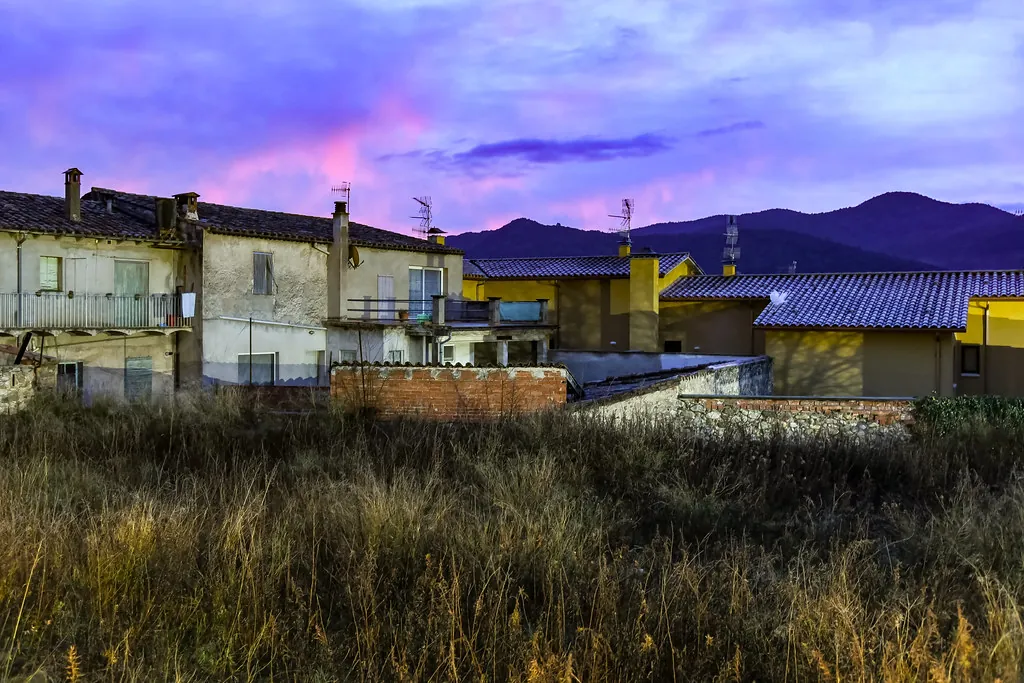
La Vall de Bianya, in the comarca of La Garrotxa in Catalonia, has just over 1,300 residents spread across small settlements and isolated farmhouses. There is no single centre bringing everything together. Houses appear between meadows, behind a stone wall or at the end of a narrow lane. Many still have reddish tiled roofs and wide doorways designed for agricultural life. Some remain working farms, others have been restored while keeping their original structure.
The sense of space is constant. Nothing feels concentrated. Life is dispersed, and so is the experience of visiting.
Fields, Woods and the Serra de Cabrera
The valley opens out between the gentle mountains of La Garrotxa. From many points, the outline of the Serra de Cabrera can be seen in the distance. This is not a dramatic landscape. It unfolds gradually: meadows linking into oak and beech woodland, small vegetable plots close to houses, paths crossing the terrain with little signposting.
Walking here means paying attention at junctions. At times the route runs between two fields and seems to disappear altogether. Then it reappears beside a moss-covered wall or an old stone fountain. These are quiet paths, also used by local residents moving from one settlement to another.
The continuity of the scenery is part of its character. Meadows lead into woodland without clear borders. Agricultural land and forest sit side by side. There are no large landmarks dominating the view, just a steady rhythm of fields and trees, rising gently towards the surrounding hills.
Romanesque Churches in Remote Corners
Among the oldest buildings in the valley are several Romanesque churches scattered across the territory. Sant Martí del Clot and Sant Esteve de Vallfogona are two examples. Like many rural Romanesque churches in Catalonia, they are small constructions built in dark stone, with simple bell towers and minimal decoration.
Many remain closed for much of the year. Even so, walking out to reach them makes sense. They tend to stand in isolated spots, surrounded by fields or woodland, far from any busy road. The approach is often as memorable as the building itself: a narrow path, a stretch of grass, the sound of wind in the trees.
They reflect the medieval organisation of the territory, when small communities were spread across valleys like this one. Today they remain as quiet markers of that past, integrated into the everyday landscape rather than set apart from it.
Seasons That Redefine the Valley
The landscape changes noticeably with the seasons. In spring the meadows turn an intense green and the river carries more water. The valley feels fuller, the grass higher, the air fresher.
Autumn brings ochre tones to the oak woods. Fallen leaves cover the ground and crunch underfoot. The pace seems to slow further as colours soften and daylight shortens.
Winter is damp and quiet. The valley can feel almost suspended, with fewer people on the paths and moisture lingering in the air. In summer there is more movement, especially at weekends, when visitors arrive to walk or cycle through the area.
These seasonal shifts alter the experience without changing the essentials. The same paths, the same farmhouses and the same wooded slopes look different depending on light and temperature.
Moving Through La Vall de Bianya
Getting around by car requires patience. Roads are narrow and curve gently between fields. Traffic is usually light, which is why cyclists use them frequently. Care is needed on stretches without a hard shoulder.
The absence of a single town centre means that moving from one point to another involves crossing open countryside. Distances are not necessarily long, but they feel rural throughout. Even short journeys pass meadows, stone walls and small clusters of houses.
For those exploring on foot, starting early is advisable. By mid to late afternoon the light drops behind the mountains and the valley’s tone changes quickly. Meadows darken, the air cools and sounds carry further. The day closes much as it began, with quiet returning to the foreground.
The River and the Table
The Bianya river runs through the valley at an unhurried pace. In some stretches, fishermen can be seen, always within the permitted seasons. Near the water grow alders and ash trees, and the ground often stays soft underfoot even after dry days.
The river is a constant presence rather than a dramatic feature. It accompanies the paths and fields, sometimes visible, sometimes hidden behind vegetation.
Local cooking remains closely tied to the surrounding countryside. Lamb and beef are common, along with embutidos, the cured sausages typical of Catalonia. When the season arrives, wild mushrooms appear in dishes. Stews are served hot, even when there is a chill in the air outside.
During busier periods there may be no free tables, so it is common to phone ahead before going for lunch. The rhythm of meals follows the rhythm of the valley: simple, linked to the land and shaped by the time of year.
La Vall de Bianya does not revolve around a single attraction or viewpoint. Its appeal lies in continuity. Meadows merging into woodland, Romanesque churches in quiet corners, narrow roads threading between farmhouses. Morning mist and evening cool frame the day. The silence that settles at dusk echoes the stillness of early light, and the valley returns to itself.