Full Article
about Les Preses
Gateway to the volcanic zone from the south; home to the Pedra Tosca park
Hide article Read full article
A Quiet Counterpoint to Olot
Some places feel like the calm residential district of a nearby town. Les Preses has that kind of relationship with Olot. They are only a short drive apart, they share the same volcanic landscape and the same pace of life typical of La Garrotxa, yet the change is noticeable as soon as you arrive. There is less traffic, more open countryside around the houses, and a sense that daily life still revolves largely around the land.
That is essentially what tourism in Les Preses means. There are no headline monuments or grand attractions. Instead, it is about understanding how a small municipality fits into the volcanic setting of La Garrotxa, a comarca in Catalonia known for its distinctive cones and wooded hills.
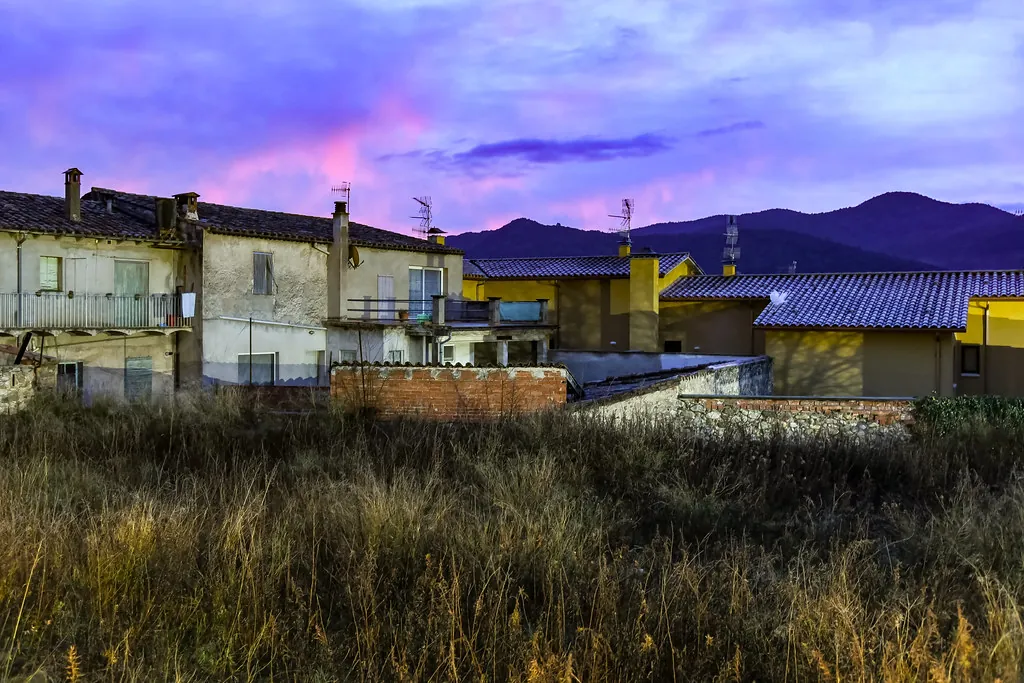
With around two thousand inhabitants and lying at about 474 metres above sea level, Les Preses sits close to one of the best-known landmarks in the area: the volcano of Santa Margarida. Even so, it tends to remain in the background compared with Olot or the most famous volcanoes. Perhaps that is why the atmosphere still feels distinctly local. Cars are parked outside houses, neighbours stop to chat in the square, and fields on the edge of town are still actively worked.
Between Volcanic Cones
The urban centre is compact. Houses built from volcanic stone stand alongside more recent homes, and the streets are short, opening occasionally into small squares where the village seems to pause and breathe. It is not a historic ensemble preserved unchanged. Rather, it is a place that has evolved over time without entirely breaking from what was there before.
From many points in and around the village, the gentle shapes of volcanic cones are visible on the horizon. In La Garrotxa this becomes a constant feature of the landscape. Wherever you look, there is likely to be a rounded, forest-covered hill in view. After walking here for a while, the silhouette becomes familiar and easy to recognise.
Les Preses forms part of the wider Volcanic Zone of La Garrotxa, one of the most distinctive natural areas in Catalonia. The relationship between settlement and landscape is direct. The stone used in older buildings reflects the geological origins of the area, and the agricultural fields spread out between wooded slopes shaped by ancient eruptions.
Sant Martí, the Village Landmark
The parish church of Sant Martí is the clearest architectural reference point within Les Preses. It can be seen from several parts of the village and acts as a natural point of orientation when walking through the streets.
Although the current building has undergone various alterations over time, it retains Romanesque origins. It is not an imposing or monumental church. Its importance lies more in its role within the community than in its scale. For generations, this has been a focal point of village life. On a Sunday morning it is common to see residents talking outside after the service, a simple scene that says much about how the space is still used.
In a place of this size, the parish church is more than a religious building. It marks the centre of social interaction and shared routine, linking present-day life with earlier periods without turning the village into an open-air museum.
Can Xac and the Masía Tradition
On the outskirts of Les Preses stands Can Xac, a space connected to the idea of the traditional Catalan masía. A masía is a rural farmhouse typical of Catalonia, historically linked to agricultural and livestock work. At Can Xac, the focus is on how that work was carried out decades ago.
The activities revolve around farming and animal husbandry in a traditional style. There are usually farm animals on site, and demonstrations related to rural tasks such as bread baked in a traditional oven. The aim is not to create a theme park version of country life, but to show how everyday work once shaped the rhythm of the area.
It does not operate as a permanently open venue. Activities tend to take place at specific times or as organised visits, so it is advisable to check in advance before heading there. In keeping with the overall feel of Les Preses, the experience is closely tied to the agricultural landscape that still surrounds the village.
Walking to Santa Margarida
One of the main advantages of staying in Les Preses is that walking routes begin almost from the edge of the village itself. Several paths connect directly with the Parc Natural de la Zona Volcánica de la Garrotxa, the protected area that encompasses much of the volcanic terrain.
The volcano of Santa Margarida lies relatively close by. Its crater is broad, and at the centre stands a small hermitage that has become one of the most recognisable images of the comarca. Reaching it involves a steady climb. The ascent is not especially long, but it is demanding enough to be taken seriously. Arriving in light footwear and without water can make the slope feel longer than it appears on a map.
Many of the trails also link up with other volcanoes in the area. The network of paths is extensive and signposted in many sections, making it suitable for a longer walk or for exploring by bicycle. From Les Preses, it is easy to spend several hours outdoors without ever needing to use a car.
The appeal here lies in the continuity of the landscape. Fields give way to forest, and forest rises towards the rounded profiles of extinct cones. The volcanic nature of La Garrotxa is not confined to a single viewpoint; it accompanies you along the way.
Local Produce on the Table
La Garrotxa maintains a strong connection with what is grown and raised nearby, and that is still noticeable in Les Preses. Local veal, white beans cultivated near the river Fluvià, and traditional cured sausages appear on many tables.
This is not elaborate gastronomy. The dishes are based on ingredients rather than complex preparation. When you have walked through fields and seen the surrounding pastures, the food makes immediate sense. The landscape and the cuisine are closely linked.
A Calm Base in La Garrotxa
Les Preses works well as a quiet base for exploring the volcanic zone. It is close to Olot and to several well-known points within the natural park, yet it retains the atmosphere of a small village.
Spend a few hours walking along the nearby trails and then return to the centre, and the contrast becomes clear. There are no major attractions drawing crowds, no long queues or headline sights. There are paths, cultivated fields and the ever-present volcanic backdrop that appears again and again on the horizon.
In Les Preses, tourism is less about ticking off landmarks and more about settling into the scale of the place. It is about observing how a small Catalan municipality continues to function within a landscape shaped by ancient eruptions. Sometimes that quieter perspective is reason enough to stop.