Full Article
about Sant Feliu de Pallerols
Town in the Hostoles valley, known for its theatre troupe and Hostoles castle.
Hide article Read full article
Arriving Slowly in Sant Feliu de Pallerols
Tourism in Sant Feliu de Pallerols moves at its own pace. The sensible approach is to leave the car at the edge of the village and continue on foot. The centre is small, and driving in adds little except inconvenience. At weekends, quite a few cyclists pass along the main road, and traffic feels heavier than the map might suggest.
Parking at one of the access points and walking in is the practical choice. Within minutes you are in the middle of the village. The streets are narrow and were never designed for constant vehicle movement.
For anyone arriving to walk or cycle, it helps to check the map beforehand. The surrounding area combines quiet paths with secondary roads that climb more than expected at first glance. Distances and gradients matter here. What looks gentle on paper can feel different on the ground.
Sant Feliu de Pallerols does not present itself as a place of grand sights or big-ticket attractions. Its appeal lies in the way daily life and landscape sit closely together.
A Compact Village Centre
The old quarter is brief. One stroll is enough to take it in.
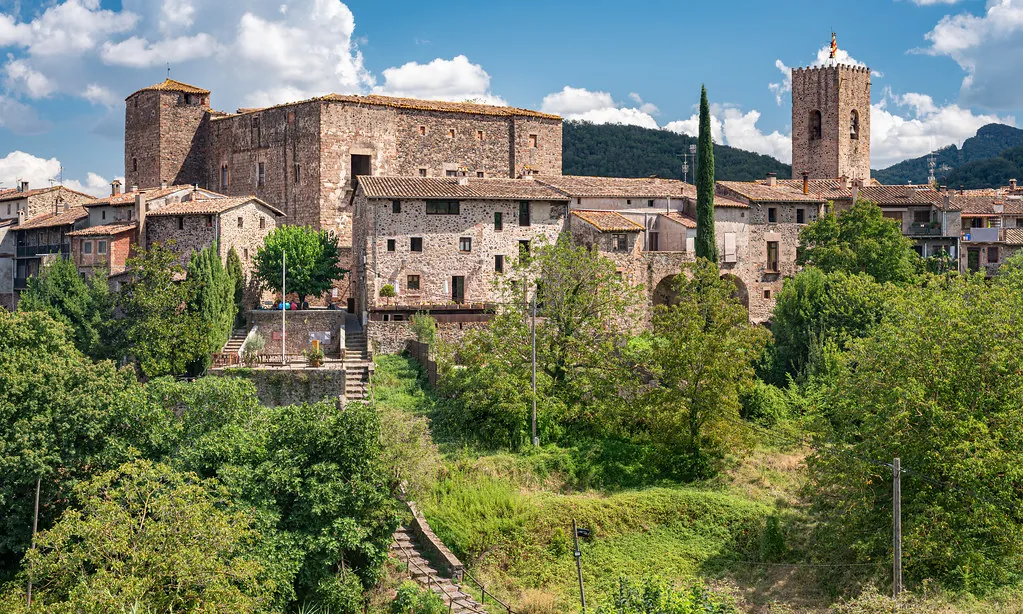
The parish church of Sant Feliu is the most recognisable building from a distance. Parts of it are Romanesque, while other sections were added later. Its bell tower can be seen from several points in the valley, acting as a quiet reference point in the landscape. Inside there is a Baroque altarpiece. It is not a monumental church, yet it fulfils its role within the village setting.
Around it, short streets branch off between modest houses. Some walls are built with volcanic stone, a reminder of the terrain beneath the village. Nothing here aims to impress. This is a lived-in place. People come and go from their homes, children leave bicycles outside, and the occasional workshop opens directly onto the street.
There is no sense of an open-air museum. Sant Feliu de Pallerols functions first as a home for its residents. Visitors pass through the same spaces used for everyday routines.
Between Forests and Volcanic Cones
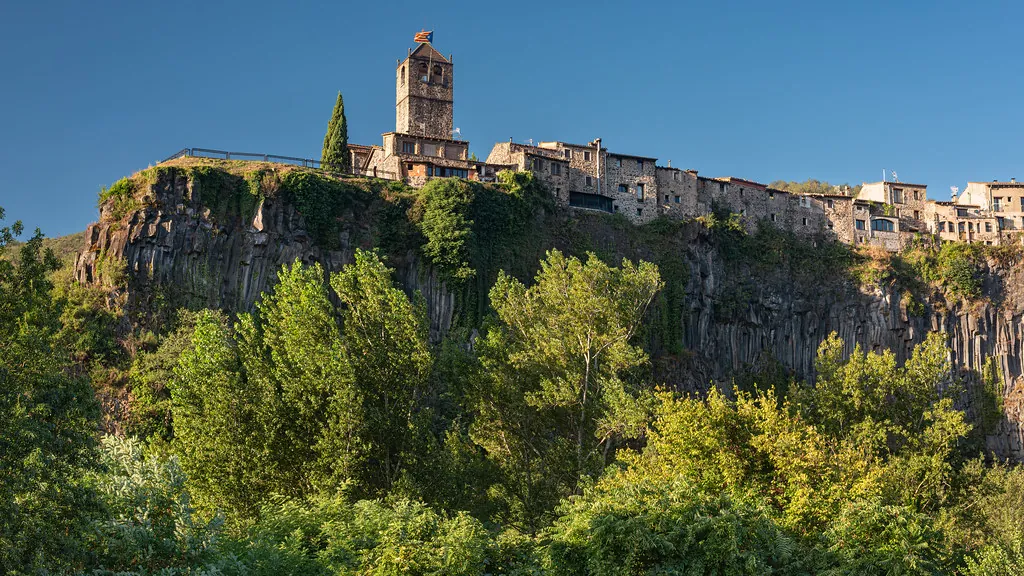
Sant Feliu de Pallerols sits within the volcanic landscape of La Garrotxa, a comarca in Catalonia known for its geological features. Across the region there are dozens of volcanic cones and old lava flows. Here, the terrain shapes the experience more than the built centre does.
Signposted paths leave directly from the village. Some cross woodland and meadows. Others climb towards higher ground near the Collsacabra area. Technical experience is not essential, but it is wise to check distances and elevation gain before setting off.
The countryside is varied without being dramatic. Forests alternate with open stretches, and the sense of elevation changes gradually as you move away from the valley floor. The land determines the rhythm of any outing.
Secondary roads also attract many cyclists. During the week they are generally quiet. At weekends, there is more movement, including motorbikes and cars. Planning around this can make a difference to how peaceful the experience feels.
The focus here is on being outside rather than ticking off sights. The interest lies in walking a marked trail, noticing how the ground shifts underfoot, or following a road as it rises gently towards the surrounding hills.
Straightforward Flavours of La Garrotxa
Food in this part of Catalonia is direct and rooted in local produce. The cooking relies on ingredients from nearby fields and farms, resulting in solid, filling dishes rather than elaborate creations.
Specialities from the wider area include patata de Olot, a local potato preparation, judías ganxet, a variety of white bean prized in Catalan cuisine, and meat from farms within the comarca. The emphasis is on substance and familiarity.
There is nothing especially sophisticated about the typical fare in Sant Feliu de Pallerols. Those looking for something more elaborate often head to other villages in La Garrotxa. Here, meals tend to reflect the everyday character of the place itself.
The connection between land and table is clear. Volcanic soil, agricultural plots and livestock farming all play their part in what ends up on the plate.
Festivities and the Local Calendar
The village calendar is still marked by traditional celebrations. The Festa Major dedicated to Sant Feliu usually brings together several days of music, sardanas and popular events. Sardanas are traditional Catalan circle dances, performed in public squares and accompanied by live music. During the Festa Major, this is when the village feels busiest and parking becomes more difficult.
Other religious celebrations continue to be observed throughout the year, alongside agricultural fairs at different times. These events do not draw large crowds from afar. They are primarily gatherings for neighbours and people from the surrounding area.
The atmosphere during these occasions remains local in character. Rather than large-scale spectacles, they are moments when the community meets in shared spaces.
Outside festival periods, life returns to its usual tempo. Streets are quiet, the church tower watches over the valley, and the paths leading out of the village are once again used mostly by walkers and cyclists.
A clear piece of advice applies: arrive early in the day or come during the week. Walk through the centre, take in the valley views, then head out along one of the marked routes. Anyone searching for major monuments will not find them here. The real interest of Sant Feliu de Pallerols lies in the surrounding landscape and the steady, unhurried way it is lived in.