Full Article
about Sant Jaume de Llierca
Industrial town with a textile past; notable for its chimney and the Fluvià river.
Ocultar artículo Leer artículo completo
The butcher in Sant Jaume de Llierca still weighs botifarra sausages on cast-iron scales that look older than the 870 people on the municipal roll. He wraps them in white paper, not plastic, and if you arrive after 11 a.m. on a Saturday you’ll queue behind grandmothers who pay in coins counted twice. That sequence—scales, paper, coins—tells you most of what you need to know about the place: transactions are slow, seasonal and stubbornly local.
A Parish that Refuses to Perform
Stand in front of the church of Sant Jaume and you’ll search in vain for a souvenir stall. The building is neither pretty nor ugly; it is simply the physical memory of the village, patched in stone whenever history demanded. The bell rings the hour, not the quarter, and on weekdays the doors are locked by 7 p.m. Step inside during Sunday mass and you’ll hear Catalan spoken at auctioneer speed—no slowed-down tourist version—while children fidget in pews their great-grandparents once varnished. Photography is tolerated, flash is not, and the priest still announces deaths before the final hymn. It is religion as social glue, not heritage theatre.
Following Water instead of Waymarks
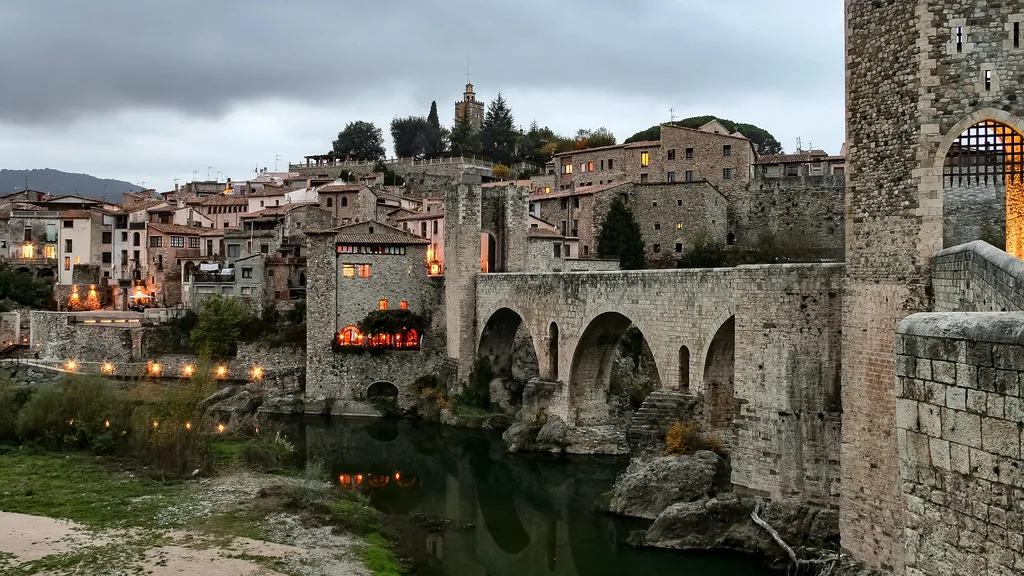
The Llierca River is the only celebrity here. It slips past vegetable plots, under a single-lane concrete bridge, then disappears into reed tunnels loud with frogs. A rudimentary path shadows the east bank for 4 km, starting behind the football pitch where the grass is kept short by grazing horses rather than grounds staff. The route is unsigned; locals call it “el camí del riu” and treat it as a utility corridor for reaching orchards rather than a leisure trail. Expect ankle-deep mud after October rain, waist-high nettles in May and the occasional rusted fridge deposited by a past flood. Yet the water is clean enough for kingfishers, and on still mornings the surface mirrors beech leaves turning copper. Swimming is technically possible in two sluggish pools near the old textile mill, but the current tightens further downstream and underwater reeds can snag ankles. Most people paddle, then retreat to the shade with a packet of those butcher-shop sausages grilled on a disposable barbecue.
The Wrong Sort of Quiet
Visitors arriving without a car discover quickly that Sant Jaume punishes the car-less. The Teisa bus from Girona stops at Argelaguer crossroads, 2 km away, and on Sundays the service is replaced by a single taxi whose driver attends mass until midday. The village itself contains one bar, one bakery that opens three mornings a week, and a chemist that doubles as the post office. Cash is sovereign; the nearest ATM is in Sant Joan les Fonts, 7 km along a lane wide enough for one Seat Ibiza and a flock of geese. Mobile reception drifts in and out like a bored teenager, so download offline maps before you leave the C-66. These are not romantic inconveniences—they are simply the operating system of a place that has never needed to compete.
What Grows Between the Lava and the Lowlands
The northern horizon belongs to the Garrotxa Volcanic Zone. Croscat’s red cone is 18 km away, close enough for half-day excursions but far enough that Sant Jaume avoids coach parties. Instead, the surrounding grid of low dry-stone walls encloses smallholdings growing hazelnuts, leeks and the white beans that end up in escudella stew. Spring arrives late; morning frost can linger until April, and when the tramontana wind blows down from the Pyrenees the temperature drops five degrees in twenty minutes. Autumn is the generous season: wild mushrooms appear along the river, local wineries sell garnatxa for six euros a bottle, and the village fiesta stretches over the last weekend of July when population swells to roughly 1,200 and every household wheels paella pans the diameter of wagon wheels onto the street. Book accommodation early or you’ll sleep in the car park behind the sports pavilion—concrete, flood-lit, free.
Eating (and Failing to Eat) Locally
Gastronomy is a village-level operation. Can Trinxet in neighbouring Montagut offers a three-course menú del dia for €14 mid-week; roast chicken and chips sits beside pig’s trotters with chickpeas, and the house wine arrives in a glass that could double as a tooth-mug. In Sant Jaume itself the sole bar serves toasted ham-and-cheese sandwiches until they run out of bread, usually around 2 p.m. Evening meals require forward planning: figure on driving to Olot for pizza, or self-catering with produce from the Thursday market in Besalú. The payoff is proximity—after dinner you can be back on the river bank listening to owls while city visitors are still hunting for parking in the volcanic park.
When the Weather Closes the Door
Winter strips the place bare. Mist parks itself between the poplars for days, the river swells to a café-au-lait torrent, and the bakery reduces hours to “if the owner’s up”. Roads remain passable but the scenic back-route to Olot narrows into a tunnel of overhanging branches that slap hire-car paintwork like wet laundry. January and February belong to residents; outsiders arrive mainly to walk the Camino de la Garrotxa, a long-distance path that skirts the village and whose waymarks are sometimes obscured by brambles. Carry gaiters and a spare sock pair—river fords are ankle-deep even in dry years.
Leaving Without a Fridge Magnet
Sant Jaume de Llierca will not beg you to stay. It offers no postcard racks, no artisanal soap shops, no sunset viewpoints with railings. What it does provide is a working example of how Catalan farm villages functioned before tourism taught them to curate themselves. If you want a base for volcano-hopping, stay in Olot. If you need sand beaches, drive east to L’Escala. But if you’re curious about how a parish clock, a river and a butcher’s scale can still organise 870 lives, park the car, buy a paper-wrapped sausage, and follow the sound of water until the signal bars disappear.