Full Article
about Santa Pau
Lovely medieval village in the heart of the volcanic zone; famous for its *fesols*.
Hide article Read full article
A small town shaped by history
Santa Pau is the kind of place you spot from the road and think, “we’ll stop on the way back”. When you finally turn off and walk in, it quickly becomes clear that it deserves more than a quick look. The old town has a way of slowing your pace without you quite noticing, as if it still runs to a different rhythm.
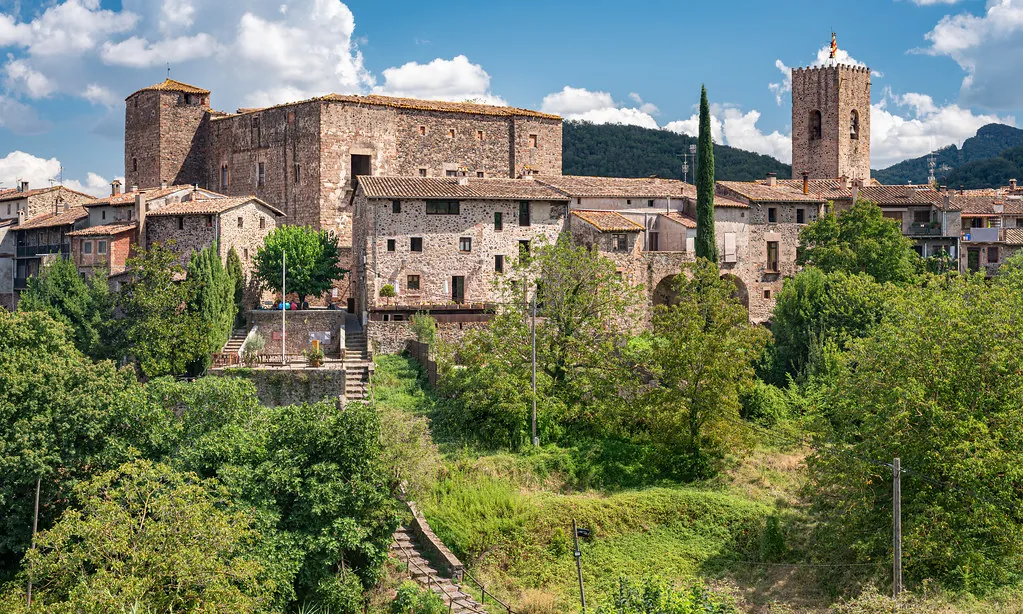
With just over 1,500 inhabitants and set at just under 500 metres above sea level, Santa Pau grew around an old route that once linked Olot with the coast. That strategic position explains the defensive features that still define it today: walls, towers and a castle overlooking the whole settlement. The castle itself cannot be visited freely, as it is privately owned and parts of it have suffered the wear of time. Even so, it continues to dominate the skyline.
The Gothic church of Santa Maria, built between the 13th and 15th centuries, follows a similar line. It is sober rather than ornate, without grand flourishes, yet it carries the quiet authority of a building that has watched generations come and go.
Through the medieval centre
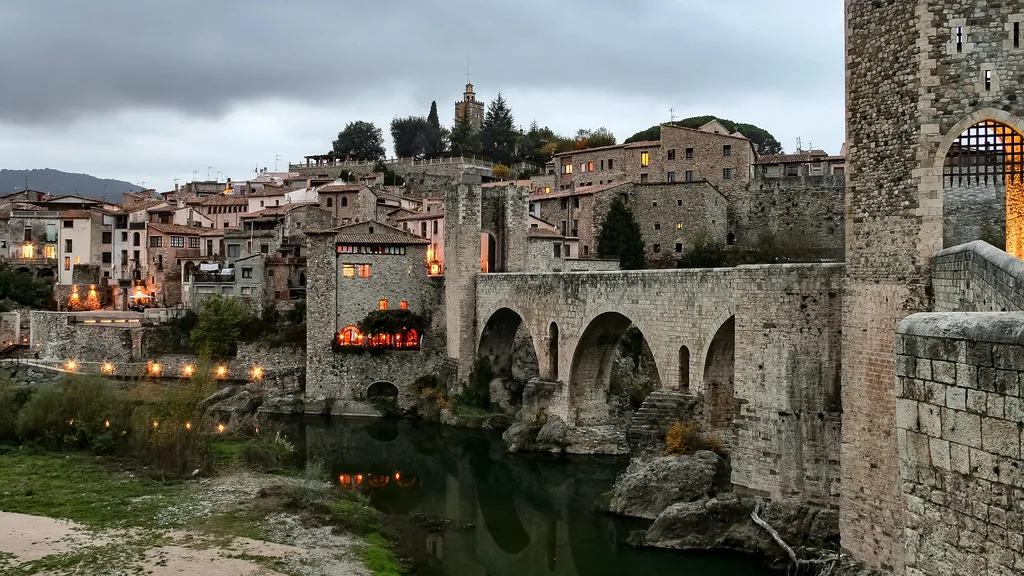
Santa Pau’s historic core is compact, which makes it easy to explore at an unhurried pace. Narrow streets such as Carrer Major lead between solid stone houses, with small passageways that slope down towards the riera, or stream. Much of the construction uses dark volcanic stone typical of La Garrotxa, giving the town a deeper, more muted tone than many other medieval villages in Catalonia.
At the centre lies the arcaded Plaça Major. In the past it hosted markets and fairs, and it remains the focal point of daily life in the old quarter. Arrive early in the morning or towards the end of the afternoon and you are more likely to share the square with local residents than day‑trippers.
One practical tip is to avoid the middle hours of the weekend if possible. Santa Pau appears on many itineraries through La Garrotxa, and the centre fills up quickly at peak times.
Fields of fesol de Santa Pau
Step beyond the medieval streets and the landscape opens into a valley. Here, another defining feature comes into view: the fields of fesol de Santa Pau. These small white beans hold a Protected Designation of Origin status and have been cultivated in this area for centuries.
They are more than a local speciality; they are part of the scenery itself. In season, neat plots surround the village, reinforcing the sense that agriculture remains closely tied to daily life. Traditionally the beans are served with local cured sausages or in simple stews. They are modest dishes on paper, yet often turn out to be the most satisfying meal of the day.
The connection between town and countryside feels direct. From the walls you can see the fields, and from the fields you can look back at the stone silhouette of the castle.
The castle and traces of the past
The castle of Santa Pau stands above the village, integrated into the line of the old walls. Although access is restricted, it is worth walking around its perimeter to see how it fits into the defensive layout.
Within the enclosure, or in buildings linked to the castle, there are usually small exhibition spaces dedicated to local history and archaeological finds from the surrounding area. This is not a large museum with elaborate displays. Instead, it offers context: who controlled these lands, how the territory functioned in the Middle Ages, and how the settlement developed around its fortifications.
The result is a clearer picture of Santa Pau as more than a postcard‑ready old town. Its position on a historic route, its defensive architecture and its agricultural base all played a part in shaping what survives today.
From medieval streets to volcanic trails
One of the most striking aspects of Santa Pau is how quickly the setting changes once you leave the last houses behind. Within minutes on foot, medieval streets give way to paths that cross volcanic terrain.
From here, routes lead to well‑known spots in the Parc Natural de la Zona Volcànica de la Garrotxa, including the volcano of Santa Margarida and the Fageda d’en Jordà. None of these walks require special fitness; they are generally manageable for most visitors.
The crater of the Santa Margarida volcano is perhaps the most eye‑catching feature in the area. It forms a wide green bowl with a small hermitage at its centre. The Fageda d’en Jordà is a beech forest that grew over an ancient lava flow. In autumn it fills with shifting colours, yet even outside that season it stands out. The ground is uneven, marked by gentle rises and dips created by solidified lava beneath the surface.
This entire area forms part of a system with more than forty volcanic cones. Today they are completely inactive, but the relief they left behind continues to define the landscape of the comarca, the local county. The contrast between cultivated fields, medieval stonework and volcanic formations is visible within a relatively small radius.
Eating in step with the landscape
Food in Santa Pau remains closely linked to what is produced nearby. The fesol de Santa Pau appears on many menus, often paired with local cured sausages or traditionally prepared pork. Simple dishes built around potatoes are common, as are seasonal mushrooms and vegetables from surrounding market gardens.
This is not elaborate cuisine, nor does it aim to be. It is cooking rooted in the territory, the sort that feels well suited to a day spent walking among volcanic cones and forest paths.
Santa Pau is not a large town, nor is it packed with spectacular monuments. That may be part of its appeal. The medieval centre, the surrounding fields and the nearby volcanoes fit together in a way that feels coherent. You can walk through the village in a single morning, yet the broader landscape suggests there is more to explore if you decide to stay a while longer.