Full Article
about Tortellà
Town known for making boxwood spoons and chirimías; gateway to the Alta Garrotxa
Hide article Read full article
Early light in La Garrotxa
In the early morning, while there is still moisture on the stone paving, tourism in Tortellà barely registers. A shutter lifts with a sharp clatter, a van rolls slowly across the square, and the smell of toast drifts out from a nearby house. The village wakes up without haste. Walk through at that hour and you may pass almost no one.
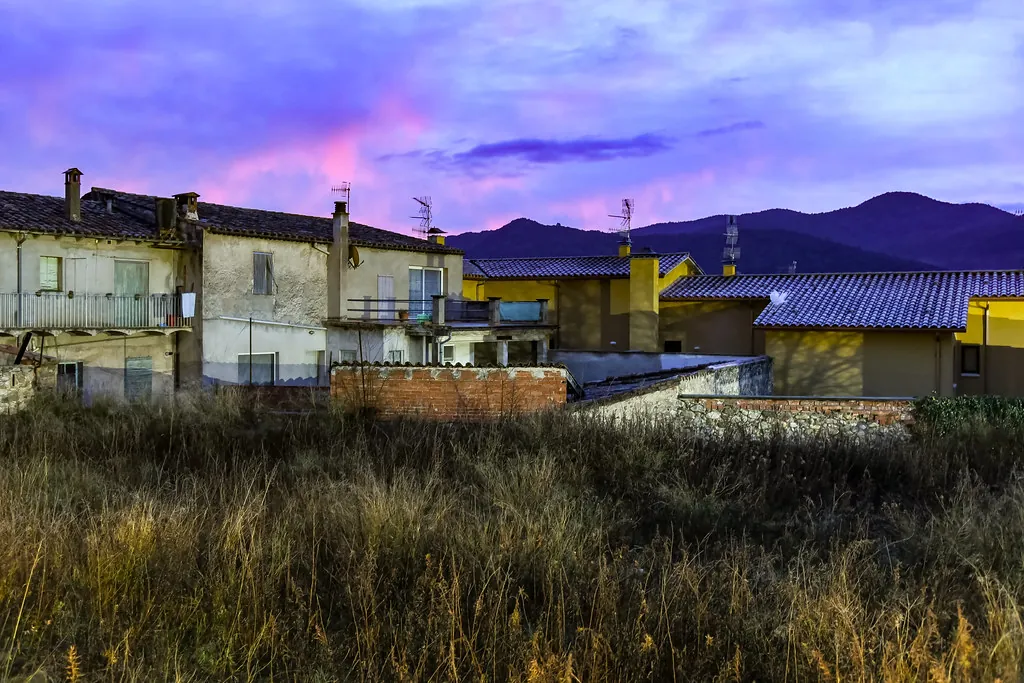
Tortellà sits in La Garrotxa, in Catalonia, although it lies slightly outside the volcanic image that usually defines the comarca. Here the landscape opens towards the valley of the Fluvià river and across fields that have been worked for generations. Fewer than a thousand people live here, around 850, and that scale is immediately clear. The centre can be covered in a matter of minutes. Streets are narrow, and stone façades show the marks of everyday use rather than careful restoration aimed at visitors.
This is not a place that announces itself loudly. Its appeal lies in daily rhythms that continue much as they have for years, shaped by agriculture and proximity to neighbouring villages rather than by large flows of travellers.
Sant Feliu and the shape of the old centre
Walk without a plan and sooner or later the bell tower of Sant Feliu comes into view. It does not dominate the skyline dramatically, yet it helps you find your bearings among the lanes of the old quarter. The church has Romanesque origins, though the current building has undergone several alterations over the centuries, something common in villages across this part of Catalonia.
Around it, iron balconies project over the street, broad doorways open onto cool interiors, and stretches of stone wall shift in colour as the light changes. In the afternoon, when the sun falls at an angle, some façades take on a soft orange tone while the streets remain partly in shadow. It is a good time to wander, following the gentle slopes without any particular destination.
The old centre does not feel arranged for display. Its proportions reflect practical needs rather than design. You notice how close buildings stand to one another, how corners turn tightly, and how the ground underfoot alternates between smoother paving and older stone. Everything seems scaled to everyday life.
A square that still belongs to the village
The main square retains something many small towns have lost: it functions as a square. It is not a backdrop but a place people actually use. There is usually someone crossing with shopping bags, children running off down a side street, or neighbours sitting for a while watching who passes by.
Throughout the year, fairs and gatherings linked to local produce or to the agricultural life of the area are often held here. They are not on the scale of events in some other towns in La Garrotxa, yet they form part of the village calendar and bring noticeable activity on certain weekends. These occasions are woven into local routines rather than staged primarily for outsiders.
Even on quieter days, the square acts as a meeting point. Movement flows through it at different speeds. Some people pass straight across on an errand, others pause to talk. The sense is of continuity rather than spectacle.
Fields instead of volcanoes
Anyone arriving in La Garrotxa expecting volcanoes at every turn might be surprised. In Tortellà the landscape differs from that of Olot or Santa Pau. Fields dominate, interspersed with small wooded areas and rural tracks that thread their way between farms and low stone boundaries.
That does not mean the surroundings are flat. Gentle hills shape the horizon, and there are open views towards the pre-Pyrenees, especially if you follow the secondary roads that link Tortellà with nearby villages such as Sant Jaume de Llierca or Argelaguer. On a bicycle there are a few climbs to tackle, though they tend to be short.
For walkers, paths follow old agricultural routes. The ground shifts between earth, gravel and sections of stone, so comfortable footwear is advisable. These are working landscapes, where fields and farm buildings set the tone. The atmosphere contrasts with the more overtly volcanic areas of the comarca, yet it remains clearly part of La Garrotxa.
The Fluvià valley opens the view and softens the terrain. Rather than dramatic cones, you find cultivated land and a patchwork of textures that change with the seasons. It is a different face of the same region.
A calm base for exploring La Garrotxa
Tortellà lies a short distance from Olot and from the Parc Natural de la Zona Volcànica de la Garrotxa, the protected area that draws many visitors to this corner of Catalonia. From here it is relatively quick to reach well-known spots such as the Fageda d’en Jordà, a beech forest that grows on ancient lava flows, or several of the most visited volcanic cones in the comarca.
For that reason, many travellers choose the village as a quiet base and then head out by car during the day. Public transport in this area does not always link the smaller villages efficiently, so having your own vehicle tends to be the most practical option.
Those who prefer to focus on Tortellà itself may want to avoid the middle hours of summer weekends. It never becomes overwhelmed, but the atmosphere shifts compared with weekday mornings, when the village returns to its usual pace: slow and almost silent.
In between these moments, Tortellà continues as it always has, centred on its square, its church and the fields that surround it. Tourism exists here, yet it rarely takes centre stage. The village keeps its scale and its rhythms, shaped more by the Fluvià valley and local life than by the expectations of visitors.