Full Article
about Aiguaviva
Small rural village near the capital; farmland and quiet, minutes from the airport.
Ocultar artículo Leer artículo completo
The church bell strikes eleven. Nothing happens. No tour groups surge forward, no selfie sticks appear, no souvenir stalls flip open their shutters. In Aiguaviva's single square, the only movement is a farmer loading lettuces into a white van while his dog investigates the church doorway. This is rural Catalonia at its most honest – a place where the rhythm of daily life hasn't been rearranged for visitors.
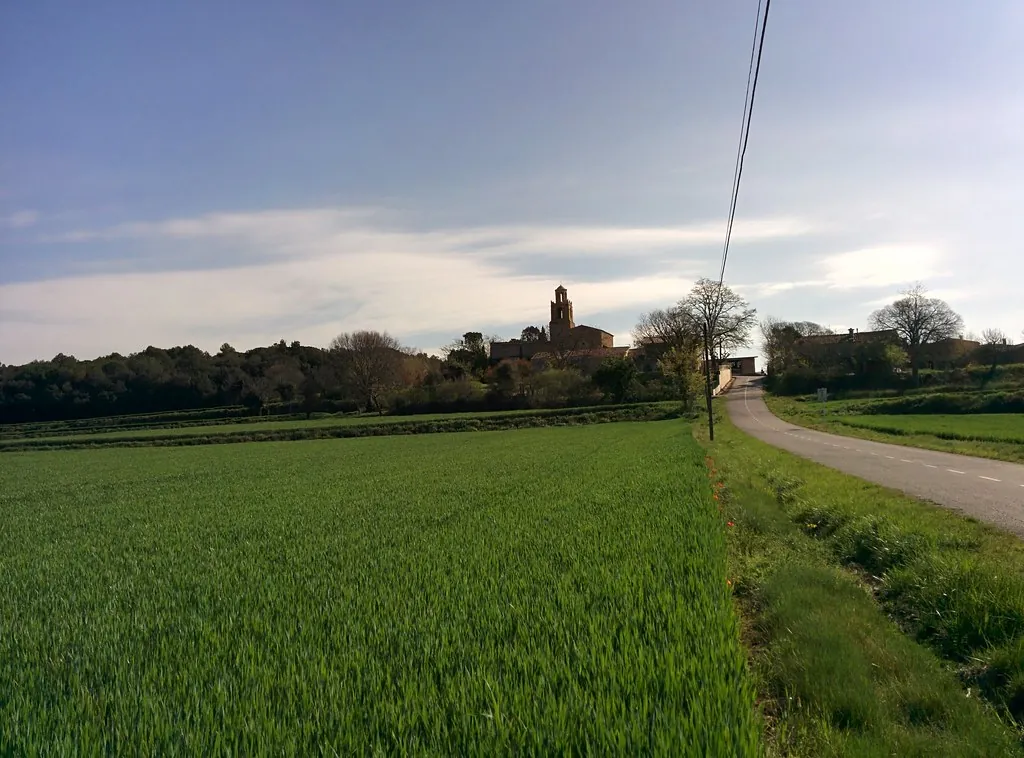
Seventeen kilometres west of the Costa Brava's packed beaches, Aiguaviva sits quietly in the Gironès plain, its 770 residents outnumbered by the surrounding vegetable plots. The name translates literally as "living water", a nod to the irrigation channels that still feed the market gardens supplying Girona's restaurants. Those expecting chocolate-box perfection will find something better: a working village where tractors have right of way and the bakery sells bread, not fridge magnets.
Morning: Following the Irrigation Ditches
The best introduction starts at the concrete wash-house behind the church. Cold water pours constantly from a metal pipe – the same spring that gave the village its name eight centuries ago. Local women once gathered here to scrub sheets; today it's where cyclists fill bottles before heading into the Gavarres hills. Follow the dirt track running parallel to the main irrigation ditch, past plastic-clad tomato tunnels and neat rows of chard. Within ten minutes you're among scattered farmhouses, their stone walls the colour of burnt cream, terracotta roofs sagging like well-worn hats.
The landscape unfolds gently. To the east, the Pyrenees float on the horizon when the tramontana wind clears the air. Southwards, Girona's cathedral spire pokes above a ridge – close enough that locals commute daily, far enough that Aiguaviva keeps its weekday hush. The walking here requires no specialist gear: flat paths connect hamlets every kilometre or so, perfect for that Catalan speciality of the paseo – walking nowhere in particular with purpose.
Afternoon: When the Village Wakes Up
Return around 1pm and something shifts. The bar on the corner suddenly fills with men in berets arguing over football. Can General, the only restaurant, starts grilling onions over vine cuttings. Their fixed-price menu del dia costs €14 and arrives with the efficiency born from feeding hungry agricultural workers: grilled pork escalope, chips cooked in olive oil, and a carafe of local red that punches above its weight. Vegetarians get escalivada – smoky aubergine and peppers that taste of woodsmoke and patience.
The church of Sant Andreu unlocks at 3pm. Inside, the temperature drops ten degrees. Medieval fresco fragments survive on one wall, their blues and ochres damaged by 19th-century whitewash. The altar frontal shows Saint Andrew tied to his X-shaped cross with rope that looks suspiciously like the ones still used in nearby fields. Ten minutes suffices, but linger longer and you'll notice details: the confessional carved with wheat sheaves, the ex-voto paintings of tractor accidents avoided.
Evening: Where the Pavement Ends
Aiguaviva's edges dissolve into countryside with no ceremony. One moment you're on Carrer Major with its 1970s lampposts; next you're on a farm track between artichoke fields. This is the village's greatest asset – the immediate transition from settlement to landscape. Walk north for twenty minutes and you reach the Gavarres proper, where cork oak forests replace vegetables and wild boar root among last autumn's leaves. The GR-92 long-distance footpath passes nearby, linking the Mediterranean with the French border, though most hikers stick to the coast and miss this inland section entirely.
Cyclists know better. Professional teams use these roads for winter training; amateurs follow their routes past stone boundary walls where lichens create maps of slow time. The climb to neighbouring Quart gains 200 metres over five kilometres – enough to raise a sweat, gentle enough for touring bikes. From the top, the plain spreads like a green counterpane stitched with irrigation channels that catch afternoon light like silver wire.
The Honest Truth
This isn't a destination for tick-box tourism. There's no castle, no museum, no viewpoint with Instagram frame. Accommodation options total two: a three-room guesthouse above the bakery and a converted farmhouse outside the village proper. Both book up during the Festa Major in late August, when returning emigrants swell numbers and everyone eats fideuà – short pasta cooked paella-style with crayfish – in the square.
Sunday presents challenges. The bakery shuts, the bakery shuts, the bakery shuts (worth repeating as visitors always forget). The single cash machine ran out of money during the 2008 crisis and nobody saw reason to refill it. And without wheels, you're essentially stranded – buses run four times daily on weekdays, twice on Saturday, never on Sunday. Taxis from Girona cost €25 each way, more than some flights from Stansted.
Yet these inconveniences preserve the very atmosphere that brings people back. In an region where coastal villages morph into caricatures of themselves, Aiguaviva remains stubbornly ordinary. The bakery opens at 6am to serve farmers, not tourists. The bar screens third-division football matches because that's what locals support. When the vegetable auction concludes each afternoon, prices are written in chalk because everyone knows the farmer personally.
Come in late April when artichokes reach peak season and the village hosts a small food fair. Or visit October for the mushroom harvest, when locals emerge from forests with baskets of rovellons that taste of pine and rain. Avoid August if you value anonymity – everyone's related to everyone else, and by weekend's end you'll be greeting strangers like old friends.
The real discovery here isn't architectural or scenic. It's temporal – the rare sensation of experiencing a Mediterranean village operating on its own terms, indifferent to whether you stay or leave. The bell strikes twelve. Still nothing happens, and that's precisely the point.