Full Article
about Cassà de la Selva
Cork-producing town with modernist heritage; crossroads between Girona and the coast
Hide article Read full article
A Town Shaped by Cork
Any look at tourism in Cassà de la Selva has to begin with cork. The scent rises after rain, when the soil is damp and the air carries a faint trace of bark. For more than a century, cork set the pace of life here. From the mid-19th century onwards, many local families made their living by stripping cork oak trees in Les Gavarres and turning the bark into bottle stoppers.
Some factories have disappeared over time. Even so, the mark of that trade remains clear. Industrial sheds, warehouses and former workers’ houses still stand as reminders of an economy tied closely to the forest. Cassà grew on the back of that work and on what the nearby massif could provide.
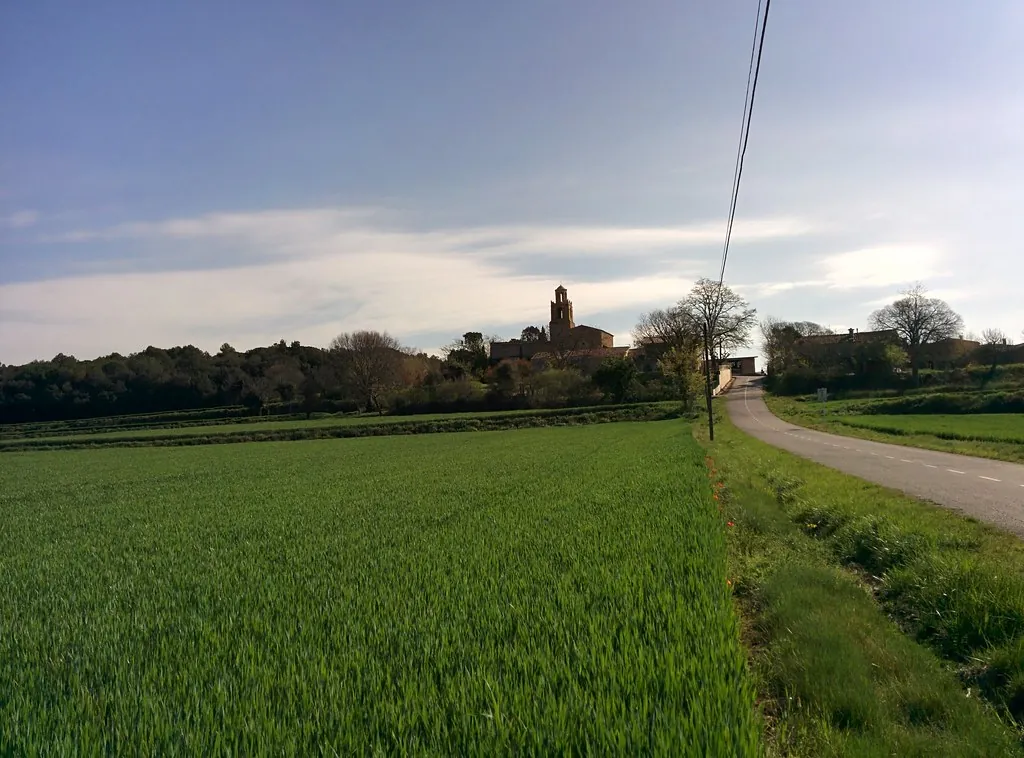
Les Gavarres begin just beyond the last houses. They are not simply a green backdrop but a presence that has shaped both the local economy and the way the land is used. The massif is granitic and relatively dry, conditions in which the cork oak thrives. Its bark can be removed without harming the tree, a process traditionally carried out every few years. That cycle created very specific working seasons that structured the year.
Lorries loaded with thick slabs of cork can still be seen on local roads. Stacked one on top of another, they resemble oversized slices of dark bread. The Ruta del Suro, or Cork Route, starts at the old Carrilet station. It explains how the work evolved from entirely manual processes to more mechanised ones, while the underlying logic of forest management remained largely the same.
The railway arrived at the end of the 19th century. It was used to transport cork towards Girona and the coast. The line no longer exists, but its route survives as a greenway. Many people now cycle along it to move between towns in the Gironès area.
Sant Martí and the Shape of the Town
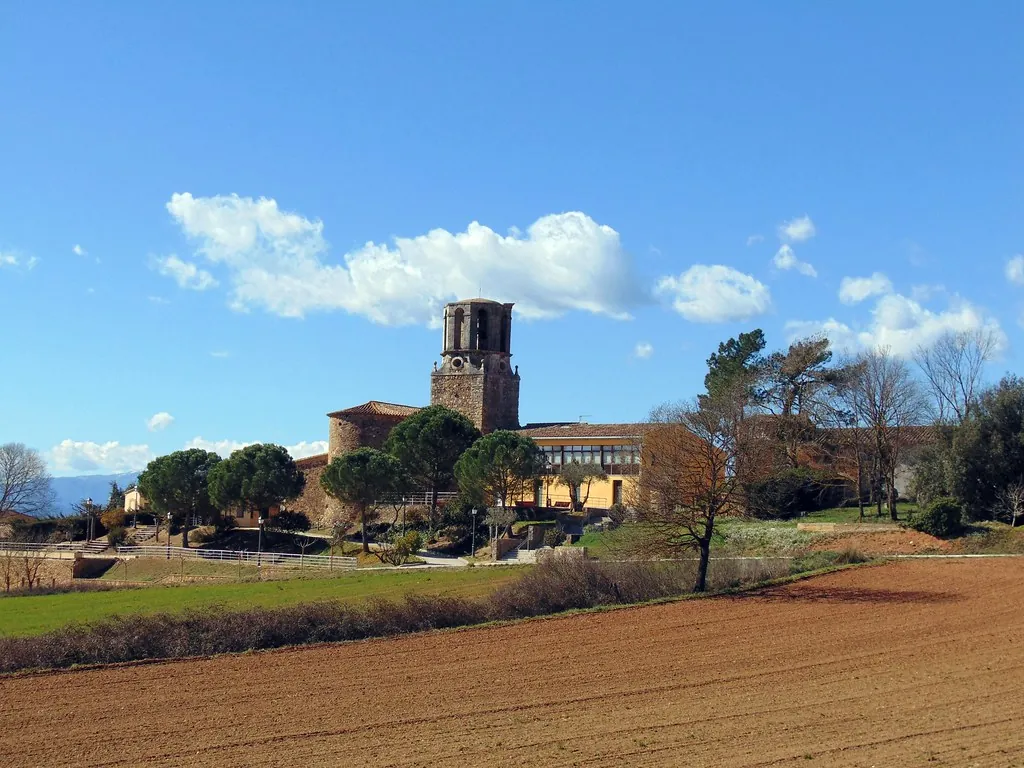
At the heart of the historic centre stands the church of Sant Martí. The present building dates from the 16th century, with later alterations. A Gothic apse has survived with relatively few changes, despite Baroque reforms elsewhere in the structure.
Stone from the same nearby massif was used in its construction. The nave is low and somewhat dark, giving the impression of a building designed to endure rather than to dazzle. It feels solid, closely tied to its surroundings.
From the bell tower, the setting becomes clear. The line of the former railway can be traced across the landscape. More recent industrial estates appear on one side, and beyond them stretches the continuous cork oak forest of Les Gavarres.
In a nearby square, the town’s giants are kept: en Roc and la Roseta. These large festival figures have taken part in local celebrations for decades. Made of papier-mâché and noticeably heavy, they are part of a long Catalan tradition in which oversized characters parade during festivities. La Roseta’s hairstyle reflects a fashion from the late 1960s, a small detail that anchors the figures in a specific moment of the town’s recent past.
Music in Everyday Life
Cassà de la Selva has a longstanding relationship with Catalan popular music. Several well-known cobles have come from here. A cobla is a traditional ensemble that performs the sardana, a circle dance closely associated with Catalan identity.
The town also hosts Càntut, a gathering dedicated to traditional song. Performers who work with oral repertoire usually take part. Some concerts are held in buildings in the centre, while others move outdoors into public spaces.
One of the venues is Can Trinxeria. This house dates back to the 17th century and now functions as a cultural facility. Its rooms and courtyards are used for concerts and meetings, providing a link between the town’s architectural heritage and its musical life.
Towards the end of summer, a musical evening often takes over the streets. Amateur musicians walk through different parts of the old town, stopping to play sardanas, habaneras or other popular songs. There is no single stage. The music shifts from corner to corner as the performers move.
As dusk falls on an ordinary day, music can surface again in daily life. Some cobles rehearse in premises in the centre. Anyone lingering nearby may catch the sound drifting into the street.
Cork as Living Memory
Cork is not only an economic memory but also a cultural one. A fair dedicated to the stopper and to cork itself brings together tools and old production methods. Visitors can sometimes watch the manual cutting and shaping of a stopper.
The gesture is quick and precise. It has changed very little since the end of the 19th century.
The fair coincides with other activities in the centre. Some recreate the old market that the town held from medieval times. Cassà lay on an inland route connecting the coast with Girona. Local trade did not depend solely on cork. Wine, charcoal and game also passed through the area, adding to the commercial movement that sustained the town.
Finding Your Way Around
Cassà de la Selva lies a few kilometres from Girona and is connected by a regional road. Buses also link it with the provincial capital. The historic centre can be explored easily on foot.
From the church, Carrer Major slopes down towards the Glorieta park. This is one of the spaces most used by residents, a place for meeting and spending time outdoors.
Those curious about more recent art can head to the Parc de les Arts. Several sculptures are installed in the open air there. The selection changes over time as new pieces are added.
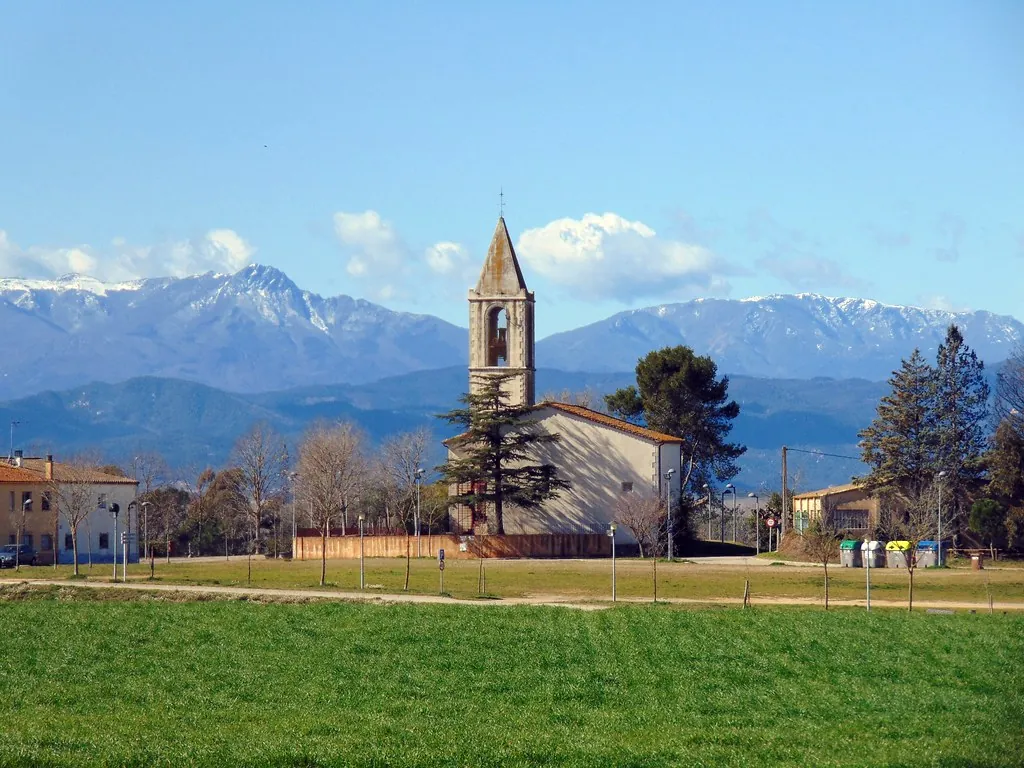
For walking, many locals make their way up to the paths of Les Gavarres. One access point begins near the cemetery. The path climbs gently towards the area around Puig del Castell. On clear days, the Pyrenees can be seen from certain spots along the way.
On a Sunday morning, Can Trinxeria may be open. At times, local residents are present to explain its history. They also describe how cork was used for years as insulation in barns and agricultural buildings, a practical application that extended beyond the stopper industry.
Cassà de la Selva does not present itself through grand monuments. Its identity emerges instead from the forest at its edge, the stone of Sant Martí, the echo of rehearsals in the evening and the persistent presence of cork in both memory and landscape.