Full Article
about Celrà
Industrial and residential municipality near Girona; preserves mining and modernist heritage
Hide article Read full article
Where the Plain Opens
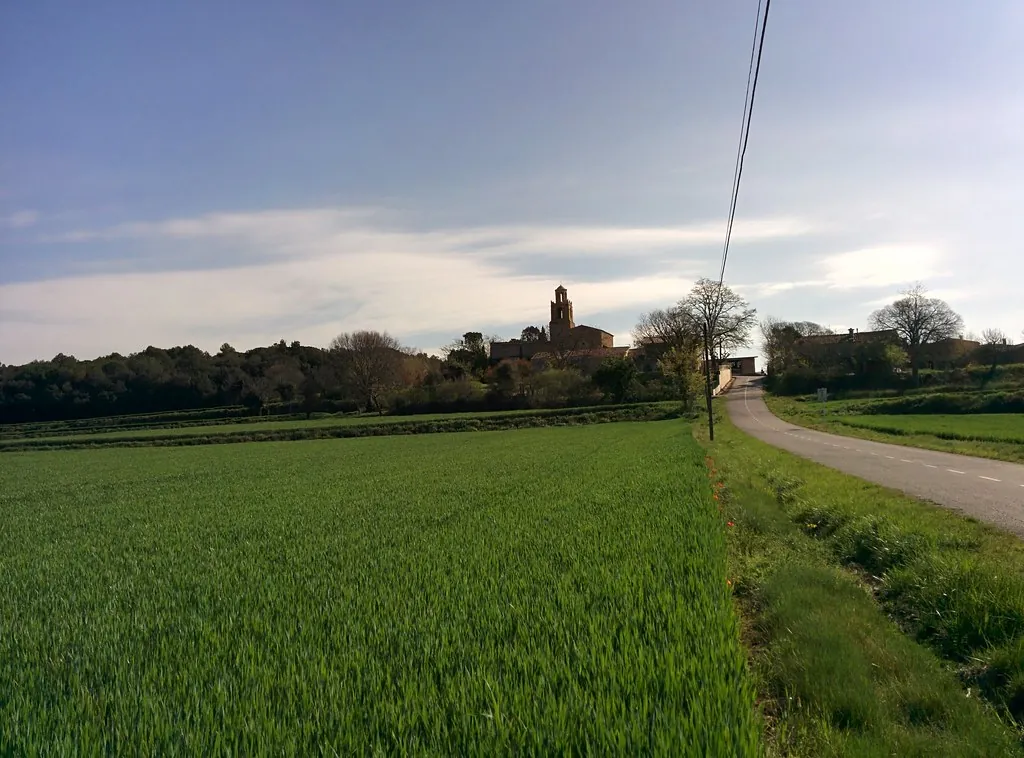
The train slows before crossing the Ter. From the window, the shift in landscape is clear. Girona recedes and the land flattens into open plain. Celrà appears there, beside the river.
In medieval documents it is recorded as “Celdaria” as early as the 11th century. It lies only a few kilometres from Girona, the capital of the Gironès comarca, yet the setting changes enough to explain why a settlement took root here. The Ter served as a natural route through the territory and as a source of water for agriculture. It also formed a boundary that was easy to monitor. That strategic combination helps explain the presence of several fortifications on the nearby hills.
Celrà today remains closely tied to that geography. The river, the plain and the gentle rises around the village still define how the place is understood.
The River That Shaped the Settlement
The Gironès is largely flat. The Ter creates the clearest break in the relief. Celrà was established on the river’s right bank and organised around the church of Sant Fèlix.
The origins of the church date back to the 11th century, although the current building includes later alterations. Part of the earlier structure can still be recognised in the apse. The square in front of the church makes it easier to read the layout of the old village. Here stood the temple, the town hall built at the end of the 16th century and later transformed in the 19th, and the path that once led down to the mill. Everything sits within a short distance.
This was an agricultural community. The waters of the Ter powered the machinery needed to grind grain. The river set the rhythm of daily work and anchored the small civic centre that grew around Sant Fèlix.
Celrà Castle was constructed in this same context. Sources usually date it to between the late 11th and early 12th centuries. Today only discreet remains survive, sections of wall and part of the base of the main tower. The site is reached on foot in a few minutes from the centre, following carrer del Castell.
From there, the view clarifies its purpose. The natural corridor linking Girona with the Empordà stretches out directly in front, the same line now traced by the road and railway. The castle’s position makes sense when seen in relation to that route.
Three Castles, One Landscape
Within a small radius stand three medieval fortresses: Celrà, Juià and Quart. Such a concentration in so limited an area is unusual. Each guarded a different passage through the territory. One watched the river, another the road towards the Empordà, and another the route connecting with the Pla de l’Estany.
The path that links these sites is known locally as the route of the Tres Castells. It covers around twelve kilometres. The terrain is gentle and passes through cultivated fields, small wooded areas and low hills. At intervals, fragments of walls or embankments appear beneath vegetation. These are remains of defensive structures that have gradually blended into the agricultural landscape.
There are not many water sources along the way, so carrying water is advisable.
The walk brings together geography and history without dramatic contrasts. Fields still dominate the view. The hills are modest. The defensive logic of the Middle Ages can be traced through subtle changes in elevation and direction rather than imposing ruins.
Storecupboard Cooking and a Marked Calendar
Local cooking remains closely linked to market gardens and rural tradition. One of the most common dishes is coca de recapte, a thin flatbread topped with roasted vegetables and, depending on the version, butifarra sausage or salt cod. It reflects the idea of using what is available, a practical approach rooted in the countryside.
Another regular presence is butifarra with mongetes del ganxet. The ganxet is a variety of white bean grown in riverside soils, valued for its texture and flavour. The combination is simple and filling.
During the hunting season, wild boar stews often appear on local menus. These are slow-cooked dishes prepared with red wine, suited to colder months.
The festive calendar revolves around long-established celebrations. The Fira de Sant Andreu usually takes place at the end of November and brings together local producers and livestock. The Festa Major linked to Sant Esteve marks the winter season. In spring, a plant market is held in the square, accompanied by cobla music, a traditional Catalan ensemble of wind instruments, and communal meals at long tables set beneath the plane trees.
These events reflect continuity more than spectacle. They follow the agricultural year and maintain ties between the town and its surroundings.
Walking the River and Understanding the Plain
Celrà has a railway station on the line that connects Girona with Figueres and the French border. The journey from Girona is very short. The town is also reached by road following the northbound route out of the city.
The historic centre can be explored easily on foot. In about an hour it is possible to cross the old core and approach the riverside. Distances are short, and the layout still reflects its origins around church, town hall and mill.
One of the most common walks follows the bank of the Ter from the old mill, where the hydraulic wheel is still preserved. The path runs between riverside vegetation and open fields. The return journey takes a little over an hour at an unhurried pace.
Celrà does not function as a major tourist focus. It is more interesting as an example of how life was organised in this part of the Catalan plain. A river determined the rhythm of work. Small fortifications kept watch over access routes. The village has continued to grow within that same landscape.
The context is best understood slowly, walking along the riverbank and observing how the fields are laid out around the Ter. The plain may appear uniform at first glance, yet the presence of water and the memory of watchtowers reveal the structure beneath it.