

Full Article
about Girona
Provincial capital with one of the best-preserved Jewish quarters; known for its houses along the Onyar River.
Hide article Read full article
A rhythm set by bells
The bells of Girona Cathedral have marked the pace of the Barri Vell for centuries. When they ring out, the sound travels down the cathedral steps, threads through narrow streets and reaches the Onyar. In medieval Girona, those bells were more than ceremonial. They warned of fires, called council meetings and signalled danger on the roads. Even now, they act as a kind of public clock for the old quarter.
This sense of continuity shapes how the city is experienced. The past is not tucked away behind glass or confined to a few monuments. It carries on in the layout of streets, in the use of buildings, and in small details that still serve practical purposes.
A city built on its own layers
Girona began as Gerunda, a Roman foundation positioned to oversee the Via Augusta and the natural route between inland areas and the coast. That first settlement stood on what is now the Força Vella, a raised area between the rivers Ter, Onyar, Güell and Galligants. The form of the old town still follows that defensive logic.
After the fall of Rome, the Carolingians reinforced the walls in the 9th century. Sections of those structures remain part of the present-day layout. From the 12th century onwards, the city expanded more rapidly. During this period, the Jewish quarter, known as the Call, became one of the most active centres of Hebrew intellectual life within the Crown of Aragon.
The streets of the Call reflect a medieval urban pattern. They are narrow, irregular and at times partially covered. This was not an aesthetic choice. It offered protection from the weather and allowed better control of movement within the neighbourhood. In some places, the distance between façades changes depending on the height, a detail that becomes clear when looking up towards the upper floors.
The cathedral that breaks the rules
The Cathedral of Santa Maria brings together several periods in a single building. The apse is Romanesque, most of the structure is Gothic, and the main façade belongs to the Baroque period.
What stands out is the single nave. At nearly 23 metres wide, it is often described as the widest Gothic nave built as a single space. The decision dates to the early 15th century, when the cathedral chapter chose a unified interior rather than the more common three-nave design. The result is a vast hall supported by particularly robust pillars.
Inside, the so-called Tapiz de la Creación is preserved. This 11th-century textile is notable not only for its size but for its rarity. It depicts scenes from Genesis alongside animals and figures drawn from medieval bestiary traditions. At that time, Girona was connected to pilgrimage and trade routes that carried stories and imagery from distant places.
Water shaping the city
Rivers define Girona’s layout. The Onyar runs through the historic centre, while the Ter marks the northern edge of the old town.
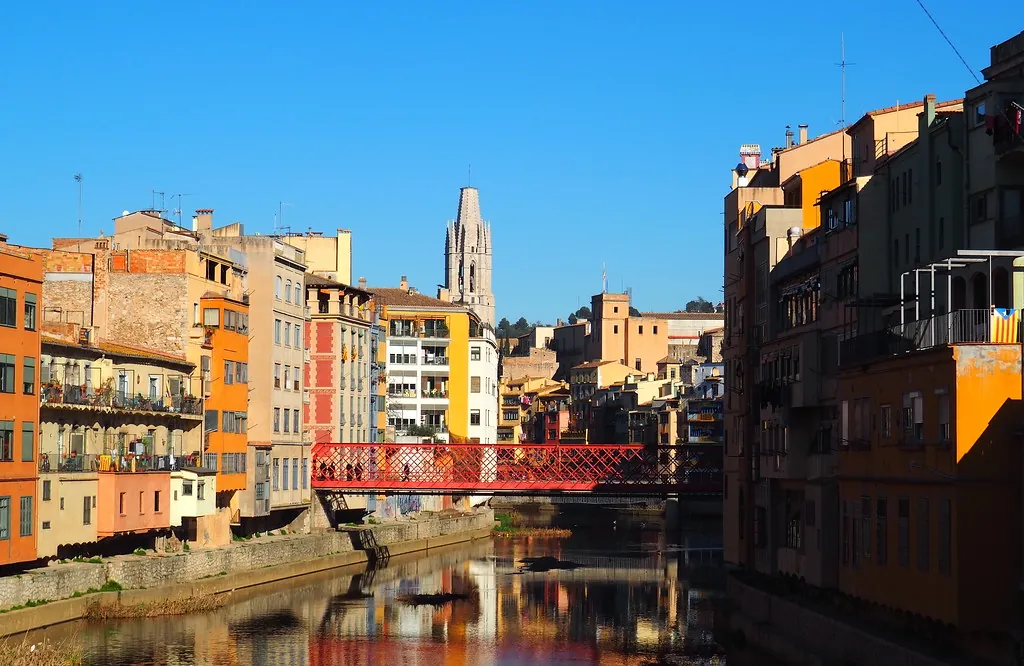
The bridges reflect different stages of the city’s development. Some have medieval origins, though they have been altered many times. Others date from the 19th century, when Girona began to expand beyond its walls. A metal bridge over the Onyar, built during that period by French engineers, introduced an industrial structure that contrasts with the older surroundings.
The houses facing the river form one of Girona’s most recognisable views. Their current colours were set during a municipal intervention in the late 20th century, which aimed to recover a traditional palette. Not every shade corresponds exactly to historical layers, yet the overall effect maintains the long-standing relationship between architecture and river along this stretch.
Walking along history
The Paseo Arqueológico runs along the northern side of the old town and follows the line of the walls. Some sections preserve Carolingian elements, although what can be seen today results from many phases of reconstruction. Over the centuries, the walls were reused as the base for houses and storage buildings.
The so-called Baños Árabes date from the 12th century. Despite the name, they follow the model of Roman baths, though the interior decoration includes features that evoke the Islamic world. They functioned as public baths in a city where running water did not reach private homes.
Beyond hygiene, these spaces played a social role. People came here to talk and to close deals. Medieval Girona depended on the textile trade and on the movement of goods between inland regions and the coast.
Moving through Girona with context
A practical starting point is the Plaça del Vi, which has served as the administrative centre since the Middle Ages. The town hall stands where the city’s old hospital once stood. For centuries, a market operated under the arcades.
From there, Carrer de la Força leads uphill towards the heart of the former Jewish quarter. It is worth walking slowly and paying attention to the façades. Many grilles and doorways date from 16th and 17th-century renovations, carried out after the expulsion of the Jewish population, when the area’s inhabitants had already changed.
Heading down towards the Onyar along the streets that connect with Ballesteries brings you to the line of bridges. From this point, the position of the cathedral becomes clear, dominating the hill above.
La Devesa lies on the other side of the river. It is a large park planted with long rows of trees, offering a contrast to the dense fabric of the historic centre.