Full Article
about Llambilles
Residential and farming village crossed by the Vía Verde; chapel with panoramic views
Hide article Read full article
A detour just outside Girona
A few kilometres from Girona, in the heart of the comarca of Gironès, Llambilles sits quietly with just over 700 residents. On a map it looks almost absorbed by the nearby city. In reality, it feels separate. Girona is close enough to reach quickly, yet the surroundings are still fields rather than suburbs.
Llambilles does not announce itself with dramatic landmarks or a skyline that demands attention. The first impression is subtler. Life moves at its own pace here, even with the provincial capital so near. It is the kind of place you pass through without expecting much, only to realise that its character lies in continuity rather than spectacle.
This is not a village preserved as a rural backdrop. It feels lived in. People go about their routines. The agricultural setting is not staged for visitors. That distinction matters, especially in an area where proximity to a city could easily have reshaped everything.
A small village that does not try to impress
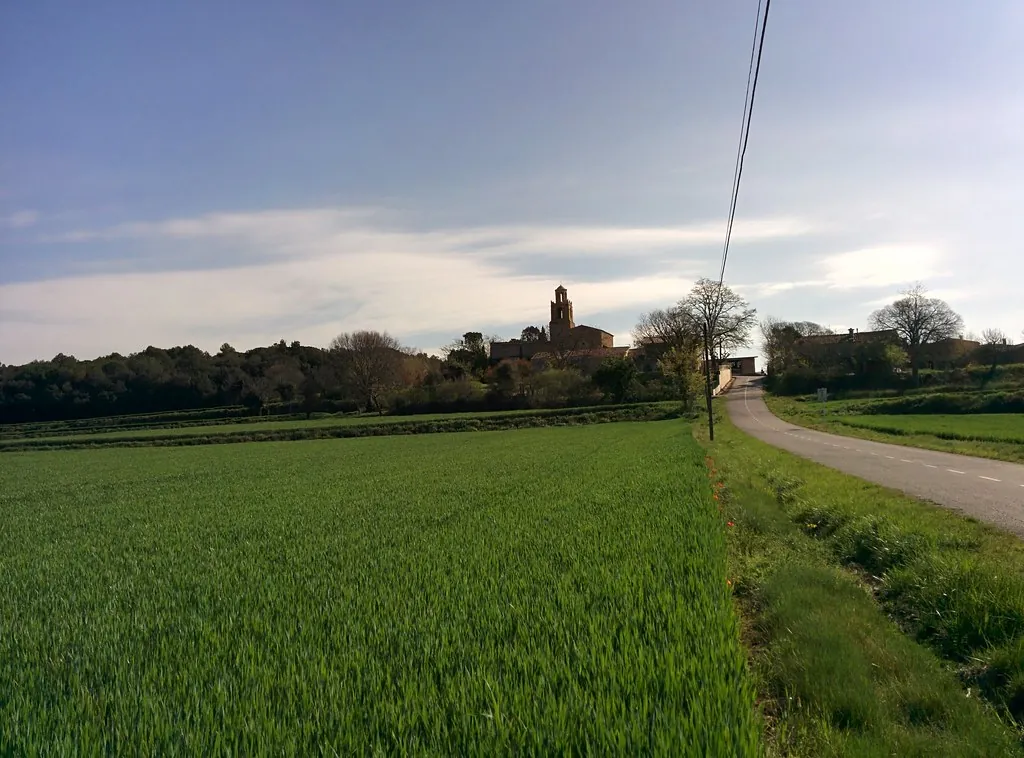
Llambilles still follows the logic of the agricultural villages of inland Girona. Renovated houses stand beside others that remain much as they were, without cosmetic changes. Scattered masías, the traditional Catalan farmhouses, dot the surrounding land. Open fields stretch out between them, divided by low walls and linked by rural tracks.
There is no clearly defined historic quarter designed to funnel visitors from one photogenic corner to the next. The appeal is quieter. It lies in how the stone houses sit within the landscape, how plots of land are marked out, how vegetable gardens are still cultivated.
It is easy to picture daily life decades ago because many aspects have changed little. Fields are worked. Paths connect properties as they always have. The village layout reflects function more than display. Llambilles rewards a slower look, not because there is a long list of sights, but because the pieces fit together in a way that makes sense.
Sant Esteve, the village landmark
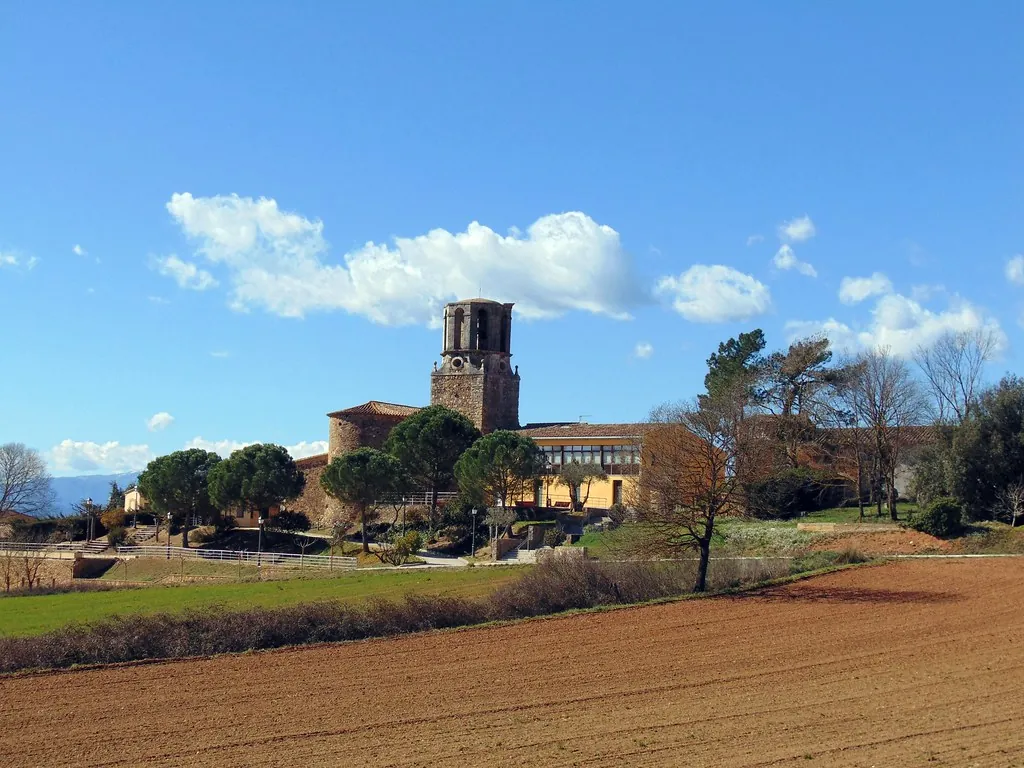
The most recognisable building in Llambilles is the parish church of Sant Esteve. It stands in the most identifiable part of the village centre and has been there since medieval times, although it has undergone alterations over the centuries.
This is not a monumental church built to dominate the landscape. Its scale matches that of the village. The structure forms a natural reference point, both visually and socially. If the doors are open, it is worth stepping inside briefly. The atmosphere tends to be quiet in the way that small villages are quiet, without the formal hush of a museum.
Sant Esteve also provides a link to local tradition. In many Catalan villages, the parish church is closely tied to community life, and Llambilles is no exception. The church’s name returns later in the calendar when the village celebrates its main festivities.
Walking beyond the centre
Llambilles becomes particularly appealing once you move beyond the immediate cluster of houses. The surrounding landscape alternates between cultivated fields and small patches of woodland that break up the agricultural terrain. Rural tracks extend outwards, connecting Llambilles with other nearby villages in the Gironès.
The terrain is gentle. There are no major gradients or complicated routes to navigate. It is the kind of countryside where you can walk at an easy pace, following paths between fields. The soundscape is simple: perhaps a tractor in the distance, otherwise little to interrupt the quiet.
Cycling also works well here, especially if you prefer calm secondary roads. Most of the traffic concentrates on the routes leading directly towards Girona. Step away from those and the atmosphere shifts noticeably. The sense of space increases, even though the city remains close.
These surroundings help define Llambilles as much as its buildings do. The village and its farmland form a single setting rather than two separate elements. The open views and working land make it clear that this is still an agricultural environment, not a commuter estate with a rural façade.
Living near the city
Part of Llambilles’ appeal lies in its position. Girona is about ten kilometres away. In practical terms, that means it takes very little time to move from a rural setting into a city with a lively urban atmosphere.
Many residents do exactly that each day, living in Llambilles while working or running errands in Girona. The arrangement feels natural rather than exceptional. The village remains distinct, yet it benefits from being so close to a provincial capital.
For visitors, this proximity offers flexibility. Time can be divided between a walk through fields and a visit to Girona’s streets. One moment you are in open countryside, the next you are approaching a city that plays an important role in the region. The contrast is part of what makes Llambilles interesting.
Festivities and village life
In smaller communities, social life often gathers around specific dates in the calendar. In Llambilles, the traditional focal point revolves around Sant Esteve, when the village usually celebrates its festa major, the main annual festival common to towns and villages across Catalonia.
Expectations should be realistic. These are not large-scale productions. The atmosphere is more about neighbours coming together, simple activities and the sense that most people know one another. The celebration reflects the scale of the village itself.
Outside these moments, daily life tends to be discreet. There are no grand events competing for attention. What defines Llambilles socially is continuity rather than spectacle.
Is it worth stopping in Llambilles?
That depends on what you are looking for. Anyone in search of a striking village packed with dramatic viewpoints and constant photo opportunities may well continue driving.
Llambilles makes more sense for those curious about how small villages function when they sit close to a city. It shows how rural and urban spaces can coexist within a short distance of each other. The village does not dominate the map. It blends into the broader territory of the Gironès.
Pause for a while and the setting begins to make sense. The church of Sant Esteve anchors the centre. The masías and fields extend outwards. Girona hovers nearby without overwhelming the scene. Llambilles may not shout for attention, yet it fits naturally into its surroundings. Sometimes that quiet coherence proves more interesting than first impressions suggest.