Full Article
about Salt
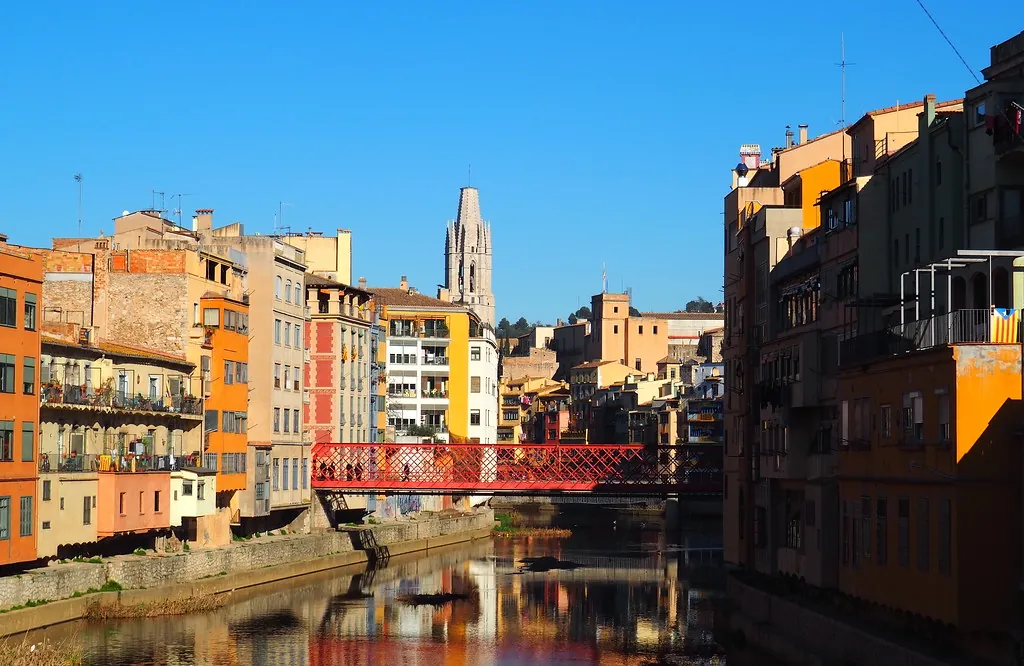
Conurbated city with Girona; known for its cultural life and the Ter meadows.
Hide article Read full article
A Different Kind of Visit
Tourism in Salt means something different. This is not a medieval village preserved in stone, nor a carefully staged historic quarter. Salt grew pressed up against Girona, expanding quickly in the 1960s and 70s with apartment blocks and new housing. Today more than thirty thousand people live here in a relatively small area, and much of daily life revolves around commuting in and out for work.
That context matters. Coming to Salt with expectations of grand monuments or cobbled lanes will lead to confusion. It makes more sense to see it as part of the wider urban fabric of Girona, a neighbouring town with its own rhythm and character.
From Girona you can reach Salt in minutes. Many people simply cross the bridge on foot or take the bus. The boundary between the two places feels thin, and daily movement back and forth is constant.
Getting There and Parking
If arriving by car, take the first reasonable parking space you find. The centre has many one-way streets, and driving in circles can take longer than expected. It is the sort of place where a short distance on the map turns into a slow loop through residential blocks.
On market mornings, traffic becomes noticeably more complicated. Part of the central area fills with stalls and vans, and moving around takes patience. If your visit coincides with the market, it is often easier to park a little further out and walk in.
Coming from Girona on foot or by bicycle is a practical option. The route is short and avoids the whole question of parking. Given the proximity between the two towns, many visitors find this the simplest way to approach Salt.
A Modest Centre
The church of Sant Cugat is the one building that interrupts the feeling of a modern neighbourhood. It is not spectacular, but it at least carries some sense of history. The current construction dates from a relatively recent period, although it attempts to look older than it is.
The square around it functions more as a crossroads than a destination. People pass through to shop, wait for the bus or leave the market. It is active, but not somewhere designed for lingering. The mood is practical and everyday.
A few minutes away stands the Torre Farga. This stone tower survived everything that was built around it later on: factories, roads and blocks of flats. Without knowing what you are looking at, it is easy to walk past. It sits slightly isolated among newer buildings, a fragment from another time surrounded by the expansion of the twentieth century.
In truth, the centre of Salt can be seen quickly. A short circuit of the main streets and squares gives a fair idea of the place. Its interest lies less in individual monuments and more in observing how the town functions as part of the Girona metropolitan area.
The River Ter and the Deveses
The most appealing side of Salt is not found in its central streets but in the direction of the river.
The deveses del Ter form a strip of trees and dirt paths that follow the course of the water. For readers unfamiliar with the term, a devesa is a riverside area of woodland or open ground. Here, it creates a green corridor along the Ter, used daily by residents of Salt and the wider Girona area.
Many people come to run, walk the dog or simply stretch their legs for a while. Compared with the built-up centre, there is more shade and noticeably more quiet. Do not expect large facilities or elaborate infrastructure. The paths are flat, the terrain simple, and the appeal lies in fresh air and space rather than in designed attractions.
After a turn around the centre, the deveses offer relief. They show another side of Salt, one that connects it to the landscape of the Ter rather than to the surrounding blocks of flats. For some visitors, this riverside walk will be the highlight of a short stay.
Fairs and Local Atmosphere
Throughout the year, Salt organises several fairs. The best known revolves around basketry, a craft that had significance in the area for decades. During those days the centre becomes much busier and moving around can be more difficult. Stalls and activities take over public spaces, and the usual flow of traffic adjusts to the event.
There are also concerts and cultural activities in summer. Part of the musical life of the Girona area passes through Salt, attracting a varied mix of people. It is not unusual to see a large section of the neighbourhood sitting in the square, listening to live music together. The atmosphere can feel communal and informal, shaped more by local participation than by tourism.
These events do not transform Salt into a traditional holiday destination, but they do reveal its social side. Visiting during a fair or a summer concert offers a clearer sense of how the town gathers and celebrates.
A Brief Stop, Close to Girona
Salt is seen quickly. A walk through the centre, a look at Sant Cugat and the Torre Farga, a stroll towards the river, and little more is needed to understand its layout.
If the plan is to sit down for a long meal or extend the day, many people cross back into Girona. It is right next door, and the contrast between the two places is part of the experience. Salt works better as a way to understand how the urban periphery of Girona lives than as a destination for a full day’s sightseeing.
Viewed in that light, it becomes more interesting. Rather than searching for landmarks, the visit becomes about observing daily routines, the market in motion, neighbours gathering in the square for a concert, runners tracing the paths along the Ter. Salt may not fit the usual idea of tourism in Catalonia, but it offers a straightforward glimpse of contemporary life on the edge of Girona.