Full Article
about Sant Joan de Mollet
Small farming village near Flaçà; quiet life, rural setting.
Hide article Read full article
Between Girona and Les Gavarres
Sant Joan de Mollet lies in the central part of the comarca of Gironès, on a stretch of farmland between the city of Girona and the Les Gavarres massif. Today it has around 536 inhabitants. The setting explains much of what the village is and how it developed. This is flat, fertile land that has been worked for centuries.
The name of Sant Joan de Mollet appears in medieval documents linked to the bishopric of Girona. Like many small settlements on the plain around Girona, it grew around a parish church and a handful of scattered masías, traditional Catalan farmhouses. For generations, daily life revolved around the cultivation of cereals, vines and market gardens. That agricultural base is still visible in the layout of the municipality and in the constant presence of open fields.
Sant Joan de Mollet does not feature on the usual tourist routes through the province. Its recent evolution has been shaped more by its proximity to Girona than by any visitor economy. Many residents work in the city, yet the immediate surroundings remain clearly rural in character.
The Parish Church and the Village Core
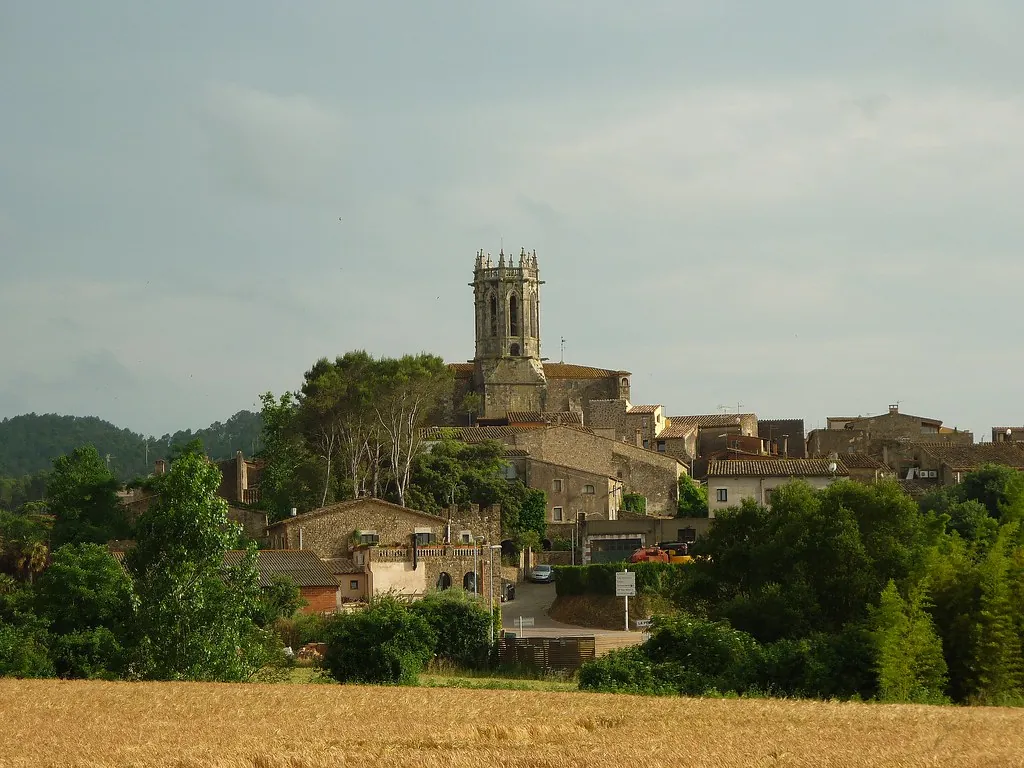
At the centre of the small urban nucleus stands the parish church of Sant Joan Baptista. The building has medieval origins, although it has undergone several alterations over time. Parish records mention the church as early as the late Middle Ages, when the territory was under the ecclesiastical structures of Girona.
The present appearance of the church largely reflects changes carried out in the early modern period. The same process occurred in many villages across the Gironès, where parishes were expanded during the 17th and 18th centuries to accommodate population growth.
Around the church, the main cluster of houses took shape. The homes are simple in form and many have been remodelled over the years. Even so, some façades retain stone doorways and windows with old lintels. These are small details, yet they offer a sense of continuity and speak to the village’s long history.
Beyond the centre, several historic masías are scattered across the municipal area. Some remain linked to agricultural work. Others have been altered over time, though they still preserve their original structure. Together they reinforce the impression that this is a place defined by farming rather than by expansion or new development.
The Agricultural Landscape of the Gironès Plain
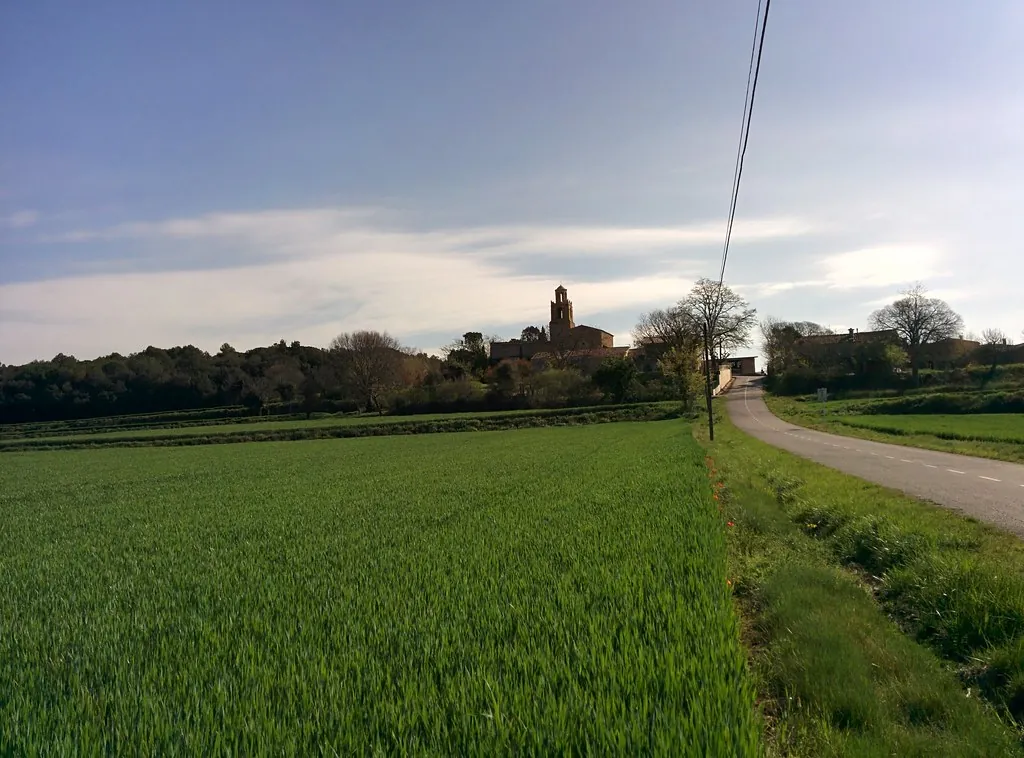
The municipality is essentially agricultural. Open fields dominate, criss-crossed by rural tracks that connect farms and neighbouring plots. In spring and autumn the colours of the landscape shift quickly, following the agricultural calendar. These seasonal cycles remain clearly visible.
To the east rise the first elevations of Les Gavarres. Although the massif does not form part of the municipality itself, it shapes the horizon. Traditionally, Les Gavarres has been an area of woodland, charcoal production and forestry uses. Its wooded slopes contrast with the flat farmland of Sant Joan de Mollet.
Between the cultivated fields are small patches of holm oak and cork oak. There is also vegetation associated with rieras, the small streams typical of this part of Catalonia, and wetter areas of ground. The terrain is straightforward, without dramatic viewpoints or steep relief. Its interest lies in the continuity of the agricultural landscape and in the sense of space created by the open plain.
Paths Linking the Villages of the Gironès
The area around Sant Joan de Mollet can be explored easily on foot or by bicycle. Agricultural tracks link the village with neighbouring municipalities on the plain of Girona. These are gentle routes, generally without significant inclines.
For centuries, these paths were working routes. They were used to move livestock, transport harvests and reach scattered masías. Today they follow the same lines, although traffic is minimal. Walking or cycling along them offers a direct experience of the rural setting, shaped more by cultivation than by infrastructure.
Local roads also make it straightforward to travel around the comarca. Girona is only a few kilometres away, reinforcing the sense that Sant Joan de Mollet belongs to its orbit. Les Gavarres is close at hand for those wishing to extend a route into more wooded terrain, where the landscape becomes more forested.
Parish Festivities and the Rhythm of the Year
Festive life in Sant Joan de Mollet centres on the parish of Sant Joan Baptista. The main celebration usually coincides with the feast day of the saint, around 24 June. In many Catalan villages, the religious calendar structured communal gatherings for centuries, and this pattern is still visible here.
In addition to this date, the municipality takes part in celebrations widely observed across Catalonia, such as Sant Jordi and the Christmas festivities. Sant Jordi, held on 23 April, is associated throughout Catalonia with books and roses, and marks an important cultural moment in the calendar. In villages of this size, activities depend largely on the involvement of local residents, which gives these occasions a strongly community-based character.
When to Visit
Spring and autumn are the most pleasant times to walk the rural paths within the municipality. The temperatures are generally milder, and the agricultural landscape is in transition, with visible changes in colour and texture.
Summer often brings heat in the middle hours of the day, typical of inland areas of Catalonia. Winter is quiet and offers a clearer view of the agricultural setting, with fewer changes in the fields and a more subdued palette across the plain.
Sant Joan de Mollet is not a destination defined by monuments or major attractions. Its identity lies in its fields, its parish church and the network of paths that have connected farms and neighbours for centuries. Close to Girona yet firmly rooted in the countryside, it reflects a long continuity of rural life on the plain of the Gironès.