Full Article
about Sant Jordi Desvalls
Hilltop village with a medieval core; views over the Ter and the Empordà
Hide article Read full article
A village that wakes with the fields
Early in the morning, while there is still a trace of moisture in the air, Sant Jordi Desvalls wakes to the sound of cockerels, the engine of a car starting up and wind moving through the trees that line the fields. Just a few minutes by car from Girona, the village appears among open agricultural plots, the soil clearly marked by furrows and gravel tracks. Fewer than a thousand people live here, and the pace of life seems tied more to the seasons than to the clock.
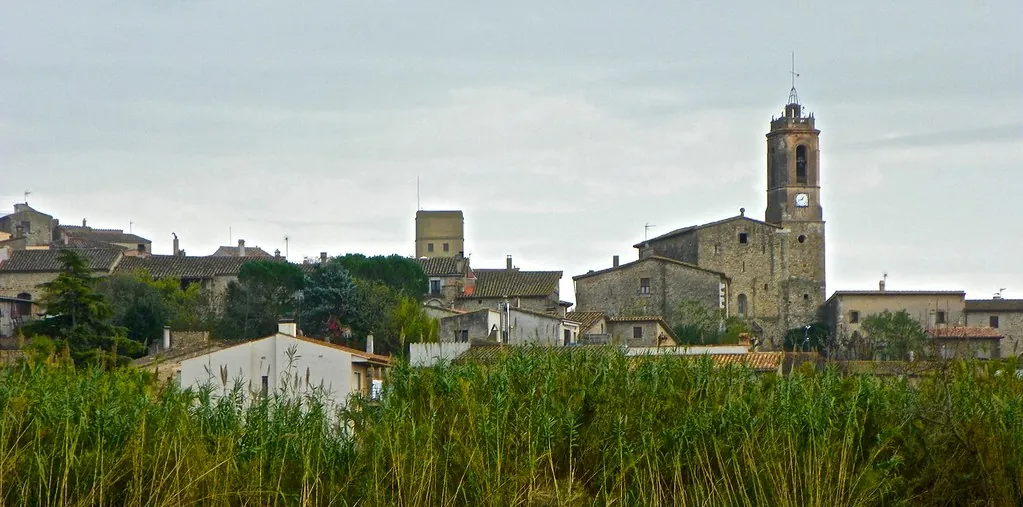
The name itself blends devotion and family history. Sant Jordi is the patron saint of Catalonia, widely recognised across the region, while Desvalls refers to a family that held influence in the area for centuries. That past is not expressed through grand buildings or monumental squares. It is sensed instead in the wide stone doorways, in walls slightly uneven after years of use, and in courtyards where tools or stacked firewood still occupy a corner. Newer houses stand alongside older ones without much fuss, as tends to happen in places where daily life matters more than appearance.
A walk through the village centre does not take long, but it rewards a slower pace. In the late afternoon, when the sun falls at an angle, some façades take on an almost golden hue. Others show traces of old render, revealing layers from different periods beneath the surface. At times, the scent of damp earth drifts in from nearby vegetable plots, particularly after watering.
Stone houses and open horizons
Beyond the compact centre, masías are scattered among fields and narrow agricultural tracks. These traditional Catalan farmhouses often have solid, compact volumes, sloping roofs and inner courtyards that once housed barns or animal pens. Many remain private homes today and keep their original structure. From public paths they are clearly visible. Some are carefully maintained, others bear the gradual wear that comes with time.
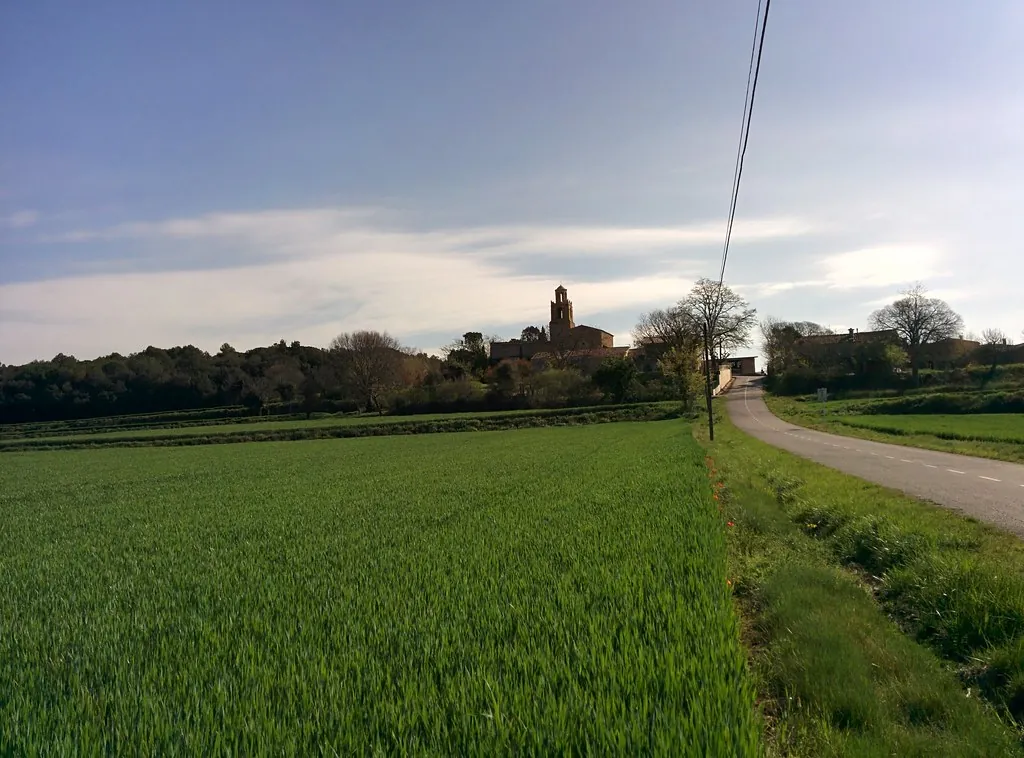
The surrounding landscape feels open, with no mountains closing in the horizon. In winter, ochre tones and bare earth dominate. Spring brings green fields and the smell of freshly cut grass in the air. At sunset, when the sun drops low, the fields reflect a warm light that stretches the shadows of trees across the ground. In the distance, gentle rises hint towards the Empordà, a nearby area of Catalonia known for its plains and agricultural land.
There are no dramatic viewpoints or showpiece landmarks here. The interest lies in the continuity between village and countryside. Houses give way to plots of cultivated land. Gravel tracks branch off from the main streets. The transition feels gradual and unforced.
Quiet routes across the Gironès
Sant Jordi Desvalls works well as a starting point for unhurried exploration of the Gironès comarca, the local administrative area around Girona. Secondary roads and rural paths link the village with nearby places such as Flaçà and Cervià de Ter. These are straightforward routes for cycling, usually across open fields, where encounters are more likely to involve a tractor than heavy traffic.
There is no need to seek out marked trails. Following the agricultural tracks that leave the village centre is often enough. Many form small loops that eventually lead back to Sant Jordi Desvalls or connect with neighbouring settlements. The layout encourages wandering without a strict plan.
For those on foot, early morning or the last part of the afternoon tend to be more comfortable, particularly in summer. The landscape offers little shade, and the midday sun can be strong. Carrying water is advisable if planning to spend a good stretch of time beyond the village streets.
The experience of moving through this terrain is simple. Fields extend on either side. The wind shifts the crops depending on the season. The soundscape changes from birdsong to distant farm machinery. The sense of space remains constant.
Close to Girona, yet unhurried
Proximity to Girona shapes life in Sant Jordi Desvalls. The historic centre of the city can be reached in a short drive, as can other nearby comarcas such as the Baix Empordà. This closeness makes the village a practical base for exploring a wider area of Catalonia while staying in a rural setting.
Even so, there is value in lingering. As evening falls, lights begin to switch off in the houses. The surrounding fields grow quiet. Without the distractions of a busy centre, the end of the day feels gradual. Night arrives without rush, and the darkness over the farmland emphasises how lightly populated the area is.
Sant Jordi Desvalls does not rely on a list of major sights. Its character emerges through small details: the texture of stone walls, the geometry of ploughed land, the shift in colours from one season to the next. It is a place defined by continuity between past and present, by agriculture that still shapes daily routines, and by the steady rhythm of village life.
For travellers used to measuring destinations by landmarks and attractions, this corner of the Gironès offers something quieter. A short walk through the centre, a slow cycle along a rural road, or an hour spent watching the light change across the fields can be enough to understand its appeal. The setting remains open, the horizon wide, and the days paced by daylight rather than schedules.