Full Article
about Sarrià de Ter
Industrial town just north of Girona; paper-making tradition
Hide article Read full article
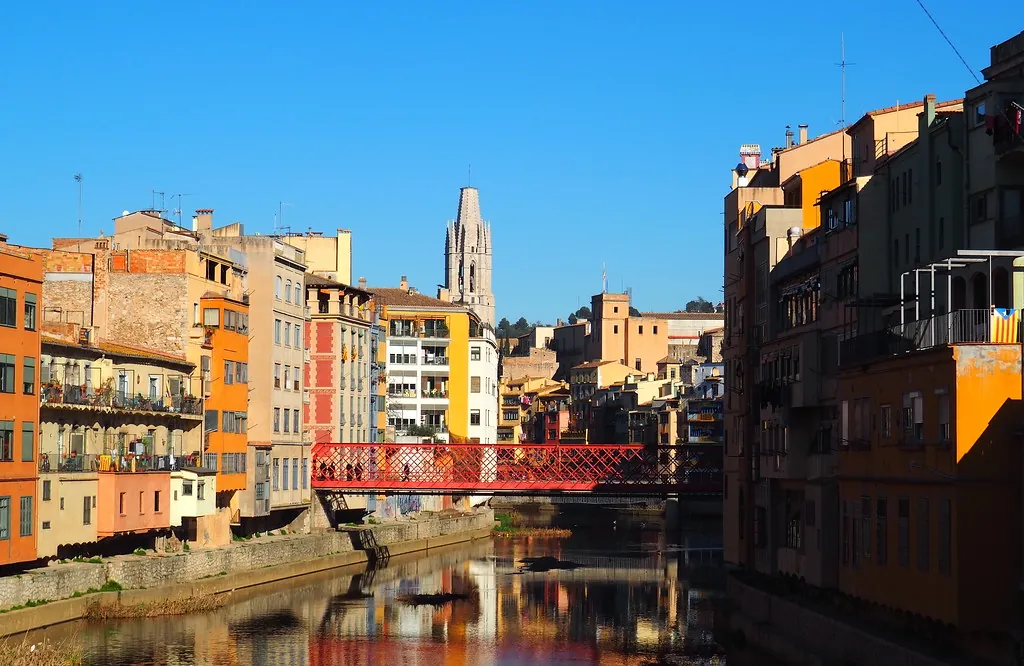
At seven in the evening, on the bridge that crosses the River Ter in Sarrià de Ter, the air carries the scent of running water and freshly baked bread drifting from a nearby house. The river moves thick and greenish below, pulling branches down from further upstream, from the mountains. Around that time cyclists begin to pass, heading back from Girona along the cycle path that follows the riverbank. They ride without hurry. On the open ground beside the old spinning factory, a group of teenagers kick a football around as the light fades.
Tourism in Sarrià de Ter works differently from other towns in the province. Life here unfolds on an everyday scale: people who live locally, work in Girona and cycle home, neighbours strolling by the river at dusk, vegetable plots that still survive between the road and the water.
Light Through Brick and Iron
The building of the former schools, designed by Rafael Masó, stands on Carrer Major with a recognisable combination of exposed brick, painted iron and simple geometry. Masó was a key figure of Noucentisme in Catalonia, a movement that favoured order and restraint over ornament. The tall windows let in a clean light that falls at an angle across the wooden floor in the morning. It is not a monumental building. It rewards a slower look, noticing how each element fits together.
Early in the day, when the sun is still low, the shadows of the window frames draw triangles across the façade. There are usually no large signs or explanations outside. The building is woven into the fabric of the town without ceremony.
A short walk away stands El Coro, also linked to Masó. It is recognisable by its tower and the air of a neighbourhood venue from another era. Modernisme here has little to do with the exuberance of Barcelona. It feels more contained, more practical. The interior is sometimes used for cultural activities or local meetings, although many days pass in silence.
The River at the Centre
The Ter sets the rhythm of the place. A walk along any of the paths that trace the riverbank, not all of them signposted, makes it clear how Sarrià organises itself around the water.
Some stretches are lined with willows leaning over the current. Others give way to reed beds where ducks and moorhens hide. A bicycle might be resting against the railing, or someone may be fishing in silence. The cycle lane connects easily with Girona, so it is common to see people using it for their daily commute.
In winter the river smells of damp earth and decomposing leaves. In summer the scent shifts to hot gravel, with the steady hum of bicycle wheels on the tarmac of the riverside path. The seasons are felt through the air as much as through the view.
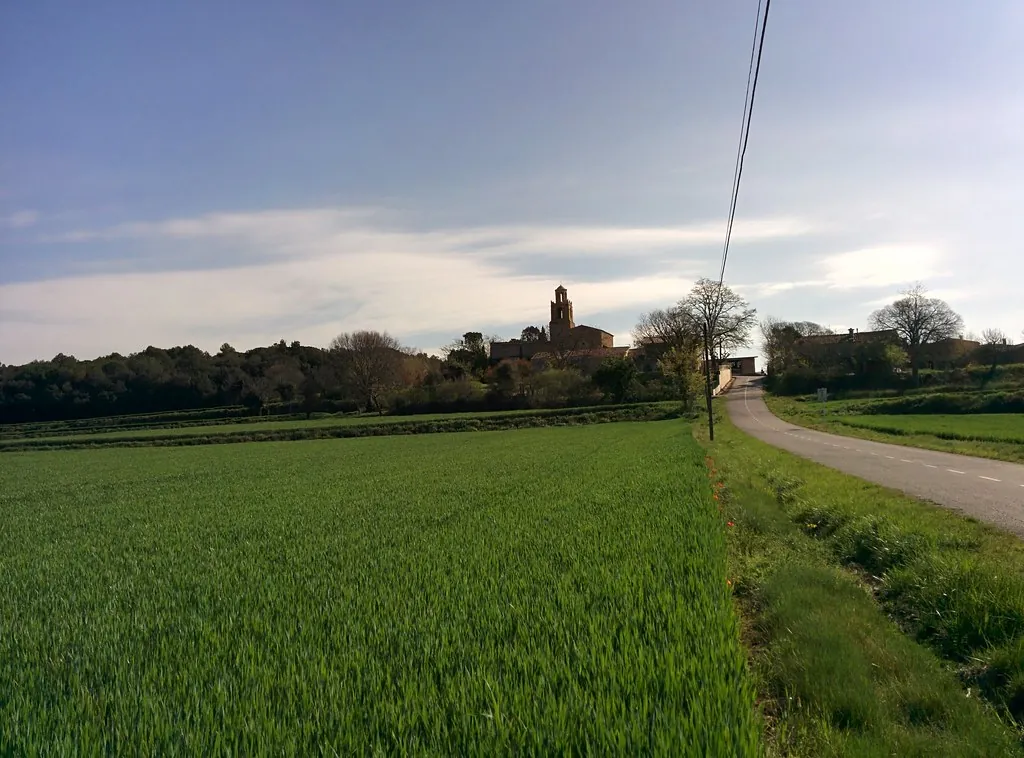
Sarrià sits slightly in between everything: Girona just minutes away, the motorway close by, open countryside still pressed against the banks of the Ter. Many cycle tourists ride straight through on longer routes. Local residents, by contrast, use this stretch as if it were a town square.
Near the river stand the remains of the old spinning factory, a reminder of the industrial activity that once relied on the Ter. Today the open ground beside it is more likely to host an informal football match than factory workers changing shifts.
The Taste of the Everyday
From time to time a small weekly market sets up under a canopy. There are only a handful of stalls: vegetables from nearby plots, some fruit, cured meats from the area. Catalan is heard more than anything else and most people already know one another.
Cooking in local homes follows the seasons. When the cold bites, there is escudella, a hearty Catalan stew traditionally made with meat, vegetables and pulses. On certain days bacalao, salted cod, appears on the table. Sautéed vegetables come straight from the kitchen gardens near the fertile plain of the Ter. Walking through some streets late in the afternoon, the smell of garlic softening in olive oil drifts out of open windows.
This is not gastronomy shaped for visitors. It is simply what has long been eaten here, without presentation or explanation.
When to Go and What to Bear in Mind
Sarrià de Ter does not have a clearly defined season. In summer there is more movement as people take to the Ter cycle lane, and evening walks draw slightly larger crowds. In autumn the river often runs higher and the landscape shifts in colour.
On weekdays, early in the morning, traffic towards Girona can build up heavily on the access roads. Anyone planning a walk along the river is better off avoiding that moment.
The church of Sant Julià stands in the centre of the town, its bell tower visible from several streets. Sometimes it is open, sometimes not. If the doors are closed, the steps at the entrance still offer a place to sit for a while, listening to the bells and the distant sound of traffic heading towards the city.
Sarrià de Ter does not present itself as a destination in the usual sense. It does not arrange its life around visitors or dress up its streets for effect. The appeal lies in something quieter: the rhythm of the Ter, the geometry of Masó’s brick and iron, the cycle path that links town and city, and the everyday routines that continue regardless of who happens to be passing through.