Full Article
about Viladasens
Rural municipality crossed by infrastructure yet with quiet corners
Hide article Read full article
A Small Municipality Near Girona
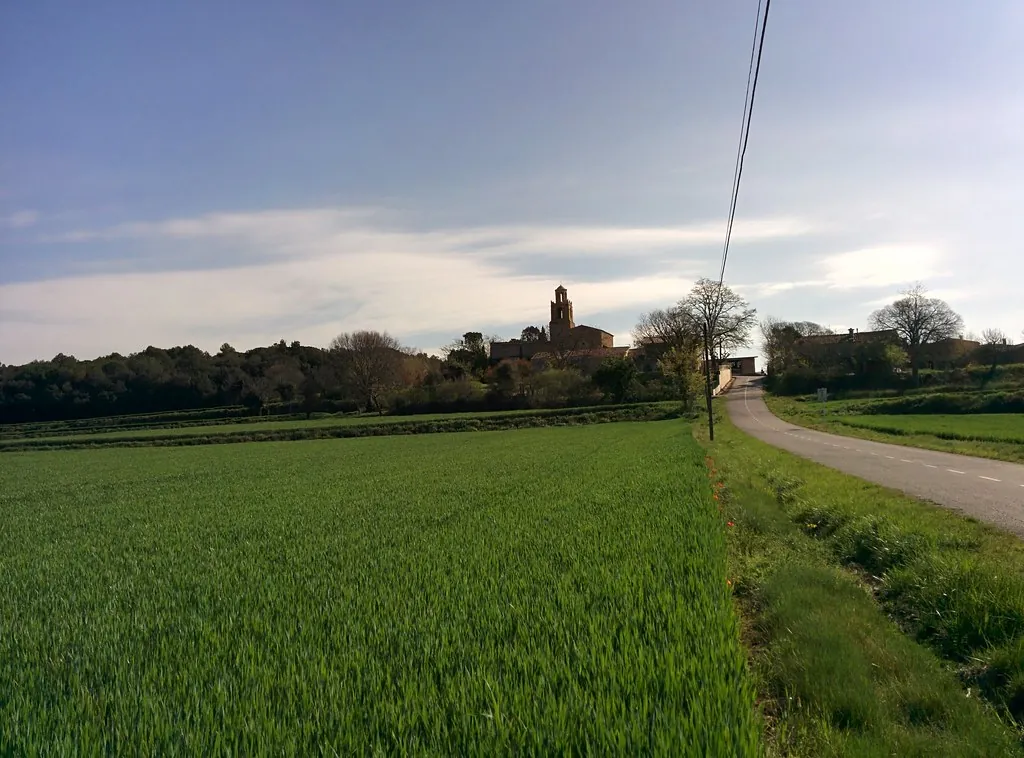
In the comarca of the Gironès, around fifteen kilometres from the city of Girona, Viladasens offers a clear picture of the agricultural interior of this part of Catalonia. It is a small municipality, home to just over two hundred residents, set among gentle hills that rise to less than one hundred metres above sea level. Open fields stretch between patches of Mediterranean woodland, and much of the landscape still moves to the steady rhythm of farming.
This is not a place defined by landmark monuments or headline sights. Viladasens is better understood through its territory than through any single building. Rural tracks link scattered masías, traditional Catalan farmhouses, while cereal fields shift in colour with the seasons. The compact village centre retains a distinctly agricultural character. Tractors passing along the tracks and people working the land are part of everyday life rather than a staged rural scene.
Its proximity to Girona shapes its present reality. Many errands, shopping trips and administrative matters are handled in the comarca capital, so Viladasens functions in part as a quiet village within the rural belt that surrounds the city. It feels separate, yet closely connected.
Around the Church of Sant Vicenç
The heart of Viladasens is organised around the parish church of Sant Vicenç. The current building largely reflects alterations from the modern period, probably built over an earlier structure, a common story among rural parishes in the Gironès. It is not monumental in scale, yet it provides a clear focal point for the cluster of houses that gather around it.
Several of these homes retain elements of traditional architecture. Stone walls, broad doorways designed to accommodate agricultural work and interior courtyards speak of a way of life centred on the land. In villages of this size, urban planning tends to be simple and practical, shaped by daily needs rather than display. Streets are modest, spaces functional.
Beyond the small nucleus lie a number of masías scattered across the municipality. Many remain tied to agricultural activity. This continuity helps explain why the surrounding landscape has stayed relatively open and cultivated. The relationship between farmhouse and field is still visible, and the pattern of dispersed dwellings connected by tracks gives the area its structure.
Walking Between Fields and Farmhouses
The clearest way to explore Viladasens is on foot or by bicycle along the rural tracks that radiate from the village. These routes have been used for decades to connect masías and plots of land, and they continue to serve that purpose today.
The terrain is gentle, without significant climbs, which makes walking straightforward. As the year progresses, the scenery changes noticeably. In spring the fields turn green. Early summer brings the dominant tones of ripening cereal. Later, after the harvest, drier shades take over. The shifts in colour mark the agricultural calendar more clearly than any signboard.
It is worth remembering that many of these tracks remain working routes. During busy periods in the farming year, agricultural machinery is a common sight, and some stretches may be dusty or churned up. This is an active landscape rather than a preserved one.
The open nature of the terrain allows broad views across fields broken by small areas of Mediterranean woodland. The overall impression is of space and continuity, with little interruption from dense building. The structure of the land itself, the layout of parcels and paths, tells much of Viladasens’ story.
Local Life and Sant Vicenç
Community life in Viladasens follows a modest scale. The most attended celebrations tend to take place in summer, when the population increases for a few weeks. During this period, the area around the church and nearby squares becomes a meeting point for shared meals, simple events and neighbourhood gatherings.
The feast of Sant Vicenç, the patron saint of the municipality, forms part of the traditional calendar. Its tone is more local than touristic. Rather than large-scale festivities, these occasions reinforce social ties within the village and among those who return during the summer weeks.
With a population just above two hundred, everyday life is marked by familiarity. The agricultural setting is not a backdrop but the basis of the community’s identity. The movement between fields, farmhouses and the small village centre continues to shape how the place functions.
A Quiet Stop in the Gironès
Viladasens is small and can be seen quickly. A visit tends to make more sense as part of a wider route through the Gironès or as a calm pause near Girona. Its appeal lies less in ticking off sights and more in observing how rural space is organised.
For those interested in rural architecture, the dispersed masías across the municipality deserve attention. Looking at how the fields are arranged around them offers insight into the history of the area that no information panel can fully convey. The layout of land and buildings reflects generations of agricultural practice.
The absence of major monuments does not mean a lack of character. Instead, Viladasens presents a straightforward example of the agricultural interior of Catalonia. Gentle hills, cereal fields and working farmhouses define the setting. The church of Sant Vicenç anchors the small centre, while tracks lead outward into an active landscape.
Close to Girona yet clearly rural, Viladasens shows how small municipalities in the Gironès continue to balance proximity to a city with a strong agricultural base. Its scale encourages a slower look at the land itself, at the relationship between settlement and cultivation. In that relationship lies the clearest understanding of the village.