Full Article
about Masquefa
Growing town with the amphibian and reptile recovery center
Hide article Read full article
The bells of Sant Pere de Masquefa strike eight in the morning while the sun is still pushing through the mist that sometimes drifts down from the vineyards of the Penedès. There is already movement in a bar: a short coffee, toasted bread, the low murmur of two men discussing this year’s grape prices. Behind the counter, the waitress wipes the formica surface with a damp cloth, listening without looking up much. At that hour the town moves slowly, as if it has not quite decided whether it belongs to the countryside or to the outer edge of Barcelona.
Masquefa is not a picture-postcard destination. It feels more like a crossroads where everyday life, trains, work, vegetable plots, industrial units, sits alongside traces of a more rural past that still lingers at the edges.
A town stretched along the road
Walking through Masquefa means following a route that for centuries connected inland areas with Barcelona. The old centre is not built around a neat, central square. Streets stretch out along the historic road, with houses that seem to have been fitted in wherever space allowed.
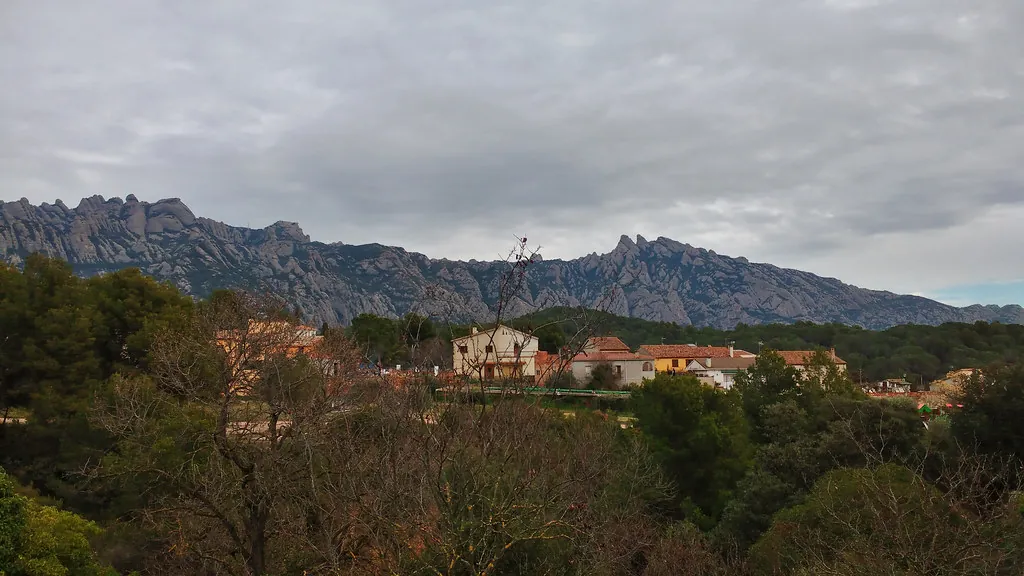
The church of Sant Pere i la Santa Creu stands where the street widens slightly. Its stone shifts in colour depending on the time of day: grey in the morning, almost golden as the sun drops towards Montserrat. Inside there is that cool, unmistakable scent of old churches, a mix of worn wax and damp. Some walls still hold faint traces of painting that only reveal their figures if you get close enough.
From slightly higher points in the town, the landscape of the Anoia becomes clear: cultivated plots, scattered masías, and, increasingly close, residential developments that have expanded over recent decades. The train continues to set the rhythm of daily life. In the morning, services head towards Barcelona filled with people who work elsewhere; by late afternoon they return, carrying the same quiet fatigue found on any commuter line.
If arriving by car, it makes sense to leave it on the outer streets and walk in. The centre is compact, and this avoids circling unnecessarily.
When industry changed the air
For much of the twentieth century, a textile factory in Masquefa reshaped daily life. It was a large brick building with wide windows, designed to make the most of natural light. Many people from the surrounding area ended up working there.
Those who remember that period often mention the whistle marking shifts and the chemical smell that sometimes hung in the air. The town no longer depended only on agriculture. Fixed schedules, regular wages and a different way of organising the day became part of life.
Today the space has been adapted for municipal use. There are classrooms, a library and sports facilities. Look closely when going up the stairs or glancing at the ceilings and traces of the factory remain: metal hooks, thick beams, floors that creak underfoot.
What comes out of the oven at midday
By mid-morning, the centre of Masquefa begins to smell of warm dough. Traditional bakeries still prepare savoury cocas topped with roasted vegetables such as pepper, aubergine and well-browned onion. The base is thin and crisp at the edges, softer in the middle.
It is food meant to be eaten on the go. It is bought, folded into paper and eaten while walking or sitting on a bench. For years it was also the quick meal for people finishing shifts at the factory or coming back from the fields.
At weekends, in the roadside restaurants around the area, grills are often lit early. Smoke from holm oak wood mixes with the morning air and leaves that persistent smell of grilled meat clinging to clothes.
A centre for reptiles and amphibians
On the outskirts lies the CRARC, the Centre for the Recovery of Amphibians and Reptiles of Catalonia. Tortoises, lizards and snakes brought in by rural agents or private individuals arrive here.
In some rooms, Mediterranean tortoises are kept in terrariums prepared to allow them to hibernate and regain natural behaviour before being released. Work also includes egg incubation and reintroduction programmes in different parts of Catalonia.
Visits tend to be calm and informative. It is not a zoo. The focus is on explaining how these animals live and why many run into trouble when they are taken from the wild or kept at home.
When to come
Spring is when the landscape around Masquefa feels most alive. Fields begin to shift in colour, and the air has not yet taken on the dry heat of summer. It is a good time for walking the rural paths nearby.
In summer, especially in August, the pace drops noticeably. Many shutters stay closed, and activity moves towards nearby residential areas or the coast.
Early autumn has its own atmosphere. During the grape harvest, the mood across the surrounding towns changes.