Full Article
about Montmaneu
Stop on the Camino Real with castle and wall remains.
Hide article Read full article
Montmaneu at Seven Hundred Metres
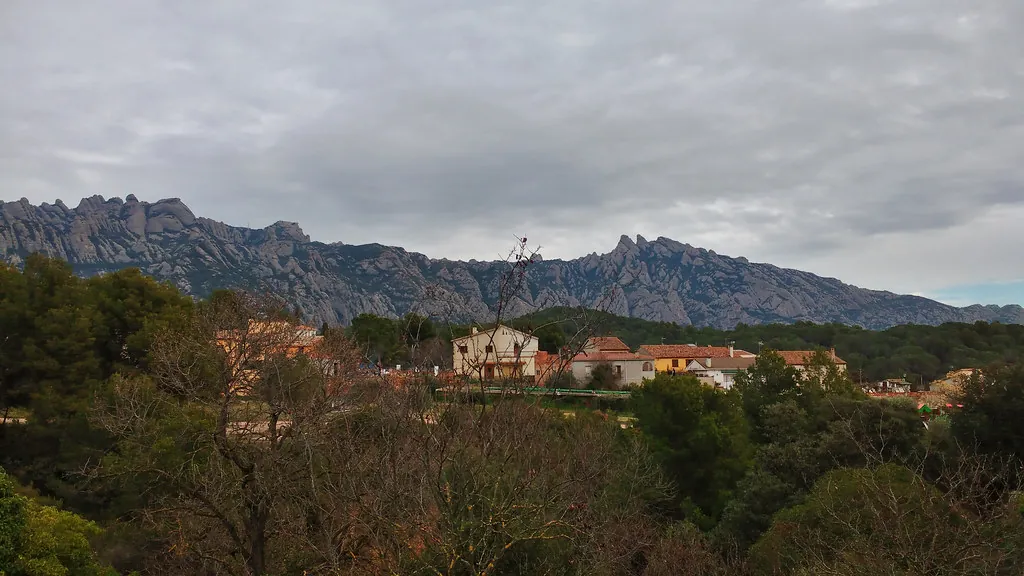
Montmaneu sits at roughly 700 metres in the upper part of Anoia, where the comarca meets La Segarra. Its population, around 180, has remained stable for decades. The village is compact, a cluster of stone houses surrounded by dry farmland and the agricultural tracks that define movement here.
The layout tells you how life has been organised in this part of inland Catalonia for centuries. The main nucleus is tight, a defensive grouping against the open plain, while the municipality is dotted with isolated masías. These farmhouses, some with arched doorways of large stone voussoirs, are the true anchors of the territory. The landscape is open, dedicated mostly to cereals, with holm oaks and small woods breaking the horizon. This is not scenery designed for visitors; it is working land, and its continuity is its primary feature.
Sant Sadurní and the Parish Church
The parish church of Sant Sadurní occupies the centre of Montmaneu. Its origins are medieval, though the current building shows the modifications typical of rural Catalan churches—a blend of periods shaped by necessity rather than grand design. The bell tower, visible from the fields, served for centuries as a reference point for a dispersed population.
The church’s importance was always more functional than architectural. It was the communal and religious centre for families living in the surrounding masías. Inside, the furnishings are simple. The interest lies less in artistic detail than in understanding the building’s role: for generations, this was where the community gathered for mass, markets, and key moments in the agricultural calendar.
The Logic of the Masía
To understand Montmaneu, you need to look beyond the village. The traditional Catalan farmhouse, or masía, is the key unit of settlement here. Several remain within the municipality, some still working farms, others private homes. Their placement follows a clear logic: built on slight elevations near springs or wells, with large lands for cultivation.
You can see this logic from the tracks. Look for the dry stone walls marking property lines, the old threshing floors paved with flat stones near some farmsteads, and the small auxiliary buildings for tools and animals. This built environment is entirely practical, a direct response to cereal farming on this plateau.
Walking the Agricultural Tracks
The best way to see the area is on foot or by bicycle along the unpaved tracks that grid the municipality. They are not signposted trails but working routes used by tractors. The walking is gentle, with no steep gradients.
The landscape changes with the season. In winter, it feels exposed, the bare fields showing the contours of the land. By late spring, the cereal crops cover almost everything in a uniform green. In summer, after the harvest, the colour turns to gold and then to pale stubble. The shifts in light are pronounced, altering the feel of the place completely.
Festivals and Local Rhythm
The annual rhythm follows the parish calendar. The main festival is for Sant Sadurní, with activities concentrated around the church and the village’s shared spaces. It has a neighbourly character, given the size of the population.
Sant Joan in June is also observed, typically with a communal bonfire in the village. Christmas is quiet and family-oriented. These are local events, rooted in tradition rather than organised for external visitors. If you happen upon one, you’ll see a version of customs common across rural Catalonia.
Practical Information
Montmaneu is about 15 kilometres from Calaf and just over 70 from Barcelona. You reach it via secondary roads that cut straight through cereal fields—the approach itself sets the tone.
The village nucleus can be seen on foot in under an hour. After that, time is better spent exploring the network of tracks. A car allows you to cover more ground to see the scattered masías, but walking or cycling gives a better sense of the scale and silence. There are no designated tourist facilities; this is a place you observe rather than consume.
Many use it as a brief stop on a route through Anoia, often continuing to Calaf for services. Montmaneu itself makes no concessions to tourism. Its value lies in its clarity—a precise example of how settlement and agriculture have shaped this high plain of Catalonia.