Full Article
about Amposta
Capital of Montsià and heart of the Ebro Delta, with an iconic suspension bridge and a strong rice-growing tradition.
Ocultar artículo Leer artículo completo
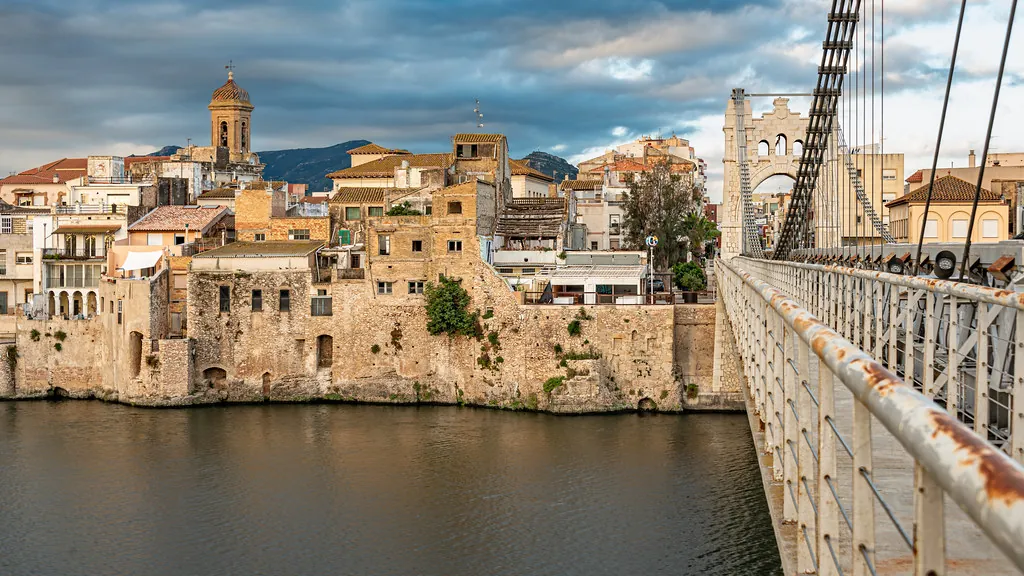
The iron bridge shakes when a lorry rumbles across, sending ripples across the Ebro below. Fishermen on the downstream platform barely glance up; they’ve felt this vibration every day since 1921. From the walkway, the view south is pure delta: rice paddies in perfect rectangles, irrigation canals glinting like mercury, and beyond them the pale line of the Mediterranean ten kilometres away. This is Amposta’s daily theatre, and admission is free.
Most maps mark the town as a mere stepping-stone to the Ebro Delta’s flamingo-filled lagoons. That undersells it. With 22,000 inhabitants, Amposta functions as the region’s agricultural engine room, a place where barges once unloaded oranges and timber, and where the weekly Tuesday market still clogs the streets with tractors rather than tour coaches. The harbour front smells of diesel, damp hemp and—if the wind swings—rice starch from the cooperative silos. It’s utilitarian, not pretty, yet oddly hypnotic.
The River Rules the Clock
Life here answers to the water. Dawn starts with the clatter of metal shutters on the Passeig de l’Ebre cafés; crews from the rice co-ops order short, abrasive coffees before heading to fields that sit below sea level. By eight the bridge traffic thickens: flat-bed trucks carrying seedling trays, cyclists with binoculars strapped to their chests, a lone kayak guide inflating boats on the slipway. The rhythm slows again at lunch—everything closes between two and four—then cranks back to life when the sun drops low enough to bronze the river.
Even the church bells seem timed to the tide table rather than the liturgy. The neoclassical tower of the Parròquia de l’Assumpció dominates the modest old quarter, but locals are prouder of the 1940s market hall behind it. Step inside and you’ll see why: stained-glass panels depict rice sheaves and flamingos in pastel hues that wouldn’t look out of place on a 1930s London Underground poster. Upstairs, Tuesday’s produce market sells Delta oysters for €6 a dozen and tomatoes that still hold their stalky scent.
Flat Roads, Big Sky
Amposta makes an ideal base for two-wheeled exploring. The delta is pancake-flat, criss-crossed by gravel service roads built for combine harvesters. Hire a hybrid from Hotel Rull (€18 a day) and you can freewheel 20 km south to the mouth, where the river splits into braids wide enough to lose a ferry. En route you’ll pass the wooden bird hides at Tancada lagoon; pack a sandwich and wait—flamingos feed in water so shallow their reflection looks like pink calligraphy. Bring repellent from April to June; the mosquitoes have no respect for SPF.
If cycling sounds too energetic, flotillas of small boats leave the river port most weekends (check at the tin-roofed ticket hut; €22 for a two-hour chug). Trips don’t always reach the open sea—sandbanks shift weekly—but the detour through the irrigation canals is worth it. Rice farmers wave from four-metre-long punts, and herons use the boat wake as a moving fishing platform.
Rice is Everything, and Everything is Rice
Order lunch after eleven-thirty and the waiter will still be wiping breakfast crumbs from the tablecloth. Ask what’s good and he’ll shrug: “Arròs, com sempre.” Rice, as always. The local variety carries DOP status, the grains shorter and more absorbent than Italian Arborio. Arroz negro arrives squid-ink black with a whiff of iodine; fideuà swaps rice for toasted noodles, easier on anyone nervous about seafood texture. Portions are calculated for farmhands—two hungry cyclists can split a single plate and still skip supper.
Wine lists are short and local. Terra Alta Garnacha Blanca, pale as straw, cuts through the oil of ali-oli without the oak overload that puts many Brits off Spanish whites. A bottle rarely tops €14, even in restaurants. If you’re self-catering, the cooperativa on the edge of town sells five-litre boxes for €11; perfect for sunset consumption on the river-wall steps.
When the Sun Drops, Cross the Bridge
Evening is Amposta’s finest hour. The ironwork of the Pont Penjat is floodlit amber, and the downstream apron fills with families wielding twenty-metre casting nets. Teenagers queue at the gelato kiosk for €1.80 scoops of turrón, while grandparents park folding chairs to watch the sky turn the colour of dried chilli. The spectacle is free, democratic and mercifully untainted by piped music.
Staying overnight makes sense if you want dawn bird activity or a crack at the full 40-km coastal loop. The three-star Hotel Rull occupies a 1923 merchant’s house on the main drag; rooms are plain but spotless, and staff will store bikes in the cellar. Budget travellers can try the riverside campsite five minutes out of town—clean showers, shaded pitches, and the smell of mint growing wild along the bank.
Getting Here, Getting Out
Public transport is the main snag. The regional train from Barcelona terminates at L’Aldea-Amposta station, still twelve kilometres short of town—add €18 for a taxi or an hour on the connecting bus that runs thrice daily. Driving is simpler: AP-7 south, exit 40, then twenty minutes across pancake-flat rice fields. Parking is free on the streets after six and all day Sunday.
Once you’ve had your fill of feathers and flatness, the coast is fifteen minutes by car. Eucaliptus and Riumar beaches are wild, backed by dunes and lapped by water warm enough for paddling until late October. Unlike the Costa Daurada, there’s no promenade, no sun-lounger touts, and usually no one within 100 metres of your towel. Bring water and shade—the only facility is an honesty-box ice-cream cooler in the car park.
Worth the Effort?
Amposta won’t dazzle anyone hunting for medieval alleyways or boutique hotels. The old quarter fits inside a single square kilometre, and the liveliest nightlife is a crowd of pensionados playing dominoes under the plane trees. What it offers instead is immersion in a landscape still shaped by human muscle and river volume, plus access to one of Europe’s premier wetlands without the package crowds. Come with a bike, an appetite for rice and a tolerance for mosquitoes, and the delta repays the detour handsomely. Come expecting tapas trails and infinity pools, and you’ll be asleep by ten—though, to be fair, so will the locals.
