Full Article
about Sant Jaume d'Enveja
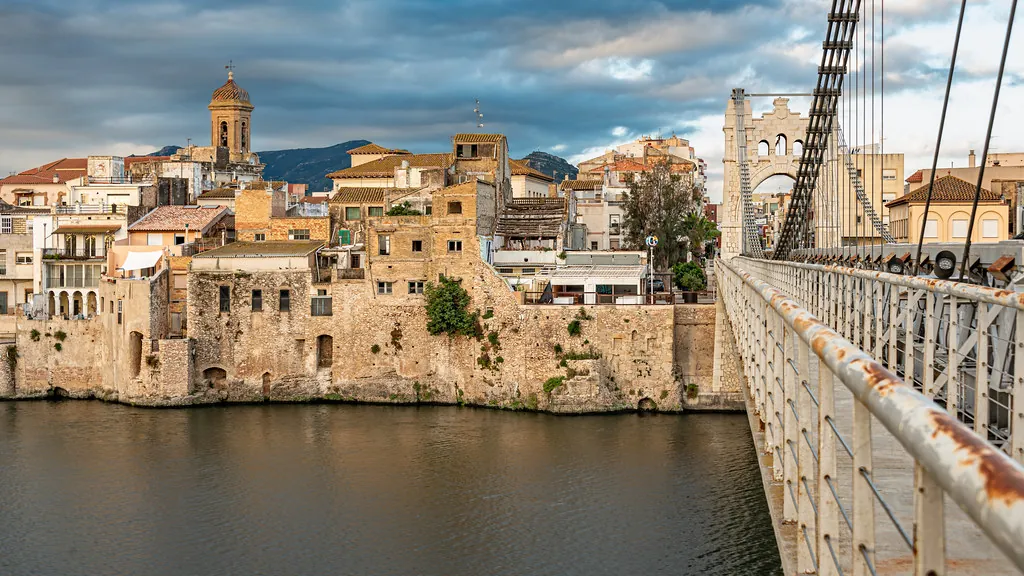
Town in the heart of the Ebro Delta, linked by the Lo Passador bridge and ringed by rice fields.
Hide article Read full article
The road from Amposta ends at a bridge, and then there is only water and sky. Sant Jaume d’Enveja appears on the other side, a low silhouette of houses built on land reclaimed from the Ebro Delta. The air here is thick, carrying the damp, fertile smell of flooded rice fields and the distant, briny hint of the sea.
This is a village of straight lines and right angles, laid out for utility, not postcards. The streets are wide enough for a tractor, the houses painted in sun-faded pastels. Life congregates around the bakery in the morning and the bar in the evening, a slow, quiet pulse. You come here not for the village itself, but for what lies beyond its last streetlight: one of the Mediterranean’s great wetlands, a flat world of mirror-like lagoons and whispering reeds.
The Rhythm of Water and Reeds
Life here is dictated by the rice cycle and the migration of birds. In spring, the paddies are flooded, creating vast shallow lakes that reflect the sky and attract flocks of stilts and avocets. By summer, the green shoots form a dense carpet, and the heat brings a heavy silence, broken only by the call of a marsh harrier. Come autumn, the gold of the harvest is cut through with the deep blue of waterways where fishermen check their traps.
The people who live here navigate this landscape with an unspoken knowledge. You see it in the way an old man pauses his bicycle to scan the horizon, identifying birds by silhouette alone, or in the conversation at the market about which illot yielded the best clams this week. It’s a practical relationship with nature, earned through generations.
Moving Through the Flatlands
Your key to the delta is a bicycle. The land is profoundly flat, crisscrossed by gravel caminos and raised dikes that run for kilometres between fields and lagoons. From Sant Jaume, you can pedal south towards the vast Encanyissada lagoon. The path is straight and exposed, with nothing but rice on either side until the reeds appear, and then the open water. Flamingos are often here, a distant pink smudge against the green, their curved necks bent to feed in the shallows.
Further on, the Puente Lo Passador, a slender metal bridge, carries you over one of the main channels of the Ebro. Stop halfway across. To one side, the river flows broad and slow; to the other, it fragments into a maze of smaller canals that feed the wetlands. At sunset, the light doesn’t fade so much as dissolve into the water vapour, turning everything—sky, river, far-off mountains—into layers of soft violet and grey.
A short drive or a long ride north of the village brings you to Les Barraques. These are not quaint replicas but reconstructed thatched huts, built from reed and wood using traditional methods. The small interpretation centre nearby explains their use by fishermen and field workers with a straightforward clarity. It feels honest, a nod to a harder way of life that wasn’t so long ago.
A Taste of the Mudflats
The delta’s kitchen is built on two things: rice and what comes from its brackish waters. The signature dish is arroz del delta, which here often means rice with eel and galeras, a type of mantis shrimp. The eel is rich and gelatinous, a world away from fish-and-chip shop fare; the galeras have a sweet, dense flesh. It’s a flavour of mudflats and freshwater currents.
You won’t find elaborate menus or fusion experiments in the village’s eateries. You will find family-run places where the day’s catch dictates what’s cooked. Rice dishes are usually made for two and require ordering ahead. For something simpler, bars along the main street serve tapas like small river prawns or local sausages, best eaten standing at the counter with a cold beer.
If You Go
Come between April and June or September and October. The temperatures are mild, the mosquitoes are less fierce, and bird activity is at its peak—during migration periods, the skies are busy. July and August bring a palpable heat that sits on the landscape from noon until dusk, along with clouds of insects.
You will need a car. While you can rent bicycles in Amposta or Deltebre, reaching Sant Jaume d’Enveja and exploring different corners of the delta requires one. Book accommodation early; options in the village are very limited. Many stay in Amposta, a 15-minute drive away.
Pack binoculars. Even if you’ve never noted a bird in your life, this place will make you want them. Bring water, sunscreen, and a hat for cycling—shade is a rare commodity out on the dikes.
Sant Jaume d’Enveja doesn’t perform for visitors. Some shops close for siesta, restaurant hours can be flexible, and after dark, the streets are quiet save for the murmur of televisions through open windows. The reward is access to a living wetland at dawn or dusk, when the light turns long and the only sound is wings cutting through humid air