Full Article
about Àger
Historic town at the foot of Montsec; world-class destination for free flight and astronomy
Hide article Read full article
Tourism in Àger often begins with a simple question: where to leave the car. The historic centre is a tight weave of narrow streets with limited space. Most visitors park in the lower part of the village and walk up. Arrive late and there may be a few laps involved before finding somewhere suitable. Early morning or the end of the afternoon makes for an easier approach on foot. By mid-morning, cars and paragliders begin to appear in greater numbers.
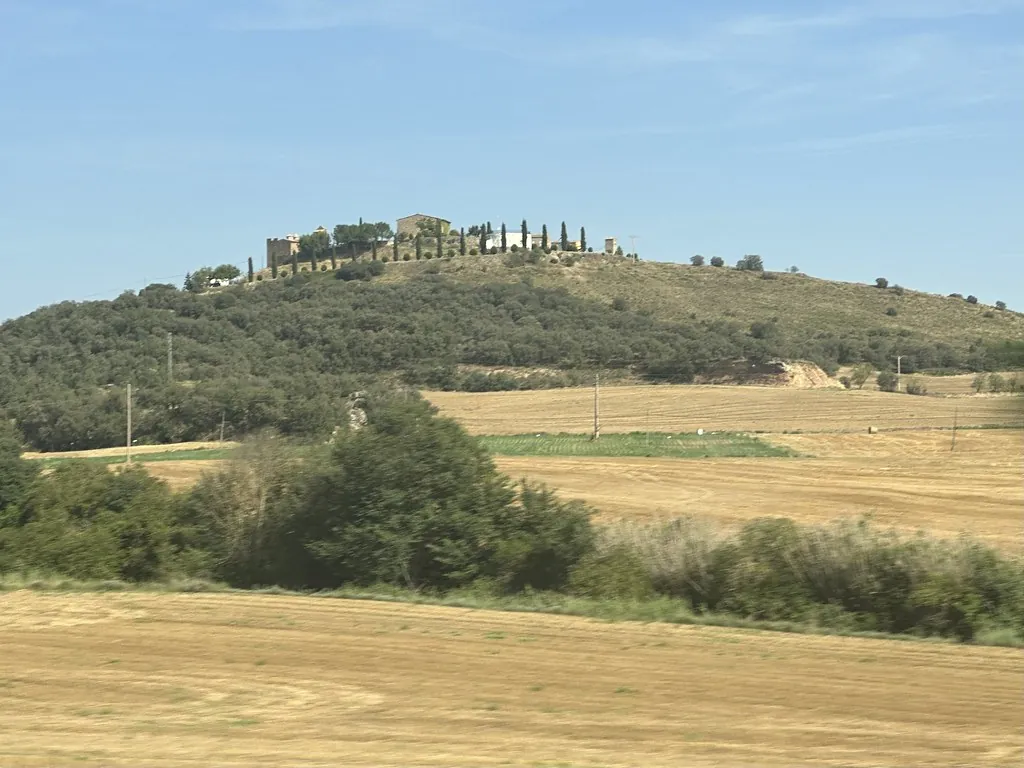
Àger is small and can be covered quickly. From the lower streets, the route climbs towards the collegiate church along steep lanes lined with sober stone houses. There are few shops and hardly any display windows. This is a quiet place, somewhere people pass through rather than linger all day.
In warm weather, carrying water is sensible. Some of the uphill stretches offer little shade, and the sun can be strong.
Stone on the Hill: The Colegiata and Castle Remains
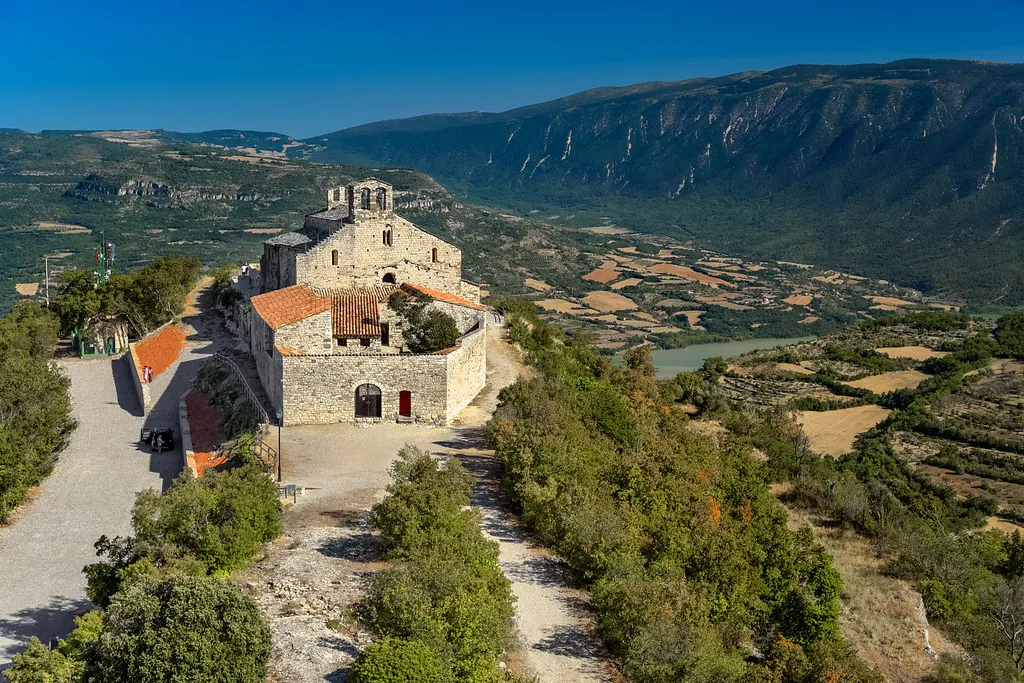
At the top stands the Colegiata de Sant Pere, a Romanesque church dating from the 11th century. Its thick stone walls and simple lines give it a solid, restrained presence. Inside, the atmosphere is austere. The visit does not take long, yet it helps explain why Àger once mattered on the medieval frontier. In that period, this area lay on contested ground, and religious and military buildings were closely linked.
A few metres away are the remains of the castle. There is no complete fortress waiting at the summit. Instead, fragments of walls and traces of the old enclosure hint at what stood here before. The real reward is the view. From this height the valley opens out, and in the distance lies the embalse de Canelles, its waters cutting into the landscape.
The setting clarifies the strategic importance the site once had. Even today, the sense of elevation shapes the experience of the village.
The Congost de Mont-rebei
Many people come to Àger because of the Congost de Mont-rebei. The gorge lies relatively close and has a strong influence on life in the area. Sheer rock walls rise high above, with the river running below, tightly enclosed between the cliffs.
The best-known path is carved directly into the rock face. In places it narrows, and it is not always comfortable when there are large numbers of people. Before setting out, it is usually wise to check access conditions and the weather. Strong winds or intense heat can change the character of the walk considerably.
The Congost de Mont-rebei has become one of the defining landscapes of this part of Catalonia. Its scale and geology draw walkers from far beyond the village itself, yet the experience depends heavily on timing and conditions. On busy days, patience is part of the journey.
Paragliders Over Montsec
The Montsec mountain range rises immediately above Àger. When the wind cooperates, the sky fills with paragliders and hang gliders. Take-offs from the higher areas of the sierra are a common sight, and the movement overhead becomes part of the rhythm of the place.
Those who do not fly can explore on foot. There are trails that climb towards the ridge and others that circle the embalse. Some routes follow straightforward tracks, while others involve loose stones and serious gradients. This is not terrain for flip-flops. Proper footwear and a realistic sense of distance matter here.
The relationship between village and mountain is direct. Àger sits at the base of a landscape shaped by rock and wind, and outdoor activity defines much of its appeal. Even a short walk above the houses changes the perspective, placing the village in the wider context of the Montsec.
Dark Skies and Simple Cooking
After sunset, the area is known for its exceptionally clear skies. Nearby is the Parque Astronómico del Montsec, recognised for its low levels of light pollution. When the weather allows, observations are organised, taking advantage of the darkness that is increasingly rare in much of Europe.
The quality of the night sky has become another reason to pause in Àger, even if only briefly. Away from major urban centres, the absence of artificial light reveals stars with unusual clarity.
As for food, the norm in this part of Catalonia is straightforward cooking. Embutidos, the cured sausages typical of the region, appear regularly. There may be lamb when available, and cheeses from nearby producers. The approach is uncomplicated and rooted in what the surrounding countryside provides.
Àger works well as a long half-day stop. Village streets, the viewpoint by the Colegiata de Sant Pere, perhaps a stretch of mountain path. Those looking for urban life will not find it here. For anyone interested in the landscapes of the Montsec and the proximity of the Congost de Mont-rebei, stopping in Àger makes sense.
The scale is modest, the pace unhurried. The draw lies in stone, height and open sky rather than in entertainment or shopping. In that context, the practicalities of parking and walking uphill feel like part of the experience rather than an inconvenience.