Full Article
about Artesa de Segre
Key communications hub and market town; gateway to the Prepirineo with several outlying hamlets
Hide article Read full article
The Segre Sets the Pace
The Segre runs thick and almost muddy after the spring rains. From the Pont Vell, the old bridge, the water moves slowly beneath your feet, carrying fine branches and the smell of damp earth. Early in the morning there is little to hear beyond the river and the occasional car heading towards the Montsec road. From this spot the town opens out in front of you: low houses, dark roofs and more recent apartment blocks. Tourism in Artesa de Segre often begins here, looking at the river and understanding how the valley shapes everything around it.
The valley gives the place its rhythm. Fields stretch out from the water, and beyond them the land begins to rise. The light changes quickly here, especially in the first hours of the day, when it slips in low through the Vall d’Ariet and clings to the almond groves. On clear mornings the neat rows of trees take on an almost silvery sheen.
Artesa de Segre sits within this landscape rather than apart from it. The river, the crops and the distant hills are not a backdrop, they are the framework around which the town has grown.
When the Town Was a Frontier
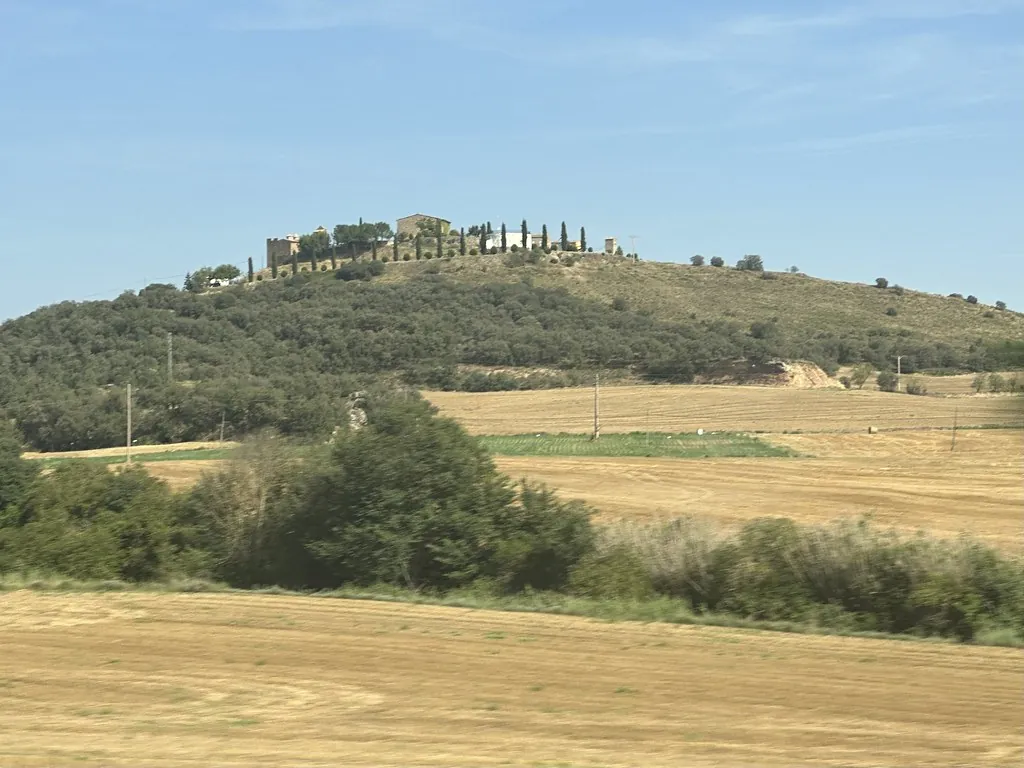
On a nearby hill stands the site known as el Castellot, an Iberian settlement that once watched over this natural passage through the valley. The climb takes around twenty minutes. It is not especially long, but after rain the reddish soil sticks to your shoes and slows the pace.
At the top the view opens suddenly. To the north, the sierra del Montsec appears as a long, bluish wall. To the south, the terrain gradually flattens towards the plain of Lleida. The Segre winds between cultivated plots that, seen from above, look like uneven steps cut into the land.
This was once a strategic position. From here it is easy to see how the valley narrows and widens, how movement could be observed and controlled. Today, what remains is the sense of height and exposure. At midday the sun falls hard and there is little shade on the hill. It is better to come early or towards the end of the afternoon, when the light softens the outlines of the Montsec and the fields below.
Back in town, the slopes and narrow streets of the old quarter reflect that same terrain. Cars struggle with the gradients, which is why it makes sense to park on the outskirts and continue on foot. Sooner or later you reach a small square with stone benches. Almost every afternoon someone is there playing cards or simply watching time pass as the Montsec in the distance turns a muted red.
Small Settlements Across the Valley
The municipality of Artesa de Segre is large, scattered with small villages spread across the valley and the nearby hills. Some consist of only a handful of houses grouped around a church and a fountain. They are separated by narrow, winding roads, so visiting them requires time and, in practice, a car.
These are quiet places even in summer. By mid-morning the dominant sound is the hum of insects along the field margins. Now and then a flock moves downhill towards the valley, the soft clanging of bells echoing briefly between the slopes.
In some of these small communities goat’s cheese is still made in a fairly traditional way. It is usually sold directly on site or at local markets. The curing rooms have a distinctive smell, a mix of milk, dampness and cold stone, that clings to clothes for hours afterwards.
The pace in these villages is unhurried. Doors remain open, conversations drift out into the street and the day revolves around the fields and the weather. Even at the height of summer, there is little sense of bustle.
The Industrial Colony by the River
Halfway between the main town and the Segre stands an old industrial colony built around a factory. Its layout is still clearly visible: rows of similar houses, a small square and shared buildings that once organised the lives of the workers.
Only a few people live there today, yet the sense of order remains. Straight streets, repeated façades and gardens that are still tended give the area a particular character. It is easy to imagine how daily life was once structured around the factory bell and the routines of production.
Many of the house doors retain their dark wood, worn smooth by years of use. In some courtyards there are remnants of former warehouses or workshops. Walking here at dusk brings a distinctive silence, broken only by the nearby river and the distant bark of a dog.
The colony forms a contrast with the older, more irregular streets of Artesa de Segre itself. It reflects a different chapter in the town’s history, when industry reshaped the riverbank and introduced a more rigid geometry to the landscape.
Sundays of Cargols and August Nights
When the heat arrives and rain has recently fallen, snails begin to appear along the edges of the fields. They have long been gathered here and often end up cooked in a llauna, a metal tray set over embers, with garlic, oil and a little rosemary. The dish is known locally as cargols, a speciality across parts of inland Catalonia.
It is Sunday food. Lunch stretches into the afternoon, and the smell of allioli, a garlic mayonnaise, mingles with smoke from the grills. Meals are slow, and conversation carries on well after the plates are cleared.
August changes the atmosphere of the town. Many families who live elsewhere return for a few days, and the squares fill at night. Long tables are set up beneath the plane trees in the main square. Sardanas, the traditional circle dances of Catalonia, are played, and older residents move through the steps almost without looking at their feet.
These gatherings are simple but central to summer life. The return of those who have left, the music and the shared meals give the town a temporary sense of expansion before it settles back into its quieter routine.
Getting There and Choosing the Moment
Spring is often the most rewarding time to visit. The almond trees blossom across the valley and the river carries enough water to be heard from nearby paths. The air feels fresh, and the fields are active without the intensity of summer heat.
In summer temperatures rise quickly, especially after midday. If travelling at that time of year, it makes sense to explore early in the morning or wait until late afternoon, when the light softens and the heat eases.
Artesa de Segre is less than an hour by road from Lleida. Public transport does exist, though with limited services, so coming by car is usually the most practical option.
Within the old centre, parking is best left to the outer areas before continuing on foot. The streets are narrow and steep. Eventually you will find that small square with its stone benches, someone shuffling a deck of cards, and the Montsec turning reddish in the background as the day draws to a close.





