Full Article
about Castelló de Farfanya
Historic town dominated by the ruins of a large castle and a Gothic church.
Hide article Read full article
Arriving and finding your pace
If you come to Castelló de Farfanya, start with the car, but don’t expect to keep using it. Most people leave it in the lower part of the village and continue on foot. The central streets are narrow, and driving through them rarely feels worth it.
Mid-morning is the easiest time to wander. There’s a quiet rhythm, with little interruption. Later on, there is a bit more movement, but it never turns into crowds.
Castelló de Farfanya has around 500 residents. It sits in the comarca of La Noguera and remains an agricultural village in every sense. That shows in the pace of daily life, the stone houses, and the general lack of hurry. There is no large monumental complex to draw attention. Instead, the appeal lies in a small, straightforward historic centre that can be covered in a short walk.
The old centre
The main reference point is the church of Sant Miquel, visible from several parts of the village. Like many churches that have grown over time, the building reflects different periods rather than a single style.
Around it, the streets are short and slightly irregular. The houses are plain, with old doorways and the occasional small square where everyday life continues without much fuss. You might see washing hanging out, neighbours talking, or cars parked wherever they fit. Nothing feels arranged or staged.
A gentle loop is enough to take it all in. There’s no real need for a map, and no pressure to follow a route. The scale of the place does the work for you.
Fields and tracks beyond the village
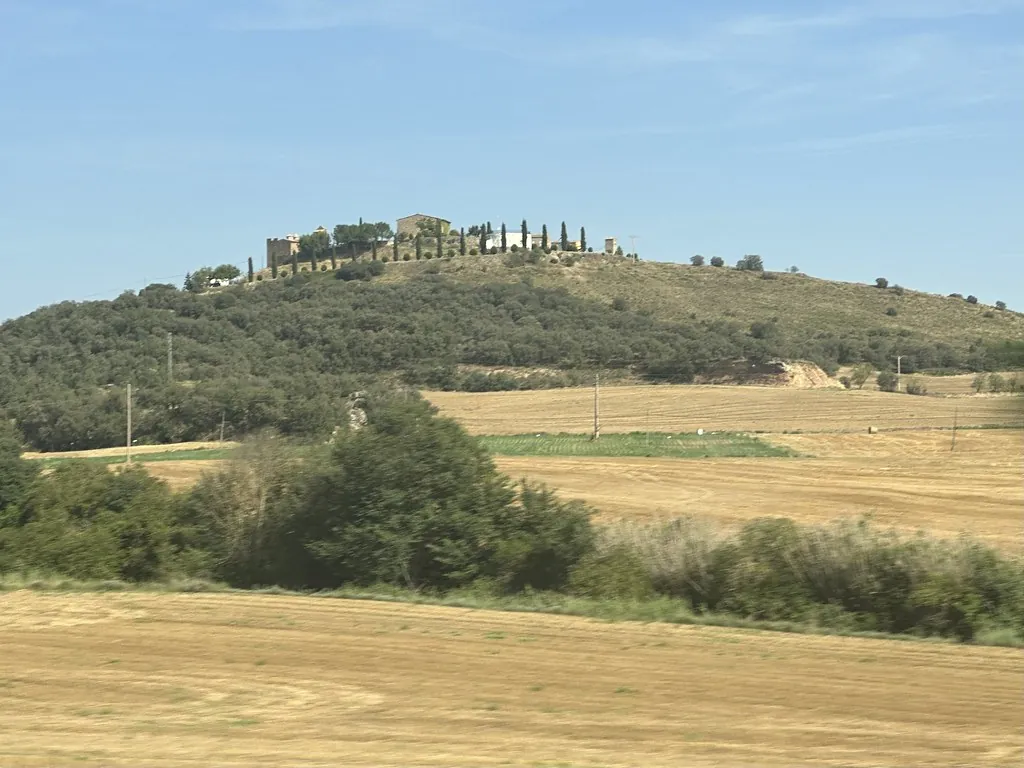
Step outside the village and the landscape opens quickly. There are wide stretches of cereal crops, some almond trees, and scattered masías, traditional rural buildings typical of this part of Catalonia.
The terrain is open and, for much of the year, quite dry. Dirt tracks run through the fields, mainly used by farmers but also suitable for walking or cycling. They are easy to follow and not demanding.
The main challenge here is the sun. In summer, shade is scarce and the heat can be intense. Carrying water and some form of protection is essential, especially if heading out around midday.
Spring brings a slight shift. The fields turn greener, and there is a bit more activity. Even so, the landscape keeps the character of dry farming that defines this area of Lleida.
A change of scene at the Camarasa reservoir
A few kilometres away lies the pantano de Camarasa, on the river Noguera Ribagorçana. Reaching it requires a car, but the change in scenery is immediate. The dry fields give way to a broad expanse of water.
Around the reservoir, it’s common to see people fishing, and depending on the time of year, some water birds as well. Others come simply to walk or to spend a while looking out over the landscape.
It isn’t part of the village itself, but many visitors include it in the same outing. The contrast adds another dimension to what would otherwise be a very brief visit.
Local life and small celebrations
The main festival usually takes place around Sant Miquel, at the end of September. The atmosphere is very much that of a small village: religious events, gatherings among neighbours, and some evening celebrations.
Throughout the year, there are also moments tied to the traditional Catalan calendar. These include the castañada, a seasonal celebration linked to roasted chestnuts, and summer bonfires. They are not designed as attractions for visitors. They belong to the people who live here and follow their own rhythm.
Getting there and how long to stay
Castelló de Farfanya is in La Noguera, within the province of Lleida. It is reached by local roads that connect to the N‑II and other routes in the area.
From Lleida, the journey takes about an hour, depending on the route. From Barcelona, it takes significantly longer, with the final stretch always along secondary roads.
Public transport is limited, so travelling by car is the usual option.
For those already passing through La Noguera, it works well as a short stop. A walk through the old centre, a look around, and perhaps a drive to the Camarasa reservoir can comfortably fill a few hours. There’s no need to plan more than that.