Full Article
about Cubells
Town with a superb Romanesque façade on its church; natural balcony over the region.
Hide article Read full article
By mid-morning, the sound of a hoe striking dry soil carries from the small plots around the village. Swifts cut quickly across the sky, skimming close to the rooftops. In Cubells, sound seems softened, as if the rocky outcrop where the settlement sits filters out the rest of the world.
Narrow streets, uneven stone underfoot, neighbours going about their day without interruption. There is no sense of staging or urgency. This is simply a small village in La Noguera that continues much as it always has.
Cubells does not rearrange itself for visitors. What you encounter is daily life, steady and unpolished, shaped by routine rather than expectation.
The climb to the castle fragments
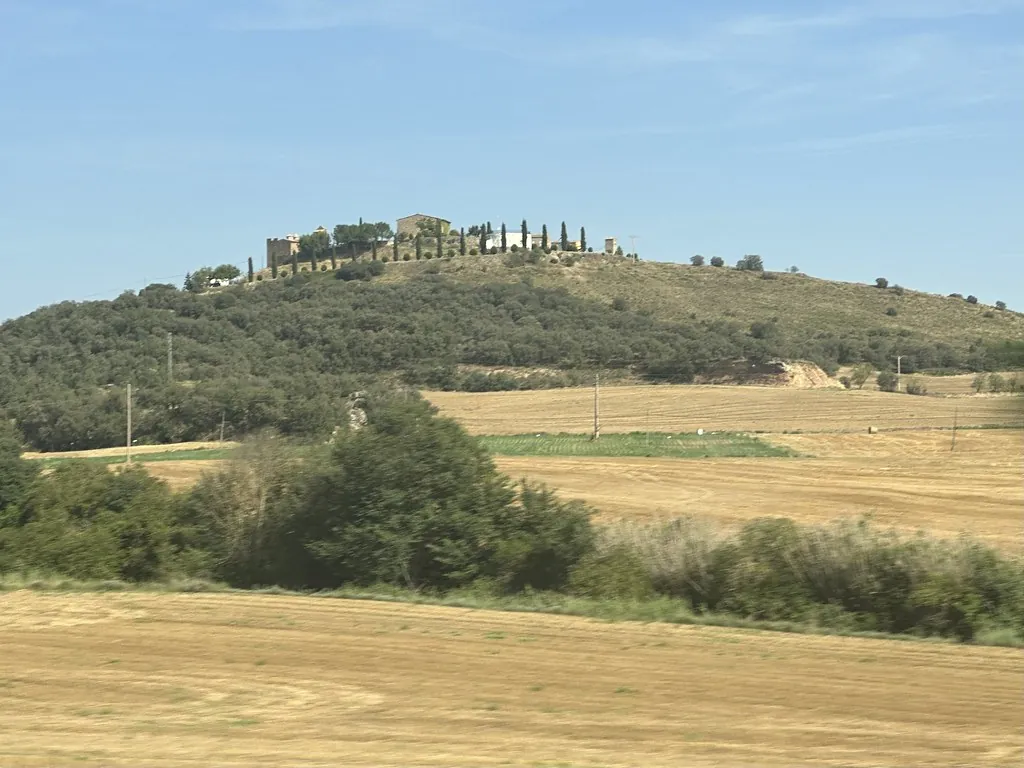
Cubells rises on a hill overlooking the Segre valley. From below, its outline is easy to pick out: the remains of an old castle and the cluster of houses gathered around it.
The castle survives in fragments. Sections of wall still trace its perimeter, though much has disappeared. The site is already mentioned in medieval documents, likely around the 11th century. Today it is less a monument than a short walk that ends in quiet and wide views over the surrounding fields.
There is no easy road access all the way to the top. The final stretch must be done on foot along somewhat uneven stone paths. After rain, care is needed, as some slabs can be slippery. The climb is not long, but it slows your pace and draws attention to the ground beneath your feet.
Up there, the sense of height is clear. The land opens out, and the village below feels compact, gathered close to the slope.
Stone, wood, and ordinary sounds
At the centre of Cubells stands the church of Sant Pere. Its base retains Romanesque features, although the building has been altered several times over the centuries. The bell tower is modest in size, yet visible from most parts of the village.
Around it, stone houses line the streets. Thick wooden doors and narrow windows are common. Many façades include practical details shaped by daily use: wood stores built against the wall, fixed benches by the entrance, and occasional arches that offer shade during the summer.
At certain hours, the sound of tools carries from small garages or storage spaces. Someone repairs a metal gate. Someone else checks a tractor wheel. Nothing appears arranged for effect. These are ordinary tasks, carried out without fuss.
Walking through the old centre means accepting its irregularities. The paving is not even, the streets do not follow straight lines, and corners reveal small variations in how each building meets the next. The village feels cohesive, though not uniform.
Evening light over the Segre
From several points along the edge of the village, the ground drops sharply towards the valley. In the distance, the reservoir of Santa Anna appears as a band of blue that shifts in tone depending on the light.
Towards evening, when I was last there in October, the light arrived at a low angle. Hillsides took on a golden colour, and the fields formed broad patches of ochre and green. The change was gradual rather than dramatic, but it altered the entire scene.
Sound travels differently at that time of day. A distant engine might be heard, or a dog barking from a scattered farmhouse. Otherwise, there is little to interrupt the stillness.
Those looking for that quieter moment will find it later in the day. Around midday, especially in summer, the sun is strong and shade is scarce on these exposed edges.
Tracks through fields and orchards
Beyond the built-up area, agricultural tracks extend into the surrounding land. They link fields of cereal crops, olive groves, and almond trees. These routes are not usually signposted for walkers, but many are wide and easy to follow.
The landscape shifts with the seasons. In spring—usually late February or early March here—almond trees bloom in white and pink against pale earth. Later in summer, colours flatten into yellows; dust rises from paths and dry heat shapes any movement you make before ten in the morning.
The area also attracts those interested in birdlife. Near the reservoir and across cultivated land you can spot herons or kestrels using open terrain; activity tends to be greater at dawn when light is softer and air cooler.
These paths do not present a single defined route; they offer a network that invites wandering with village rooftops always visible as reference point behind you.
A table shaped by dry land
Local cooking reflects what grows nearby: olive oil pulses almonds seasonal vegetables form basis for many dishes When temperatures drop meals tend towards stews; during hotter periods food becomes simpler lighter often relying on tomatoes peppers good oil
Olive oil often comes from cooperatives within wider comarca Nearby villages also make cured meats wines tied to these dry lands where vines olive trees have been cultivated centuries
Throughout year some celebrations remain linked agricultural calendar Certain festivities revolve around harvest recall older farming tasks not entirely disappeared here
Cubells does not depend on tourism It’s home just over three hundred people time still shaped by fieldwork seasons Visitors notice this quickly There’s no spectacle designed impress What exists instead landscape quiet everyday life continuing at its own pace