Full Article
about Menàrguens
Agricultural village near the Segre River; former sugar mill
Hide article Read full article
A quiet corner of La Noguera
Early in the day, when the sun still sits low over the plains of La Noguera, Menàrguens carries the smell of damp earth and cool wood. The nearby river Segre moves slowly, tracing soft curves between orchards and drier plots where the soil turns a muted brown. Tourism in Menàrguens comes without urgency or headline sights. The village invites the same unhurried pace with which mornings tend to begin here.
Around 800 people live in the municipality, which spreads across a wide agricultural landscape. Lleida lies roughly twenty kilometres away, close enough for a day trip. Even so, the appeal here lies in slowing down and paying attention to the surroundings. Dirt tracks cut through the fields, tractors pass raising fine dust, and rows of trees shift in colour as the months change.
A walk through the streets reveals stone houses and ivy-covered walls that reflect a long connection to the land. There are no grand monuments or carefully staged postcard views. Instead, everyday sounds define the place: a shutter lifting, voices echoing from an open window, gravel crunching under the tyres of a car easing into the square.
The village and its details
The centre of Menàrguens is organised around the parish church of Santa María, an old building that has evolved over the centuries. Its façade is modest rather than imposing, though a closer look shows the marks of time etched into the stone and worn decorative mouldings. Inside, light filters through simple stained glass, creating a calm atmosphere where even footsteps seem quieter.
The old quarter keeps its stone houses, with iron balconies and wide doorways that once allowed carts and animals to pass through. There are no information panels explaining what stands in front of you. The place works best at a slow pace, with attention on small details: a wooden door darkened by age, a vine climbing up a façade, plant pots lined along a windowsill.
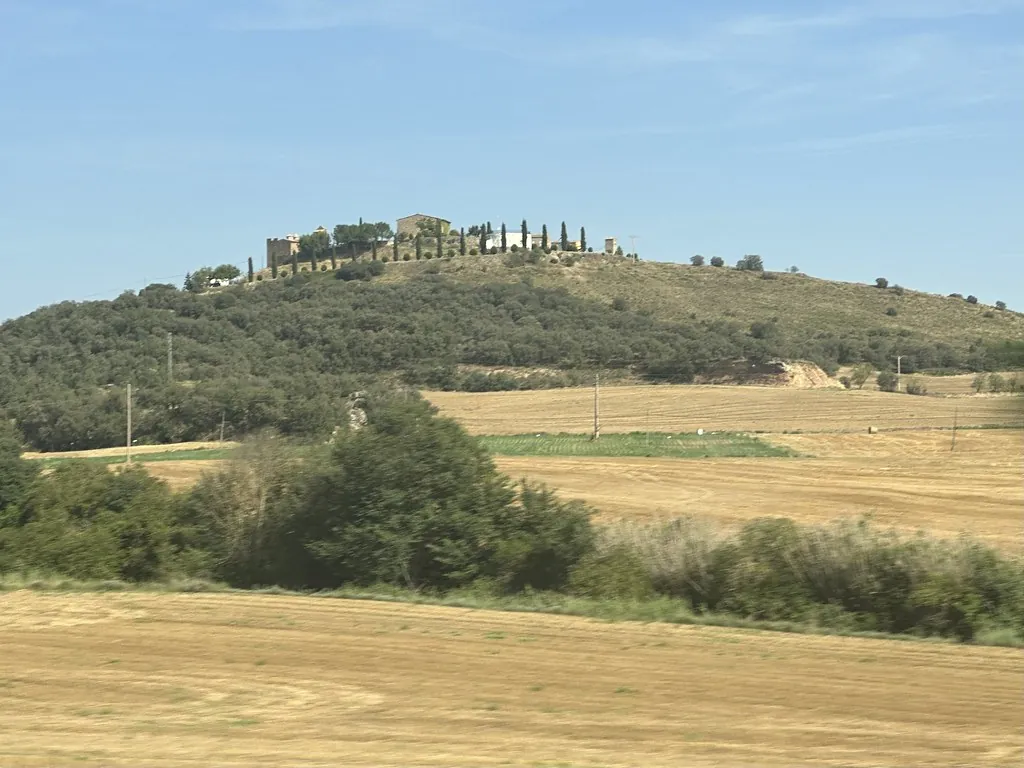
Beyond the streets, the surrounding countryside takes over. The landscape is shaped by agriculture, open and expansive. February and March bring the first blossoms, when almond trees and other fruit trees begin to flower and scatter white and pink across the fields. Summer shifts the palette to denser greens, and the heat builds from mid-morning. During those weeks, early starts or late afternoon walks make more sense along the rural tracks.
Along the Segre and through the fields
The paths around Menàrguens are flat and easy to follow. Many are used daily by farmers and connect with other nearby villages in La Noguera. Walking or cycling here does not demand much effort, and the routes unfold gradually through the farmland.
Closer to the Segre, the scenery changes slightly. Poplar groves appear, bringing patches of shade, and the constant sound of water breaks the stillness of the fields. Signposted trails are not always present, so the simplest approach is to stick to the main agricultural tracks and avoid entering private land or crossing cultivated areas.
Windy days are common in this part of Catalonia. When it picks up, the leaves move all at once and the fields produce a steady murmur. It is a small detail, yet it reveals something essential about the rhythm of the place when you stop long enough to notice it.
A base for exploring La Noguera
A short distance away lies Balaguer, often the natural next stop for anyone extending a visit. The atmosphere shifts there, with more movement, shops, and visible remains of old walls. Its historic centre still reflects a medieval past, offering a contrast to the quieter pace of Menàrguens.
Across the comarca, vineyards linked to the Costers del Segre designation appear in different municipalities. Their appearance changes with the season. At certain times, vines are heavy with grapes; after the harvest, they stand bare, and the reddish soil becomes more visible between the rows.
Secondary roads criss-cross the area and reward an unhurried drive. Many run through open fields where the horizon stays clear and the sky fills a large part of the view. The sense of space becomes part of the experience, rather than simply a backdrop.
Life shaped by seasons
The main annual celebration, the Fiesta Mayor, usually takes place in August, when the heat settles heavily over the village even after sunset. During those days, the streets fill more than usual. Open-air dances, long shared tables for communal meals, and a livelier atmosphere briefly change the rhythm of daily life.
For the rest of the year, things return to a steady pace. Agricultural work sets the timetable, and the seasons are clearly reflected in the landscape. Winter brings pruning. The end of the colder months leads into flowering. Harvest arrives when summer is already well advanced.
Anyone expecting constant activity may find little of it here. Menàrguens operates differently: a small village surrounded by fields, where the most interesting moments often sit in the details that pass unnoticed when time is short.