Full Article
about Os de Balaguer
Large municipality with prehistoric caves; monastery of les Avellanes and castle
Hide article Read full article
A Detour into La Noguera
There are moments on a secondary road when a signpost appears with the name of a village you have never heard of. Os de Balaguer can easily be one of those names. It sits in the comarca of La Noguera, a county in the province of Lleida, a short distance from the town of Balaguer and close to where the landscape begins to hint at the Pre-Pyrenees.
With just over a thousand residents, it is small and easy to cover on foot. Yet it carries enough character to justify pulling over and having a look. The impression is of an old settlement where different periods have quietly layered themselves over time, like a wall revealing traces of earlier paint beneath the surface.
This is not a place that tries to dazzle. It simply exists, shaped by its geography and its routines.
Streets that Climb Towards Santa María
The centre of Os de Balaguer is compact. Narrow streets rise and fall without much apparent logic, the sort that make you slow down because each corner suggests something new. There is no grand urban plan to decipher, just the organic layout of a village that grew as it needed to.
At the highest point stands the church of Santa María. Its origins date back to the medieval period, though like many buildings in this part of Catalonia it has been altered and restored over time. The bell tower acts as a visual guide. From almost anywhere in the old quarter you can glimpse it above the rooftops, a steady reference point as you wander.
If the door happens to be open, it is worth stepping inside briefly. The appeal lies less in specific decorative features and more in the overall atmosphere. The interior feels restrained and simple, in keeping with the tone of the village itself.
Around the church are stone houses, some bearing coats of arms on their façades. Others have been restored, blending newer materials with older walls. The overall look is not uniform, and that is part of its appeal. It feels like a lived-in place rather than a carefully staged setting.
Views Over the Segre Valley
The old streets taper off almost without warning. One moment you are between houses, the next you are looking out across open land.
The River Segre shapes much of the surrounding scenery. From various points in the village, views open onto fields and low hills that roll gently away. There are no formal viewing platforms set up for photographs. Often it is enough to follow a street that climbs a little further than expected and simply stop.
To the north, on clear days, the ridges of the Pre-Pyrenean ranges draw a line along the horizon. The landscape is not dramatic in an overwhelming sense. It is quieter than that, something to take in slowly rather than tick off a list.
The feeling is of space and light, especially when the weather is settled and the outlines of the hills are sharply defined.
Rural Tracks Through Mediterranean Countryside
Beyond the last houses, broad rural tracks begin. Some link Os de Balaguer with nearby small settlements and were traditionally used for moving livestock or transporting harvests.
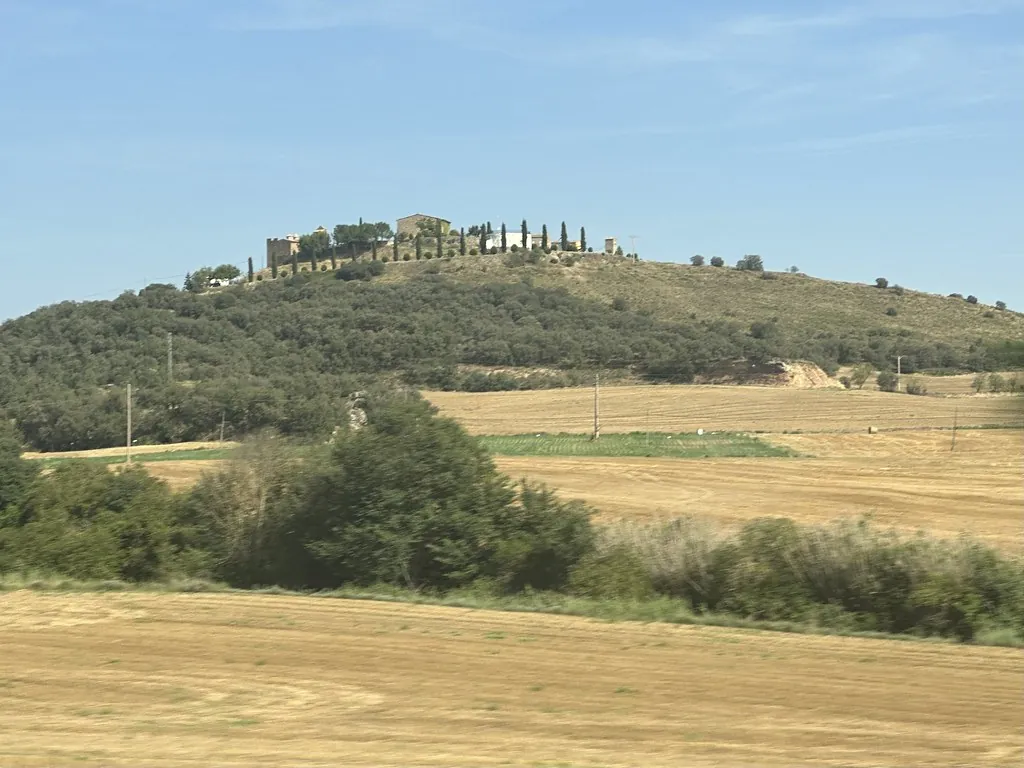
The setting is distinctly Mediterranean. Aleppo pine and scattered holm oak appear among low scrub. Between these patches of woodland lie cereal fields, olive groves and occasional areas of almond trees. The pattern shifts as you move further out, but agriculture remains a constant presence.
For those who enjoy walking or mountain biking, there is plenty of ground to explore. The tracks are generally wide and open, and you can spend hours circling through the surrounding countryside without straying far from the village.
It is wise to come prepared. In summer the sun can be intense and shade is limited along many stretches. Carrying water may sound obvious, but here it makes a noticeable difference to how comfortable the outing feels.
The overall experience is simple: earth underfoot, the smell of dry vegetation, and long views back towards the cluster of houses and the tower of Santa María.
A Quiet Spot for Birdwatching
The area around Os de Balaguer also draws people interested in birdwatching. The mix of farmland and the margins of the River Segre creates steady movement, particularly early in the day.
Species linked to open countryside are commonly seen, including partridges and thrushes. At certain times of year birds of prey appear as well, taking advantage of air currents that rise from the nearby hills. You do not need specialist knowledge to appreciate it. Sitting still for a while and watching the sky can be enough.
The combination of river, fields and low ridges gives the area a varied feel despite its modest scale. Even without identifying every species, it is easy to notice how active the landscape can be.
Extending the Day to Balaguer
If, after a walk through Os de Balaguer, there is still time and energy left, Balaguer is only a short drive away. As the capital of the comarca, it is larger and has a more extensive historic centre.
There you will find a broader mix of religious and civil buildings from different periods. Many visitors combine both places in a single day. First the calm of Os de Balaguer, then the slightly livelier atmosphere of Balaguer.
The contrast works well. One offers quiet streets and open views, the other a denser urban setting with more going on.
A Village That Keeps Its Own Rhythm
Os de Balaguer does not compete for attention. There are no streets lined with souvenir shops and few signs aimed specifically at visitors. Daily life continues at its usual pace.
Local festivals bring more energy for a few days during the summer. At that time the village fills with returning residents and the squares become noisier and more animated. For the rest of the year, the rhythm remains steady and subdued.
Nothing extraordinary may happen during a short visit. That is part of the appeal. A slow walk through the lanes, a pause to look over the Segre valley, a moment of silence broken only by distant sounds from the fields. Then the road continues, and with it the sense of having glimpsed a very real corner of inland Catalonia.