Full Article
about Térmens
A farming town with a converted old sugar mill; beside the Segre
Ocultar artículo Leer artículo completo
The barley turns gold in late June, and the whole village knows it. Combine harvesters crawl across the plain like bright-green beetles, kicking up dust that drifts over the single-track railway and settles on the stone walls of Carrer Major. In Termens, the calendar is still ruled by cereal, not by school holidays or airline sales. That simple fact explains almost everything a visitor needs to know.
A Plain-Speaking Place
Termens sits on the fertile floor of the Segre valley, 35 km north-west of Lleida and exactly 208 m above sea-level. There is no dramatic gorge, no cliff-top castle, just a grid of quiet streets laid out for tractors as much as for cars. The church bell of Sant Andreu tolls the quarters; the town’s single bar opens at seven for the farm crews; and the evening paseo is a slow lap of barely three blocks. Guidebooks tend to overlook villages like this, which is why they still work.
Architecturally, the centre is a palimpsest of rural practicality. Eighteenth-century stone houses wear twentieth-century render; modernista iron balconies curl off façades that are still grounded by barn doors wide enough for a cart. Nothing is staged for tourists, so the details arrive as small surprises: a stone coat-of-arms wedged into a garage wall, Art-Nouveau tiles framing the bakery window, irrigation runnels cut straight into the pavement to carry away storm water from the fields that begin where the pavement ends.
Walking the Checkered Fields
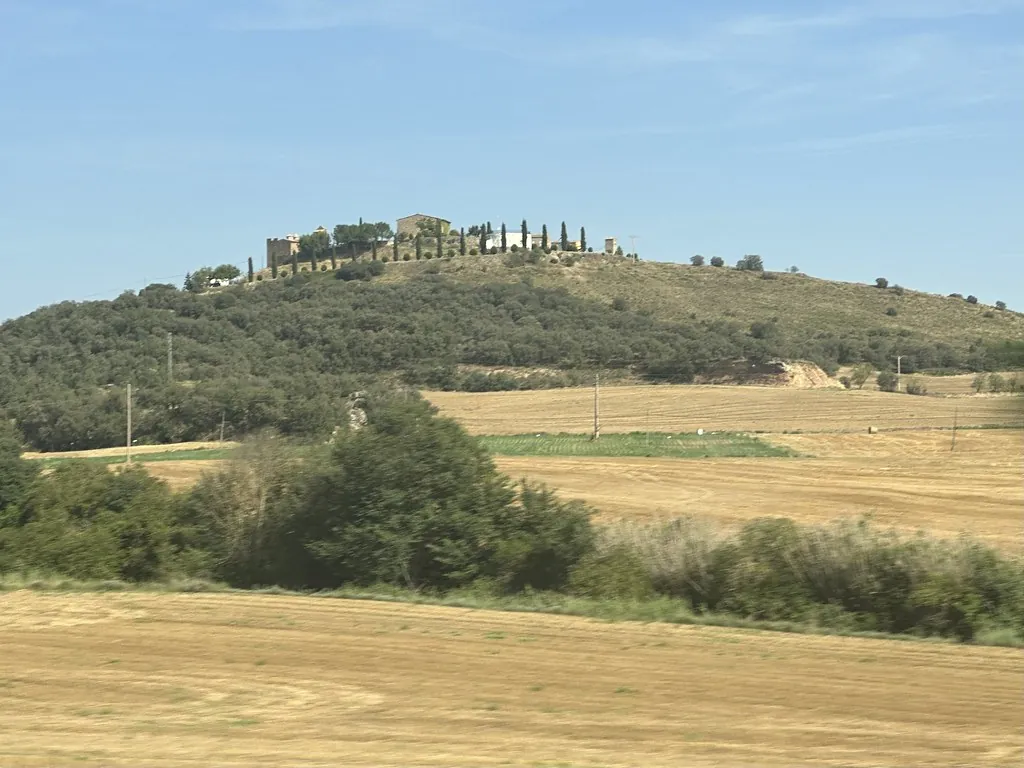
Within five minutes of the church square you are among wheat, alfalfa and sun-yellow parcels of rapeseed. A lattice of farm tracks—gravel, not asphalt—radiates towards the neighbouring hamlets of La Sentiu and Bellcaire, flat enough for a sturdy hybrid bike and shady only at dawn. Early mornings smell of damp earth and diesel; evenings of dry straw and rosemary crushed under tyres. Swallows skim the irrigation ditches, and the Pyrenees float on the northern horizon like a rumpled paper cut-out.
There are no way-marked “routes” in the British sense, so take the same approach as the locals: pick a track, note the position of the sun, and turn back when the church tower looks small. A comfortable loop south to the old mill of Molí d’En-Torres and back takes ninety minutes; add another hour if you want to reach the ruins of the Roman bridge at Fontanet, where the Segre slides slow and muddy between reedbeds.
What Appears on the Table
Food here is governed by what can be grown or shot within a twenty-mile radius. Lunch at Brassa Termens (the only full restaurant in the village) might start with a clay dish of caragols a la llauna—snails baked with garlic, paprika and a splash of brandy—followed by xai de pastor, salt-crusted leg of local lamb that has grazed exactly the stubble you walked past earlier. The wine list is short and Lleida-heavy: try a Costers del Segre blanc to cut the richness, or the house-made vermouth if you still need an excuse to sit still while the siesta heat settles.
Thursday is market day on Plaça de l’Església. Stalls fit into six parking spaces and pack up by one o’clock, but you can fill a pannier with honey from Agramunt, goat cheese wrapped in chestnut leaves, and the small, knobby pears that survive the plain’s 40 °C summers. Bring cash; the card reader fails when the temperature climbs above 35 °C, which is often.
When the Village Decides to Party
Termens does not do quiet, low-key fiestas. The main celebration, Festa Major de Sant Andreu, lands on the last weekend of August and triples the population. Brass bands march at midnight, giants dance under fireworks, and the communal paella feeds 800 people in a single sitting. Visitors are welcome, but there is no tourist office to smooth the edges: you buy drink tickets from a neighbour’s kitchen table and queue with everyone else while the rice burns orange in pans wide enough to paddle in.
If you prefer your crowds edible, come in late October for the Fira del Caragol. Three tonnes of snails disappear into broth, pastry and charcoal smoke while a local oenologist pours free tastings of last year’s tempranillo. The event finishes promptly at seven; the village hose-down starts at seven-thirty, and by eight the square is so clean you would never know 3,000 people had lunch.
Getting Here, Staying Sane
Termens has no railway station; the Rodalies line from Lleida stops 6 km away at Bell-lloc, and taxis are scarce unless booked a day ahead. Driving remains the sensible option. From Barcelona, take the A-2 west to Lleida, then the C-12 towards Balaguer; after 25 km turn right on the L-904 and follow the signposts for “Termes” (the old spelling still appears on some road signs). The whole journey is 150 km, mostly dual carriageway, and takes around ninety minutes unless you leave the city after four on a Friday, in which case add an hour for lorries.
Accommodation is limited to two rental flats above the bakery and a trio of rural rooms five minutes out of town at Masia Els Casals. Prices hover around €70 a night for a double, breakfast of farmhouse eggs and cured bacon included. Book early during fiesta weekends; cancellations are rare because the village WhatsApp group snaps them up first.
The Heat, the Silence, the Deal
Summer on the plain is uncompromising. Daytime highs regularly top 38 °C, shade is patchy, and the breeze feels like someone opening an oven door. Sightseeing is best done before ten or after six; the middle of the day is for lizard behaviour—walls, shutters, cold soup. Conversely, January can lock the fields under a brittle fog that never lifts above the rooftops. Spring and autumn are the kindest seasons, when the light turns honey-coloured and the smell of new-cut alfalfa drifts through open windows.
Crowds are never a problem; tour coaches physically cannot turn around in the square. English is spoken in direct proportion to age: anyone under thirty will manage, over sixty will answer in rapid Catalan and gesture anyway. Politeness costs a smile and the single word “bon dia”; you will get directions, the name of someone’s cousin who rents bikes, and probably a glass of sweet moscatel.
If you need souvenir shops, audio guides or ticketed attractions, stay in Lleida. If you want to see how a village functions when its timetable is still set by wheat, snails and the church bell, Termens keeps the back door open. Just remember to step aside when the tractor comes through; it has right of way, and the driver will not slow down for anyone still pretending they are on holiday from real life.